
- Sleep Regression
- 18mins read
- Aucun commentaire
Last week baby was sleeping reasonably well. Not perfectly as there is no perfectly with a baby in the first year, but reasonably. You had found something approaching a rhythm. Two or three wake-ups a night that you could handle. Naps that happened more or less when you put baby down. A bedtime routine that seemed to be working.
And then, almost overnight, all of it disappeared.
Baby is waking every hour. The naps have collapsed. The settling that used to take ten minutes is taking forty-five. Baby is feeding more than they did in the newborn days. Baby is clingy in ways they were not before, distressed in ways that are new, and you are running on a level of sleep deprivation that makes everything look slightly wrong.
You are sitting with this tiny being at 3am …again… wondering what happened. Wondering what you did. Wondering whether this is permanent, and whether you created this, and whether something is wrong, and whether it will ever be different.
I want to tell you what is happening. Because there is a very good chance that it has nothing to do with what you did or did not do, and everything to do with what your baby is doing right now inside their rapidly developing brain.
Baby is probably in a sleep regression. And as exhausting as that is, it is actually a sign that baby is growing exactly as they should. Don’t trust this Mauritian saying: “If baby sleeps through the night, then they are developing well and if baby wakes up, there’s something wrong with their development”
First, what a sleep regression actually is
A sleep regression is a temporary phase during which a baby who has been sleeping well for an extended period suddenly experiences disruptions in their sleep patterns, waking up frequently throughout the night.
That is the clinical definition. The lived version is: the sleep you had finally clawed back is gone again, for no reason you can identify, and you are starting from scratch. All of a sudden… And it hits you hard!
Rather than thinking of these as regressions, which implies going backwards, it helps to think of them as predictable shifts in sleep patterns. They happen because of what is going right, not what is going wrong. Your baby’s brain is making connections, building skills, reorganising itself. That process is metabolically and neurologically demanding, and it disrupts sleep just as surely as a stressful week at work disrupts yours.
The important thing to understand before we go through the timeline: not every child hits every regression and timing varies. These ages are approximations. Your baby is not reading the same schedule you are. Baby will arrive at each developmental window in their own time and some regressions will hit you hard and others you will barely notice. Both are normal.
The honest conversation about whether sleep regressions are real
You may have read something suggesting that sleep regressions are a myth, a concept invented by parenting culture to explain normal infant sleep variation. The truth, as with most things in infant sleep science, is more nuanced.
Pediatric sleep researcher Dr. Jodi Mindell examined sleep patterns of children aged six and under, looking for spikes in night wakings at specific ages. Her informal analysis found that just 28% of parents of three-month-olds and 30% of parents of five-month-olds reported more frequent night wakings, percentages that do not suggest all infants follow the same schedule of regression and growth.
What this means in practice: not every baby experiences a sleep regression, and those who do experience them do not all experience them at exactly the same age. Some babies barely seem affected by developmental leaps. Others are significantly disrupted. Your experience is valid regardless of which camp you are in and so is the experience of your friend whose baby slept through the entire fourth month and whose baby is now waking hourly at eight months while yours slept through that one.
What is not a myth is the developmental biology that underlies these periods. Sleep changes at the four-month stage are typically the beginning of a permanent alteration in a baby’s sleep pattern. Around this time, babies start sleeping more like adults and less like infants. That change is real, measurable and neurologically documented. Whether it disrupts your specific baby’s sleep is individual. That it changes their sleep architecture is not.
The full timeline: what happens when, and why
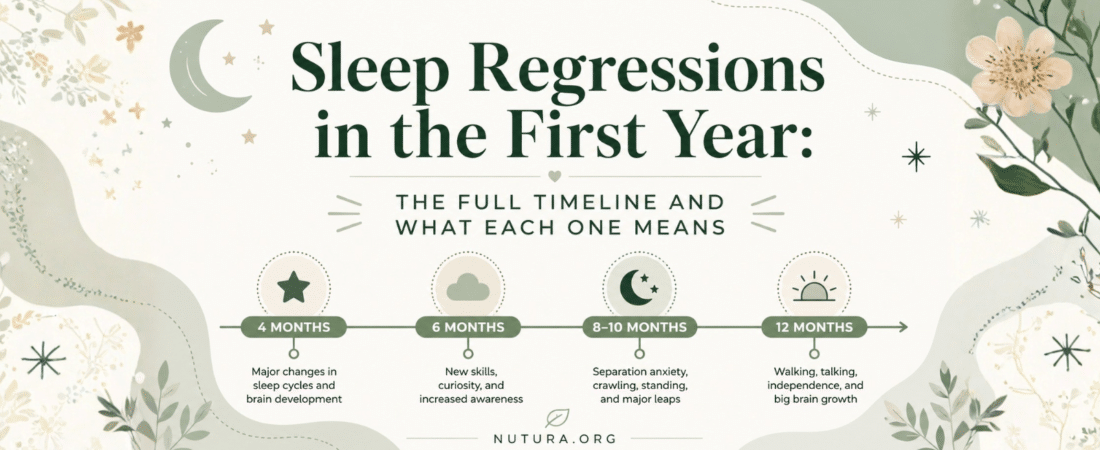
Sleep regression ages most often cluster around four months, eight to ten months, twelve months, eighteen months, and two years. This article covers the first-year regressions in full. The eighteen-month and two-year regressions will be covered in the toddler section of nutura.org.
The newborn period: not a regression, but worth understanding
Before we get to the regressions, a word about the newborn stage. Newborns start out sleeping in short segments, then over the course of a few months, they begin sleeping longer and spending more time sleeping at night. The fragmented, unpredictable sleep of the newborn period is not a regression, it is normal newborn neurology. A baby who wakes every two hours at three weeks old is not regressing. They are just being newborns.
The regressions come later, when your baby has established some kind of sleep pattern and then loses it. That loss of what felt like progress is what makes regressions feel so brutal. You knew what had changed because you had experienced the contrast.
The 4-month sleep regression: the one that changes everything
The most commonly reported sleep regression occurs at around four months. It is the one most parents have heard of, the one most often referenced in parenting groups, and in most families’ experience, the most difficult.
The reason it hits so hard is that it is not like the other regressions. It is not a temporary disruption caused by a developmental milestone that will pass when the milestone is consolidated. The four-month sleep regression is typically the beginning of a permanent alteration in a baby’s sleep pattern. Babies start sleeping more like adults and less like infants.
Before this shift, your baby’s sleep was relatively simple, in and out of a deep, restorative sleep without the complex cycling of adult sleep. A baby’s sleep architecture significantly changes around three months. Baby begins moving through distinct sleep cycles such as lighter sleep, deeper sleep, a brief arousal between cycles, in roughly the same way you do. And at the end of each cycle, when baby briefly rouses, they call for whatever they used to fall asleep with in the first place. If that was you (your breast, your arms, your presence) baby calls for you, every forty-five minutes, every cycle, all night.
This is why parents who had “a great sleeper” suddenly find themselves back at the beginning. Their baby has not forgotten how to sleep. Their sleep has matured into something more sophisticated and the settling support that worked seamlessly before now needs to happen multiple times a night.
It is normal for a four-month-old to wake one to three times per night for feeding or comfort. Some babies may wake more frequently during the regression as they adjust to new sleep cycles.
La four-month regression typically lasts two to six weeks, though a four-month-old who is rocked to sleep and suddenly starts frequently waking during the night may continue to see this pattern until they learn to fall asleep independently at bedtime — which could be a week, or months, depending on a variety of factors.
This is the regression that changes the game. Understanding it fully, what is happening neurologically, what helps, what does not, and how to come out the other side, is worth reading in full.
RELATED READ:
The 6-month disruption: not always called a regression, but absolutely real
Not every expert classifies this as a formal regression. Many parents would strongly disagree with that categorisation, because the six-month sleep disruption is very real in their living rooms.
What is happening at six months is less about sleep architecture changing and more about everything else changing simultaneously. Your baby is probably rolling confidently. They may be sitting with support. Solids have likely just begun or are about to. Baby is dramatically more alert and interested in the world than they were two months ago and their brain, busy processing all of this, is not particularly interested in switching off.
La six-month disruption often presents as nap resistance rather than night waking, with a baby who had been settling for naps fairly well, is suddenly fighting them, taking shorter naps, or skipping them. It can also present as increased feeding at night as their body catches up on the calories they burned exploring the floor.
La rolling-and-stuck phenomenon is one of the most common six-month sleep complaints: your baby has just mastered rolling from back to front, arrives on their tummy in the middle of the night, cannot yet roll back, and screams until you come and flip them. Several times a night. For several weeks. The solution is tummy time during the day, building the strength and skill to roll back gives them the tool they need to manage the night transitions independently.
The six-month disruption typically resolves more quickly than the four-month regression, two to three weeks for most babies, because the underlying cause is skill acquisition rather than a fundamental change in sleep structure.
The 8 to 10-month sleep regression: the one nobody warns you about
You made it through the four-month regression. Things settled. You found a rhythm again. And then, somewhere between eight and ten months, it all unravels again.
Around eight to ten months, crawling, pulling to stand, and object permanence all arrive at once. Your baby now knows you exist when you leave the room, and they have a very strong opinion about that.
Object permanence is the developmental milestone at the heart of this regression. Before object permanence develops, when you leave the room you ceased to exist in any meaningful sense to your baby; out of sight, out of mind, literally. After object permanence, you leaving the room is your baby’s new primary concern. Baby knows you are somewhere. Baby knows you are not here. Baby would like this situation resolved, please.
This is the regression that manifests as separation anxiety. The clingy days that arrived from nowhere. The baby who will not be put down. The child who had been happy to settle in their crib is now screaming the moment you are not within visual range. It is not regression in any negative sense. It is developmental sophistication, i.e. the understanding that relationships persist even when the person is not physically present and it is one of the most important cognitive shifts of the first year.
At night, this looks like protest at bedtime that was not there before, waking calling for you when they would previously have resettled independently, and, very commonly, a baby who pulls themselves to standing in the cot and then cannot or will not sit back down.
Generally, babies around this age wake at night because they are hungry. Maybe they are breastfed and still need a night feed, or perhaps they need to replenish the calories they burned during the day from practising their scooting, crawling, and sitting-up skills. Add developmental anxiety to genuine caloric need and you have the eight-month regression in full.
Additionally, some babies get their central incisor teeth between eight and twelve months, possibly contributing to sleeplessness. This timing overlap with teething, pulling to stand, object permanence and separation anxiety, is what makes the eight-to-ten month window one of the most reported difficult periods of the first year.
RELATED READ: The complete 8-month sleep regression guide

The 12-month sleep regression: just when you thought you had made it
The first birthday feels like a milestone in every sense. You made it through twelve months. Your baby is walking, or nearly walking. Baby has words. Baby is eating family food. Surely, you think, the worst of the sleep disruptions is behind you.
Sometimes it is. And sometimes, at eleven or twelve months, it starts again.
Around twelve months, many babies experience major cognitive growth, first words, increased independence, and the physical milestone of walking. All of these things are simultaneously wonderful and neurologically demanding, and they disrupt sleep in the now-familiar way with a brain too busy and too stimulated to switch off efficiently, night wakings that come from processing the events of a day that contained more than ever before.
The twelve-month regression also frequently coincides with the nap transition. It is not uncommon to see a nap regression around twelve months of age, meaning fighting sleep at nap time or skipping naps. A baby who has been reliably taking two naps a day may suddenly resist the morning nap, or take only one but make it shorter than either of the previous two combined, or skip naps entirely and then be catastrophically overtired by late afternoon.
The nap transition from two naps to one is one of the most sleep-disrupting developmental shifts of the entire first year and more disruptive, for many families, than any of the night regressions because it requires a complete restructuring of the daily rhythm. It typically begins between twelve and eighteen months, and the transition period itself can last several weeks of inconsistent, hard-to-predict nap behaviour.
The twelve-month sleep regression is also associated with teething (first molars, which are significantly more uncomfortable than the front incisors), begin appearing around twelve months in many babies.
The twelve-month regression, like the others, is temporary. Most families find their way through it in two to four weeks, once the developmental leap has consolidated and the new skills (the walking, the words, the heightened understanding of the world) become integrated rather than overwhelming.
RELATED READ: The complete 12-month sleep regression guide

How long does each regression actually last?
Many pass within one to three weeks when routines stay consistent, though some last longer, especially during big developmental changes.
The honest answer: it depends on what is causing it and what is happening around it at the same time. The duration of a sleep regression varies depending on the cause and the strategies used to support better rest. A baby whose sleep is disrupted by illness may start sleeping better within a week of feeling better. A baby who has developed a new sleep association may continue to wake until they learn to settle without it.
What consistently extends regressions is the same thing that makes the original disruption harder: the absence of a settled routine before, during, and after. A bedtime routine that exists and stays consistent gives your baby’s nervous system a reliable signal that sleep is coming. Regressions disrupt sleep but they do not have to disrupt the routine. The routine is the anchor you return to even when the nights are difficult.
Is it a sleep regression, or is it something else?
Not every difficult week of sleep is a regression. Before assuming a regression is the cause, it is worth ruling out the more straightforward explanations.
Illness changes sleep reliably and dramatically. This can be a congested baby, a teething baby, a baby with an ear infection… all will sleep differently than their baseline. If your baby has other symptoms alongside the sleep disruption, or if the disruption appeared suddenly without any obvious developmental context, illness is the first thing to consider.
Overtiredness is the most underestimated sleep disruptor in the first year. A baby who missed naps or had a significantly disrupted daytime will often sleep worse at night, not better because overtiredness triggers cortisol production, which makes sleep onset harder and sleep lighter. If your baby has been consistently under-napping, the night sleep may improve when you protect the daytime naps, rather than waiting out what looks like a regression.
Environmental changes: a trip away, visitors disrupting the home routine, a move, a return to work, all affect infant sleep. If something in the environment has changed in the same week the sleep changed, the environment is the more likely culprit than a developmental regression.
Concerning signs such as fever, breathing problems, poor feeding, or dehydration warrant medical advice rather than a sleep regression response. If your baby is unwell, the sleep question waits.
What to do when you are in the middle of one
The goal during a sleep regression is not to fix the sleep. The goal is to survive the regression while preserving the environment and routine that your baby will return to once it passes.
Keep the bedtime routine exactly as it was. The bath, the feed, the dim room, the song, whatever your sequence is, do not abandon it because the nights are hard. The routine is not failing. The regression is disrupting sleep after the routine, not because of it. Removing the routine during a regression makes the recovery slower, because your baby returns to settled sleep more easily from a familiar context.
Respond to your baby. A sleep regression is not manipulation. Your baby is not regressing strategically. Baby is overwhelmed by their own development and they need you. Responding to that need is not creating bad habits. It is doing exactly what a parent is supposed to do. The habits conversation can come later, once the regression has passed and you have the cognitive bandwidth to think about it.
Be flexible about what you offer without abandoning what you know works. If your baby needs more contact during a regression, give it. If they need an extra feed, give it. These are temporary concessions to a temporary situation and being rigid during a regression tends to make everyone more miserable without making the regression pass faster.
And then, the hardest thing of all, take care of yourself. Sleep deprivation is a genuine health issue, not a parenting rite of passage to be endured in silence. If you have someone who can take the baby for three hours so you can sleep, ask for it. If your mental health is suffering under the weight of cumulative sleep loss, speak to your doctor. Mauritius families often have extended family present, this is the moment to use that resource, not to prove you can manage without it.
The reframe that actually helps
The sleep regression timeline links to major developmental leaps in the baby’s brain and body. Every single regression in this article is caused by something your baby is learning to do that they could not do before. Rolling. Sitting. Crawling. Understanding that you exist even when you are not there. Walking. Talking.
The baby who is waking at 3am because they are practising pulling to stand in their cot is going to walk soon. The baby whose brain is too busy processing object permanence to switch off at bedtime is developing a cognitive sophistication that will eventually become the ability to understand relationships, to trust, to attach deeply to the people they love.
The disruption looks like regression. What is underneath it is progress.
That does not make the nights less exhausting. But it does make them less frightening. And sometimes, at 3am, the difference between frightening and simply exhausting is enough.
More from the nutura.org sleep library:


References: Sleep Foundation — 4-Month Sleep Regression (updated July 2025). sleepfoundation.org. Medical News Today — Sleep Regression Stages. medicalnewstoday.com. Huckleberry — Navigate Sleep Regressions Like a Pro (updated March 2026). huckleberrycare.com. Little Ones — Sleep Regressions: The When and Why (updated April 2026). littleones.co. Dr. Craig Canapari — Sleep Regressions (updated November 2025). drcraigcanapari.com. Smart Sleep Coach by Pampers — Sleep Regression Ages (updated March 2026). smartsleepcoach.com. Gilchrist A. et al. (2025) — Maturation of infant sleep during the first six months: a mini-scoping review. Frontiers in Neuroscience.
Disclaimer: This article is for informational purposes only. If you have concerns about your baby’s sleep or overall wellbeing, contact your paediatrician. If sleep deprivation is significantly affecting your mental health, speak to your doctor — maternal sleep deprivation is a health issue that deserves medical attention.