
- Pregnancy Week by Weeks
- 10mins read
- Aucun commentaire
This is the week where you might be pregnant and have absolutely no way of knowing it yet.
If you are trying to conceive, week three is its own particular kind of difficult, quieter than the disappointment of a negative test, less dramatic than the hope of a positive one, but in some ways harder to sit with than either. Something may already be happening inside your body. The earliest, most fragile beginning of a person may already exist. And there is nothing you can do right now except wait, and try not to read into every twinge, and resist the urge to test three separate times before breakfast even though you know it is too soon.
I want to walk you through exactly what is happening this week, because understanding it tends to make the waiting slightly more bearable, not because it speeds anything up, but because it gives the silence some shape.
Where things actually stand this week
If you ovulated roughly on schedule, week three is when fertilisation has likely just happened, usually within 24 hours of the egg being released, inside the fallopian tube, completely invisible and completely undetectable. This is the moment that most people instinctively think of as the start of pregnancy, even though in the official dating system you are technically already in week three of forty.
Out of the hundreds of millions of sperm involved, one reaches the egg first, and in that moment, an entire genetic blueprint is established. Baby’s biological sex. The colour of their eyes. The shape of their father’s nose or your mother’s smile, sitting dormant in a single cell that is, at this point, smaller than a grain of sand and utterly invisible without a microscope. Everything baby will eventually become begins, structurally, right now.
What forms in that instant is called a zygote, a single cell carrying 23 chromosomes from you and 23 from the father, the complete genetic instruction set for an entire human being. And then, almost immediately, it starts dividing. One cell becomes two. Two becomes four. Four becomes eight, then sixteen, multiplying every few hours as it begins a journey of several days down the fallopian tube toward your uterus.
By the time this cluster of cells reaches a stage called a blastocyst, which contains the cells that will become your baby, the cells that will become the placenta, and a fluid-filled cavity supporting the whole structure, it is approaching the point where it can finally do the one thing that actually matters for a pregnancy to begin in any way you would recognise: implant.
Implantation: the moment that actually starts everything
Implantation usually occurs between 6 and 12 days after ovulation, which means for some women it begins toward the very end of week three, and for others it does not happen until early in week four. There is no way to know which timeline applies to you in any given cycle, which is part of what makes this particular stretch of days so hard to sit inside.
Implantation is the moment the blastocyst burrows into the lining of your uterus and begins drawing nutrients and oxygen from your bloodstream. It is the true biological beginning of a sustained pregnancy, before this point, even a successfully fertilised egg has not yet established the connection it needs to develop further. After this point, your body begins producing the hormone that everything else depends on: hCG, human chorionic gonadotropin, the hormone every pregnancy test is built to detect.
This is also, often, the moment behind the very earliest pregnancy symptoms some women report, a day or two of mild cramping, a faint pulling sensation low in the abdomen, sometimes a small amount of light spotting as the blastocyst embeds into the uterine lining. Implantation bleeding, if it happens at all, is typically much lighter than a period (a few spots of pink or brown rather than anything resembling flow) and many women experience no noticeable signs of it whatsoever. The absence of any sensation at all is just as normal as the presence of mild cramping. Neither tells you anything definitive about whether implantation has occurred.
RELATED READ:

Implantation Bleeding or Period? How to Tell the Difference
Why you cannot test yet, even though you really want to
I know how strong the urge is. You are holding a test in the bathroom cabinet, you have already done the math on how many days past ovulation you are, and some part of you is convinced that this time, surely, it will be different if you just test a little early.
It will not be, and here is exactly why: pregnancy tests detect hCG, and hCG is only produced once implantation has occurred which, as we just covered, may not even have happened yet during week three, let alone built up to a detectable level. Even in the best-case scenario, where implantation happened early and your body started producing hCG immediately, the hormone needs several more days to rise high enough for even the most sensitive home test to register it reliably.
Testing now, during week three, will overwhelmingly produce a negative result regardless of whether you are actually pregnant, what is sometimes called a false negative, though the test itself is not malfunctioning. It is simply too early for there to be anything to detect. And a negative result this early carries real emotional weight even when it means nothing reliable, which is precisely why so many fertility specialists and midwives gently discourage testing before a missed period. Not to torture you with more waiting, but because an inconclusive early test creates suffering for no real informational gain.
If you can manage it, the kindest thing you can do for yourself this week is to put the tests away until you have actually missed your period. I know that is much easier to write than to do.
What you might be feeling and what almost certainly explains it
Most women feel completely normal during week three, and if that is you, it tells you nothing one way or the other about whether you are pregnant. The absence of symptoms this early is the most common experience there is.
Some women do notice things like mild cramping, a sense of bloating, breast tenderness, an unusual tiredness creeping in earlier than expected. The honest, slightly frustrating truth is that every one of these can be explained equally well by early pregnancy or by the ordinary approach of your period. Progesterone behaves similarly in both scenarios in the days immediately following ovulation, which is exactly why the symptoms of early pregnancy and premenstrual symptoms overlap so closely that even experienced midwives cannot reliably distinguish them by description alone. There is no symptom checklist that can tell you which one you are experiencing this week. Only time can do that.
What to do with this particular stretch of waiting
There is very little to actively do this week beyond what you were likely already doing if you have been trying to conceive and that is, in its own way, useful information, because it means you do not need to add anything new to your plate during a week that is emotionally taxing enough on its own.
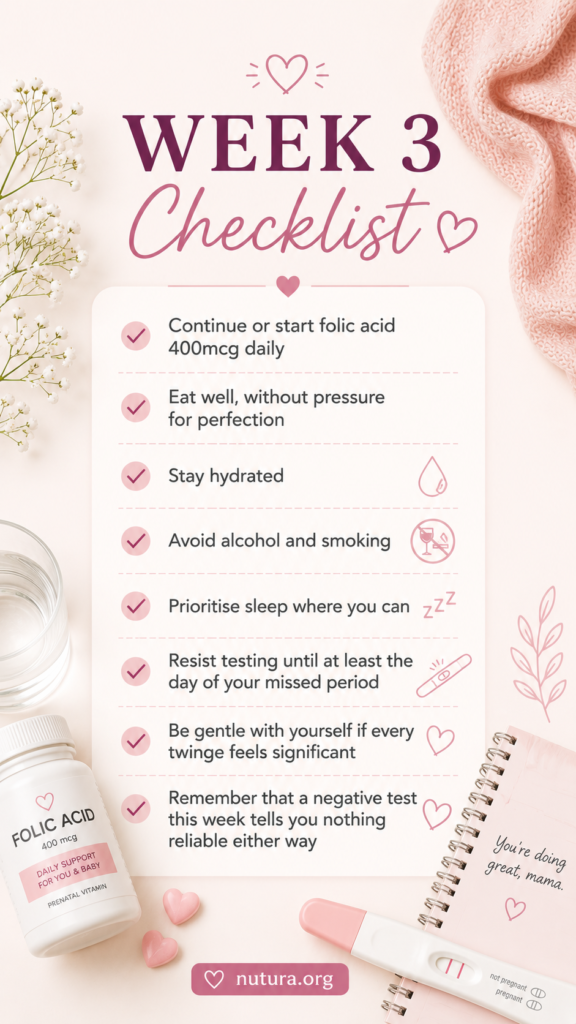
Continue your folic acid if you have been taking it, or start today if you have not, the neural tube is forming on a timeline that does not wait for a positive test to begin, and 400 micrograms daily from before conception gives the most protective effect. Eat reasonably well without obsessing over it. Stay hydrated, particularly in the Mauritius heat. Continue avoiding alcohol if you have been doing so while trying, and avoid smoking. Try, as much as you are able, to prioritise sleep, not because sleep affects implantation in any way you could control, but because you are about to need every reserve of patience you have, and rest helps with that more than almost anything else available to you right now.
And if you find yourself lying awake cataloguing every twinge, every pull, every slightly different sensation in your lower abdomen, trying to read meaning into something that cannot yet be read, that is completely normal, I’ve been there, and almost everyone trying to conceive does exactly this during the two-week wait. It does not mean you are obsessive or irrational. It means you want this, and your body has given you nothing concrete to hold onto yet, so your mind is filling the gap the only way it can.
What is actually happening, even though you cannot see or feel it
If this is your cycle, if fertilisation occurred and implantation is underway or about to be, something genuinely remarkable is happening beneath the surface of an entirely ordinary-feeling week. A single cell has already become hundreds. The genetic blueprint for an entire person, including traits that will not be visible for years, already exists. The earliest infrastructure of a placenta is forming. None of it is visible. None of it is something you can feel with any certainty. But it is real, and it is happening on its own timeline regardless of how closely you watch for it.
You may not look pregnant. You almost certainly do not feel definitively pregnant. But this is one of the most extraordinary weeks of the entire pregnancy, precisely because it is the quietest.
Next week is when this story finally has the chance to become tangible. If implantation has occurred, hCG will be rising steadily, and for many women, week four is when the first true positive test appears: the moment the quiet, invisible work of this week becomes something you can finally hold evidence of in your hands.
References: NHS — Early pregnancy: weeks 1 to 4. nhs.uk. American Pregnancy Association — Understanding conception and implantation. americanpregnancy.org. American College of Obstetricians and Gynecologists — How your fetus grows during pregnancy. acog.org. World Health Organisation — Preconception and antenatal care recommendations. who.int.
Disclaimer: This article is for informational purposes only. If you are trying to conceive and have specific concerns about your cycle or fertility, please speak with your gynaecologist or a fertility specialist. This article does not replace personalised medical advice.