
- Pregnancy Week by Weeks
- 10mins read
- Aucun commentaire
There is a word that comes up at 24 weeks that does not come up at any other point in the pregnancy with quite the same weight.
Viability.
Most pregnancy apps mention it matter-of-factly, almost in passing “congratulations, your baby is now considered viable” and then move on to the fruit comparison of the week. But if you have been paying attention to your pregnancy the way most mothers do, the word lands differently than that. It raises a question you probably did not ask directly but were holding somewhere quietly: what was it before?
I want to address that honestly before we get to anything else, because 24 weeks is a milestone worth understanding properly rather than just celebrating the label.
What viability actually means and what it does not
Viability at 24 weeks means that a baby born now would have a medical chance of survival with intensive neonatal care. It does not mean that birth at 24 weeks is safe or that outcomes are certain or simple. A baby born at 24 weeks needs weeks or months of specialist care, faces real risks, and is not in the same position as a baby born at 37 weeks. The word is a threshold, not a guarantee.
What it does mean and this is the part worth holding onto, is that your pregnancy has crossed into a different category in terms of how the medical system treats it. Before 24 weeks, if something went catastrophically wrong, there was no intervention that could change the outcome. After 24 weeks, there is. That shift is real and it is significant, and for many parents the passing of this milestone is accompanied by a particular, quiet exhale, a release of something they had been carrying without fully acknowledging.
If you have had a complicated pregnancy, a previous loss, or simply a high baseline of anxiety about this baby, it is completely valid to feel something real at 24 weeks. It does not mean the danger has passed. It means the odds have changed, and that matters.
Every additional week from here significantly improves your baby’s development and outcomes. The goal is always to keep going but knowing that the system would fight for your baby now if it had to is its own kind of reassurance.
Your baby at 24 weeks: filling out, waking up
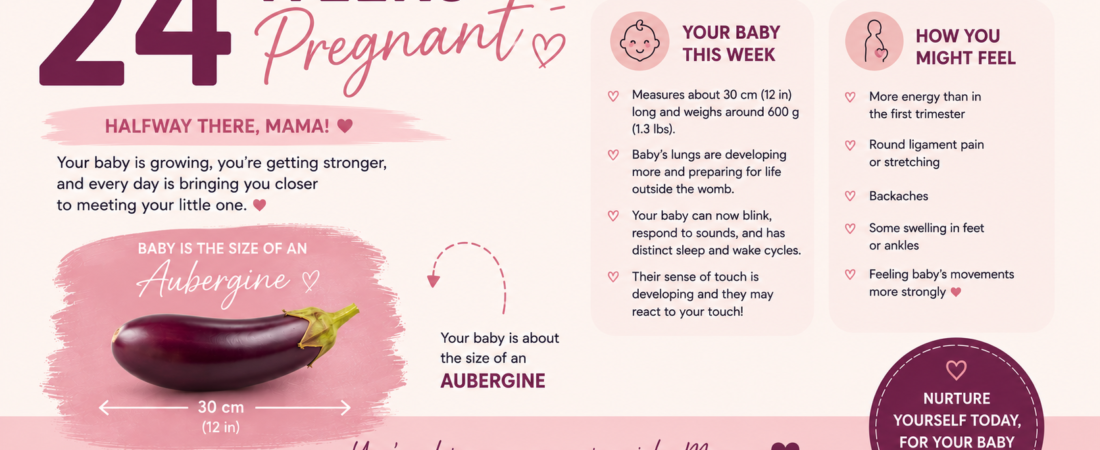
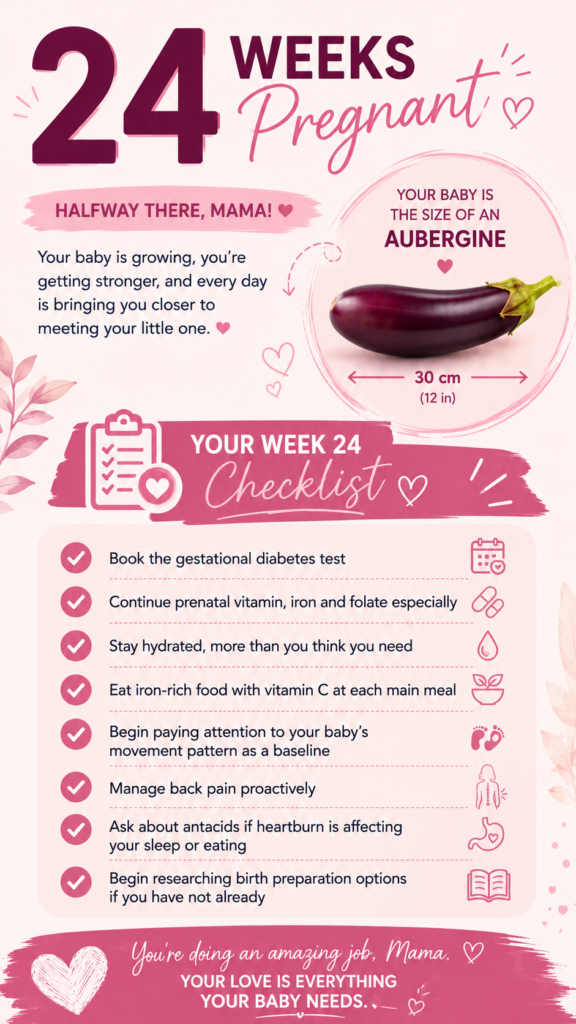
Your baby is approximately 30cm long and weighs somewhere around 600-700 grams, roughly the size and weight of a large aubergine, which in Mauritius you would know from the grocery table rather than the recipe book.
Baby looks, now, recognisably like the baby you will meet. Their eyebrows, eyelashes, lips, and nose are all present. Their facial features are distinct. If you could see them on a high-resolution ultrasound today, you would likely see the face that will be placed against your chest in the delivery room, the same nose, the same brow. That recognition, when it arrives at a scan, catches parents off guard every time.
Baby’s lungs are one of the most significant developments this week. Tiny air sacs called alveoli are forming, and she is beginning to produce surfactant, the substance that prevents those air sacs from collapsing when they first inflate after birth. The lungs are not mature yet, not by a long way, that process continues until 34 to 36 weeks, but the infrastructure is being built. The surfactant production is part of what makes viability at 24 weeks possible at all; before approximately 23 to 24 weeks, the lungs lack even the basic architecture for gas exchange.
Baby’s hearing is well developed. They can distinguish your voice from other sounds with something approaching clarity now, and baby is building familiarity with your partner’s voice, with music, with the particular soundscape of your household. The sounds baby is absorbing this week are the ones they will recognise as familiar in the first hours after birth, including your voice, which they will orient toward more specifically than any other sound in the room.
Baby’s taste buds are functioning. The flavours of what you eat pass into the amniotic fluid baby swallows regularly, exposing them to the tastes of your diet before they have taken a single independent meal. The research on this is genuinely interesting: babies show preferences after birth for flavours they encountered in the womb, which means the briani, the dholl puri, the rougaille you are eating this week are, in the smallest possible way, already becoming familiar to them.
Baby has sleep cycles now, periods of rest and periods of activity that are beginning to establish a pattern. You may have already noticed that baby tends to be active at particular times of day or night. Many babies are most active in the evenings, when you have slowed down and the movement of walking no longer rocks them to sleep. The 11pm kicks that are keeping you awake are not randomly timed.
Your body at 24 weeks: the weight of the second half
Your uterus has grown to approximately the level of your navel, and the physical weight of the pregnancy is becoming genuinely present in your daily life. Not just the visible bump, but the gravitational reality of carrying a significant amount of additional weight centred forward of your spine, the cause of the lower back and hip pain that most women are managing by now.
Back pain at 24 weeks is almost universal, and in Mauritius heat, which reduces your tolerance for discomfort in every direction simultaneously, it can feel more significant than it might in a cooler climate. Gentle movement like walking in the early morning or evening when it is cooler, swimming if you have access to a pool or the beach, stretching targeted at the hip flexors and lower back, is consistently more effective than rest alone. If the pain is significant enough to be affecting your sleep or your daily movement, a referral to a women’s health physiotherapist is worth asking your gynaecologist for.
Round ligament pain, the sharp, one-sided pulling sensation low in the abdomen that can arrive suddenly when you change position, sneeze, or move quickly, remains common at this stage and will likely continue through the third trimester. It is your uterus requiring more space and the ligaments supporting it accommodating that demand. Alarming when it arrives, harmless, brief.
Swelling of the feet and ankles, particularly at the end of the day and in the heat, is extremely common from the second trimester onwards and in Mauritius the heat makes it more pronounced than many women expect. Mild, symmetrical swelling that reduces with rest and elevation is normal. Sudden, significant swelling, especially if it involves the face and hands, or arrives alongside headache, visual changes, or feeling unwell, warrants a call to your maternity that day.
Heartburn is probably making itself at home by now if it has not already. Your growing uterus is pressing on your stomach, and the progesterone that has been relaxing your smooth muscle throughout the pregnancy is doing the same to the valve between your stomach and oesophagus. Smaller, more frequent meals. Staying upright after eating. Safe antacids, ask your gynaecologist which ones are appropriate during pregnancy rather than assuming everything on the pharmacy shelf is fine.
Movement at 24 weeks: starting to learn baby’s pattern
By 24 weeks, baby movements are becoming regular enough that you can begin to develop a sense of what your baby’s normal looks like. Not formal kick counting, which is recommended from around 28 weeks in most guidelines, but an awareness. When is baby usually active? Morning, evening, after you eat? Does baby go quiet after a big movement session? Does baby respond to your voice or to music?
What you are looking for at this stage is not a specific number of movements per day but familiarity with baby’s pattern so that when something changes significantly and your body registers it, you have a baseline to compare against. Many mothers describe a felt sense of reduced movement before they have consciously counted anything. That instinct is valuable and worth trusting. If you notice a sustained, significant change in what has been their normal pattern, eat something sweet, lie on your left side for an hour, and count. If you are still concerned, contact your clinic. This is not overreacting. It is appropriate monitoring.
What to do this week in Mauritius
Book the gestational diabetes test if you have not already. The HGPO (oral glucose tolerance test) is performed between weeks 24 and 28 in Mauritius, and in a country with one of the highest rates of type 2 diabetes and metabolic syndrome in the region, this test matters more here than in most places. It requires fasting beforehand and takes two to three hours. Call your maternity or gynaecologist now to schedule it within the next 2-4 weeks rather than leaving it until week 27 when spaces may be limited.
Continue your prenatal vitamins. Iron and folate remain important through the second trimester and beyond. In Mauritius heat, you are also losing more fluid and electrolytes through perspiration than you might in a cooler climate, staying consistently hydrated is not optional, it is a nutritional requirement.
Eat iron-rich foods with vitamin C. Your blood volume has increased significantly by 24 weeks, and your iron needs have increased with it. Combine iron-rich foods like lentils, dark leafy vegetables, lean meat, eggs with vitamin C sources at the same meal to maximise absorption.
Start thinking about birth preparation. Not urgently, not with pressure but the third trimester, and with it the birth preparation window, is now only four weeks away. Birth preparation classes in Mauritius, where they exist, fill quickly. If you are interested in attending one, or in engaging a doula for labour support, starting those conversations now gives you options that will not exist if you wait until 32 weeks.
Looking ahead to weeks 25 to 28
The next four weeks carry you into the third trimester, which begins at 29 weeks. Your baby will pass the 600g mark baby is at now and approach the kilogram milestone, gaining fat rapidly in a way that will be visible in their skin tone and the fullness of their face by the time you see your baby at your next scan. The gestational diabetes test happens in this window. Formal movement monitoring, kick counting, becomes part of your daily awareness from around 28 weeks.
The second trimester, with its relative comfort and energy, is drawing toward its end. The final stretch is close.
References: NHS — You and your baby at 24 weeks pregnant. nhs.uk. American College of Obstetricians and Gynecologists — Second trimester guidance. acog.org. WHO — Antenatal care recommendations. who.int. Tommy’s — 24 weeks pregnant. tommys.org. Ministry of Health and Wellness Mauritius — Gestational diabetes screening guidelines.
Disclaimer: This article is for informational purposes only. Always follow the guidance of your gynaecologist for decisions specific to your pregnancy. If you have any concerns about baby movements, swelling, or symptoms at any stage, contact your maternity.