
- Trying To Conceive
- 12mins read
- Aucun commentaire
When my husband and I decided we were ready to try for a baby, our plan was about as simple and as common as plans get. Stop the contraception. See what happens.
That was the entire strategy. Looking back now, I find it a little funny how unprepared we were for something we had been thinking about, in one form or another, for years.
What actually happened instead was that a friend, a mother of two, the kind of person whose advice you take seriously because she has clearly already lived through whatever you are about to walk into, asked if we had seen anyone before starting. Not a fertility specialist. Not because anything was wrong. Just a regular appointment with my gynaecologist, before any of it began.
I had never heard of doing that. I assumed, the way most people seem to assume, that all of this, the vitamins, the appointments, the careful attention to what I was eating and drinking, started the moment a test turned positive. Not before. Why would you prepare for something that had not happened yet?
We booked the appointment anyway, more out of curiosity than conviction. It turned out to be one of the best decisions we made in this entire process, and I want to walk you through exactly why, because almost nobody talks about this stage of trying to conceive, and it deserves much more attention than it gets.
What actually happens at a preconception appointment
If you have never heard the term either, a preconception appointment is exactly what it sounds like, a consultation with your gynaecologist that happens before you start trying to conceive, with the specific goal of getting your body into the best possible position for a pregnancy that has not yet begun.
I expected it to feel like a formality. It did not. My gynaecologist asked about my medical history in more depth than any routine appointment ever had, not just the obvious things, but my family history, any medications I was taking, my vaccination status, whether I had any chronic conditions that might need adjusting for pregnancy. The Dr asked about my diet, my sleep, my stress levels, my exercise habits. None of it felt like a lecture. It felt like someone taking the time to understand the actual person who was about to attempt this, rather than waiting until there was already a pregnancy to manage.
I think this is the appointment most couples skip, including, almost, us. And I understand why, it does not feel urgent in the way a positive test does. There is no obvious crisis prompting it, no fertility concern driving you there, nothing forcing the issue. It is simply a quiet, deliberate decision to prepare for something before it happens rather than reacting to it after the fact. I am genuinely glad we did not skip it.
The thing that surprised me most: folic acid is supposed to start before any of this
The very first thing my gynaecologist said, almost before we had finished explaining why we had come in, was that I needed to start taking folic acid immediately. Not when I got pregnant. Not after a positive test. Now, before we had even started trying.
I had genuinely assumed prenatal vitamins were something you picked up once you knew you were expecting. It had simply never occurred to me that the most important window for taking them might come earlier than that.
The reason makes complete sense once you hear it, even though nobody had ever explained it to me before. The neural tube, the structure that becomes the brain, the spinal cord, and the entire central nervous system, begins forming and closing in the very earliest days of pregnancy, often before a missed period has even happened, let alone before a test has confirmed anything. By the time most women find out they are pregnant, this critical window of development is already well underway. Folic acid taken only after the positive test arrives too late to provide its full protective effect during that specific stretch.
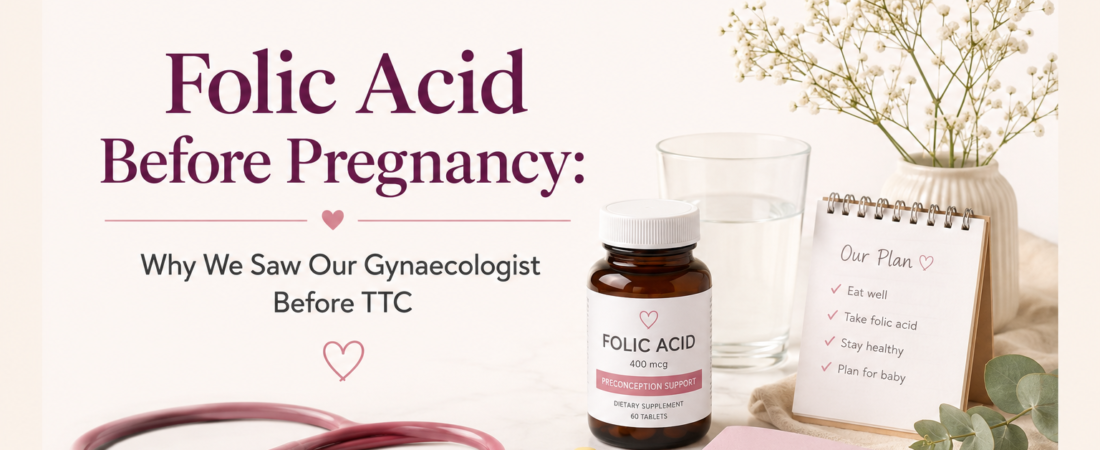
The standard guidance is to start at least one month before you begin trying to conceive, at a dose of 400 micrograms daily for most women, though your own doctor may recommend something different depending on your personal medical history. The message that stuck with me most clearly was simple: do not wait for the test. By the time the test is positive, the most important window has already partly closed.
RELATED READ:

3 Weeks Pregnant: Fertilisation, Implantation, and the Wait
The conversation nobody had prepared me for: it was not just about me
This was the part of the appointment that genuinely surprised me, and the part I think about most when I talk to other couples about trying to conceive.
My gynaecologist turned the conversation toward my husband. Not in passing but directly, with specific recommendations, in a way that made it clear this was not an afterthought to my own preparation but an equally important half of the picture.
Most of what either of us had absorbed about preparing for pregnancy, from books, from friends, from the general cultural noise around trying to conceive, was focused almost entirely on the woman. Her cycle. Her supplements. Her diet. Her stress. My husband’s role in most of what we had read or heard was largely passive; present, supportive, occasionally responsible for an ovulation-tracking app notification. Nobody had ever suggested that his own health, his own habits, might matter just as directly to whether and how quickly we conceived.
What we learned changed that completely. Sperm takes approximately three months to develop from the earliest stage to the point of being released, which means the sperm that might eventually be involved in conception are, in a very real sense, already being shaped by his habits today, months before either of us would consciously associate those habits with trying for a baby.
Alcohol came up specifically, and in a way that surprised both of us with how direct it was. My gynaecologist recommended he reduce or stop alcohol consumption for at least the months immediately preceding when we planned to start trying, given the documented effects of excessive intake on sperm quality, count, and motility. This is not a conversation I had ever heard happening in any of the trying-to-conceive content either of us had previously encountered, where the responsibility for preparation seemed to land almost entirely on one partner by default. Fertility, as it turns out, is something both people are actively doing, every day, in the months leading up to conception, not something that happens only inside the woman’s body while the man waits.
We looked at our diets together, without aiming for perfection
The nutrition conversation was less revelatory than the folic acid or male fertility discussions, but it mattered in its own quieter way. We were not handed a strict meal plan or told to overhaul everything overnight. The guidance was gentler than that, like more fruit and vegetables, good protein sources, iron-rich foods where we could fit them in, consistent hydration, and meals that were reasonably balanced more often than not.
What shifted for me was the timing of the mindset, more than the content of the diet itself. Rather than waiting for a positive test and then suddenly trying to “eat for pregnancy” under pressure, we had already, gradually, nudged our daily habits in that direction beforehand. By the time we did eventually see two lines on a test, very little needed to change abruptly, because we had already been living, for a couple of months, in a way that supported where we hoped we were heading.
We talked about sleep, stress, and the things that rarely get mentioned
Beyond the folic acid and the nutrition, we also talked, briefly but specifically, about sleep quality, exercise and stress management, the quieter, less glamorous half of preconception health that rarely makes it into TTC articles dominated by ovulation strips and fertile-window calculators.
None of what was recommended was extreme. It was, mostly, common sense dressed up as medical advice, the kind of thing you already know intellectually but rarely act on with any real consistency until someone in a white coat tells you it specifically matters right now, for this specific goal.
We conceived during the first month we tried
I want to be very careful with this part, because I know exactly how it can land, and it is not the message I want to leave you with.
I am not saying that doing these things means you will conceive quickly. Fertility does not work in a way that rewards preparation with a guaranteed timeline. Many genuinely healthy, well-prepared couples take many months, or longer, to conceive. Some need medical support beyond what any preconception appointment can offer. Every single journey is different, and none of what I am describing here is a formula.
What is true for us is that we conceived during the first month we actively tried. Whether that was the preparation, luck, timing, or some combination none of us can ever fully untangle, I genuinely do not know, and I never will. What I do know, with much more certainty, is how it felt to go into that month already informed, already prepared, already confident that we had done the reasonable things available to us in advance. That feeling of having shown up for this as ready as we could be, regardless of how long it ultimately took was worth something significant in itself, independent of how quickly things actually happened for us.
What I wish someone had told me sooner
Looking back at all of it now, three things stand out clearly enough that I find myself repeating them to almost every friend who tells me they are starting to think about trying.
Do not wait for the positive test. Some of the most important preparation, folic acid above everything else, happens in the weeks before conception, not after it is confirmed.
Male health matters just as much. Preparing for pregnancy is not something that happens only inside a woman’s body while a partner waits nearby. Sperm development has its own three-month runway, and habits during that window genuinely matter.
Book the appointment, even if nothing feels wrong. Even if you feel perfectly healthy. Even if you are not entirely sure you are ready to start trying yet. A preconception appointment costs you very little and has the potential to surface small, specific, actionable things that quietly improve your odds and your peace of mind regardless of how your particular journey unfolds from there.
Should I take folic acid before getting pregnant?
Yes. Most gynaecologists recommend starting folic acid before conception rather than waiting for a positive test, because the neural tube (which becomes the brain and spinal cord) begins forming and closing in the earliest days of pregnancy, often before a missed period has even occurred.
How long before pregnancy should I start folic acid?
At least one month before you begin actively trying to conceive is the standard guidance, at a dose of 400mg daily for most women. Some women may need a different dose depending on their personal medical history, always confirm with your own gynaecologist.
Does male health actually affect fertility, or is this mostly about the woman?
Male health matters significantly. Sperm takes approximately three months to develop, and nutrition, alcohol consumption, smoking, and overall health during that window can affect sperm quality, count, and motility. Fertility preparation is genuinely a shared responsibility, not one that falls solely on the partner trying to conceive.
Should my partner stop drinking alcohol before we start trying?
Reducing or stopping alcohol intake for at least the few months before trying to conceive is commonly recommended for male partners, given the documented effects of excessive alcohol on sperm quality and motility. Discuss specific guidance with your gynaecologist based on your circumstances.
Is a preconception appointment actually necessary, or just a nice extra?
It is not mandatory, and plenty of healthy pregnancies happen without one. But many couples find it genuinely valuable, not because something is wrong, but because it surfaces specific, actionable preparation steps and offers peace of mind heading into the process, regardless of how long conception ultimately takes.
References: American College of Obstetricians and Gynecologists — Preconception care. acog.org. World Health Organisation — Preconception care recommendations. who.int. NHS — Planning your pregnancy. nhs.uk. American Society for Reproductive Medicine — Male fertility and lifestyle factors. asrm.org.
Disclaimer: This article reflects one personal experience and is for informational purposes only. It does not replace personalised medical advice. If you are planning to try for a baby, speak with your gynaecologist about a preconception appointment tailored to your own and your partner’s health history.