
- Postpartum Depression
- 9mins read
- No Comments
You spent months imagining this.
The birth. The first cuddle. The moment they placed baby on your chest and everything you had been waiting for finally arrived. Everyone told you it would be the best moment of your life, and in some ways it was, you felt something you had no word for, something so large it barely fit inside a human chest.
And then you came home.
And the days that followed looked nothing like what you had imagined.
Not because something went wrong. Not because you do not love your baby, you love him/her more than you knew you were capable of loving anything. But alongside that love, and sometimes underneath it, and sometimes pressing against it from all sides: exhaustion like you have never experienced. A kind of overwhelm that arrives not in waves but as a permanent condition. Tears that appear without a cause. The feeling, quiet and persistent, that you are not doing this right and that other mothers are managing something you are failing to manage, that you should be enjoying this more than you are, that the gap between what you expected and what this actually is must mean something is wrong with you.
It does not.
What you are describing is one of the most common experiences of new motherhood, and it is experienced by women on every continent, in every culture, at every income level including, quietly and without enough conversation about it, by women all over Mauritius who are sitting in exactly the place you are sitting right now.
This article is not going to tell you to lower your expectations or count your blessings. It is going to tell you what is actually happening, why it is happening, and what is genuinely worth paying attention to.
Why this particular combination is so hard
Loving your baby and finding motherhood overwhelming are not contradictions. They are the simultaneous experience of one of the most demanding things a human being can do and yet the cultural story around new motherhood rarely has room for both at once. We are shown the love. We are not shown the weight of it.
Your life has changed in every possible direction at the same time. Your sleep (the foundation of everything else) has been fractured in a way that is not simply tiredness but something that affects cognition, emotional regulation, and the ability to assess situations proportionately. Your body is recovering from birth, whether that was straightforward or not, while simultaneously producing milk and managing a hormonal recalibration that is among the most dramatic your body will ever undergo. Your identity has shifted, the person you were before this baby existed is still you, but baby now shares space with someone new, and the renegotiation of that is not instantaneous.
And all of this is happening in public. In front of your mother-in-law, your neighbours, the aunties who visit with their opinions about how you should be doing this. In a culture, Mauritius specifically, where mothers are expected to be selfless, capable, and coping. Where asking for help can feel like admitting defeat. Where the extended family presence that should be your support network sometimes becomes another source of pressure rather than relief.
The overwhelm is not a sign that you are doing it wrong. It is a predictable response to an objectively overwhelming situation that nobody prepared you for with adequate honesty.
Your brain is doing something remarkable and exhausting
One of the things that genuinely helped me understand postpartum overwhelm was learning that the neurological changes of new motherhood are real and measurable. Your brain does not simply stay the same while you add a baby to your life. It changes structurally, demonstrably, in ways designed to make you hypervigilant to your baby’s needs.
You notice baby’s breathing in a way that did not exist before. You register their cry before it reaches full volume. You track feeding times, nappy count, the subtle change in tjeir colour when they are too warm, the specific quality of cry that means hunger versus the one that means something else. None of this is anxiety disorder. All of it is your newly recalibrated nervous system doing exactly what it is supposed to do.
The cost of that vigilance is that your brain does not switch off the way it used to. Even when the baby is asleep and the house is quiet and there is technically nothing requiring your attention, the monitoring continues. The mental list keeps running. You sit down and your mind goes immediately to: when did baby last feed, how many wet nappies today, is that rash still there, did I call the clinic about the appointment, what time does baby need to wake for the next feed. The work does not stop when your hands stop moving. And that invisible, continuous, largely unacknowledged mental labour is exhausting in a way that is very difficult to explain to anyone who has not experienced it.
What normal postpartum overwhelm actually looks like
The experience of postpartum overwhelm has a particular texture that is worth naming, because naming it can help you locate yourself within it rather than wondering whether what you are experiencing is something more serious.
It feels like crying more than you expected, sometimes for a reason, sometimes for no identifiable reason at all, sometimes at something so small that it embarrasses you. It feels like an emotional sensitivity that means things land harder than they used to, like a thoughtless comment from a family member, a difficult feed, a nappy change at 3am when you are so tired you cannot remember what day it is. It feels like missing your old life while simultaneously not being able to imagine life without your baby and feeling guilty about both things at once.
It feels like being touched out, that specific, depleting sensation when you have been held and needed and fed from and touched all day, and you have nothing left to give. It feels like wanting to be alone for ten minutes in a way that feels almost violent, and then feeling terrible about wanting that. It feels like scrolling through your phone at midnight looking at the way other women seem to be doing this with their clean houses, their dressed babies, their Instagram lives and feeling further away from whatever version of motherhood you thought you were supposed to be.
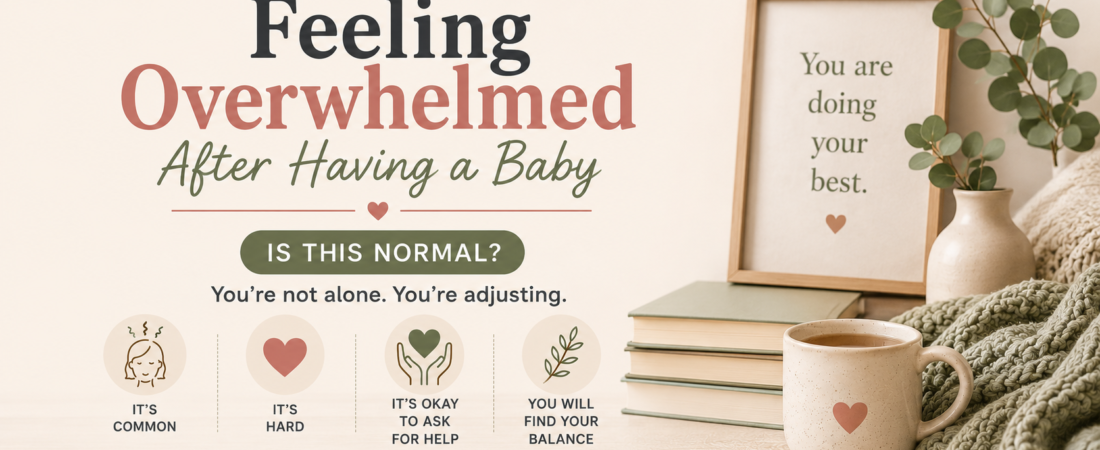
All of this is normal. None of it makes you a bad mother. It makes you a mother in the middle of the fourth trimester, which is the hardest stage, on the most difficult sleep of your life, carrying more than any single person was designed to carry alone.
The thing about sleep that nobody says clearly enough
Sleep deprivation is not simply tiredness. It is a physiological state that impairs every cognitive function you rely on to be the person you want to be, your patience, your emotional regulation, your ability to make decisions, your sense of proportion, your capacity for joy.
When you have been woken multiple times every night for weeks, the dishes in the sink do not look like dishes. They look like evidence of your failure. A baby who will not settle does not feel like a normal baby having a normal evening. It feels like a referendum on your competence. Everything is louder and heavier and more urgent than it actually is, not because you are broken but because your brain is operating without the restorative sleep it needs to maintain perspective.
This is important to know because so much postpartum overwhelm is not, at its core, about the specific thing that is triggering it. It is about sleep. The trigger is the occasion. The sleep deprivation is the underlying condition. The two things look identical from the inside, but only one of them is fixable by addressing the trigger and it is not the sleep deprivation one.
If there is one thing worth asking for directly in the early weeks, it is not help with the cooking or the laundry or the visitors. It is sleep. Three consecutive hours of sleep when someone you trust has the baby. Not every night, but sometimes. Enough to let your nervous system remember what rested feels like.
The Mauritius context: the pressure that goes unspoken
In Mauritius, new mothers are surrounded by family in a way that the Western parenting experience often is not. Extended family visit. People help. Babies are held and passed around and loved from every direction. This is genuinely wonderful and it is one of the things that makes raising a child in Mauritius rich in a way that isolated nuclear family parenting is not.
But the same closeness that brings support also brings expectation. The expectation to be coping. To be grateful. To be managing. To not be struggling when you have family around and a healthy baby and nothing to legitimately complain about.
The result is that many Mauritius mothers perform capability in front of others and fall apart when they are finally alone. They say they are fine. They accept the advice, even when the advice contradicts everything they have read, even when it adds to the pressure rather than relieving it because saying otherwise feels like ingratitude. They do not ask for the specific help they actually need because asking for help means admitting that the help is needed.
You are allowed to not be fine. You are allowed to need rest rather than visitors. You are allowed to tell the people who love you, calmly and clearly, what would actually help and to know that genuine help looks like taking the baby for two hours while you sleep, not holding the baby while you make tea for everyone.
When the overwhelm is something more
Postpartum overwhelm is normal. Postpartum depression and postpartum anxiety are medical conditions that require support beyond rest and reassurance. The difference matters, not to minimise overwhelm, but to ensure that the mothers who need more than time and sleep are able to recognise that and reach for it.
The signs that what you are experiencing has moved beyond the normal weight of new motherhood: a sadness that does not lift and does not connect to specific circumstances, a feeling of hopelessness or worthlessness that is not about any particular situation, the inability to feel pleasure or connection in any moment even briefly, a detachment from your baby that you cannot bridge even when you want to, intrusive thoughts that frighten you, anxiety that is constant and physical and does not respond to anything reassuring, a sense that your family would be better without you.
If any of those feel familiar, not just occasionally and mildly, but persistently and significantly, please speak to someone today. Your family doctor. Your gynaecologist. A specific person at Befrienders Mauritius on 800 93 93, available every day from 9am to 9pm. Not because what you are feeling is shameful, but because it is treatable, and because there is no version of this that is better managed alone.
Postpartum depression affects approximately one in seven new mothers globally. In Mauritius it is significantly underdiagnosed because we do not talk about it, and because the expectation to cope is so culturally embedded that admitting struggle feels impossible. You do not have to meet that expectation. You are allowed to say that you are not okay.
What actually helps: the honest version
Lower the bar for what the day needs to look like. The three things that matter in the early weeks are: your baby is fed, your baby is safe, and you have eaten something. Everything beyond that is optional. The house does not need to be clean. The laundry can wait. The thank-you messages can be sent next week. Give yourself explicit permission to do less, because the doing less is not laziness, it is resource management in a period of genuine depletion.
Accept help when it is offered, and ask for it specifically when it is not. Not vague help, specific help. Not “let me know if you need anything” but “can you come on Thursday at 1pm and have the baby for two hours while I sleep.” People who love you want to help in ways that actually help. Give them the instruction.
Get outside, even briefly. Not for exercise, not to achieve anything, just for the change of air and light and the minor miracle of being somewhere that is not the inside of your house. Mauritius has extraordinary outdoor spaces and a climate that, outside of the midday heat, is genuinely restorative. A 20mins walk does something that no amount of scrolling or resting indoors can replicate.
Stop measuring yourself against what you see on social media. The Mauritius mum whose Instagram shows a glowing face and a content baby and a tidy home three weeks postpartum is showing you a single captured moment from a life that also contains the rest of it, probably the tears, the 4am desperation, the feeds that did not work, the days that felt unsurvivable. You are not failing by comparison to her. You are comparing your whole experience to her highlight.
Talk to someone who tells you the truth. Not someone who says you should be grateful, not someone who says it will get easier without telling you how or when, but someone who has been in this and says yes, it is really hard, and here is what helped me. That conversation, even once, can be the difference between feeling alone in something and feeling like part of a human experience that other people have survived.
To the mother reading this at 3am
If you are here because you are awake and feeding and wondering whether this feeling is normal, whether it means something, whether other mothers feel this way or just you, the answer is yes, it is normal, and yes, other mothers feel this way, and no, it does not mean anything bad about you.
You do not have to enjoy every moment of this. You do not have to be grateful every minute. You do not have to perform contentment when you are running on empty. You are allowed to find this hard and still be a wonderful mother. You are allowed to cry and not know why and still be exactly the mother your baby needs.
Your baby does not need you to be perfect. Baby needs you to be there, and you are there. At 3am, feeding them, trying to understand what you are feeling. That is enough. That is everything.
One feed at a time.
Stay Informed!
Get weekly postpartum and motherhood care tips delivered to your inbox.
Thank you!
You have successfully joined our subscriber list.
RELATED ARTICLES:

References: Hoekzema E. et al. (2017) — Pregnancy leads to long-lasting changes in human brain structure. Nature Neuroscience. Kleiman K. and Raskin V. — This Isn’t What I Expected: Overcoming Postpartum Depression. Da Capo Press. Postpartum Support International — perinatal mental health statistics. postpartum.net. World Health Organisation — Maternal mental health. who.int. Ministry of Health and Wellness Mauritius — Maternal and child health data.
Disclaimer: This article is for informational purposes only. If you are experiencing symptoms of postpartum depression or anxiety, please contact your family doctor, gynaecologist, or a mental health professional. In Mauritius, Befrienders can be reached at 800 93 93 every day from 9am to 9pm. If you are in crisis, go to your nearest Emergency.