
Postpartum Guide: Recovery, Mental Health & Life After Baby
Your recovery, your mental health, your well-being, because you matter too.
You did it. Your baby is here.
Everyone prepares you for birth and very few prepare you for what comes after. The moment your baby arrives, everything shifts.
Your body feels different. Your emotions feel heavier. Your energy feels drained.
Postpartum is one of the most intense transitions a woman goes through.
Postpartum in Mauritius: Your Complete Guide to the Fourth Trimester!
And now you are home, maybe sitting on the sofa at 2am, one hand holding this screen, the other holding a baby who will not sleep, wondering why nobody warned you that this part would feel so hard.
This page is for you. Not the polished version of new motherhood you see on Instagram. The real version. The Mauritius version, where you may have left the Hospital or clinic with very little information about what comes next, where the heat makes everything harder, and where the advice from your mother-in-law directly contradicts what your paediatrician told you this morning.
The postpartum period, sometimes called the fourth trimester, covers roughly the first 12 weeks after your baby is born. It is one of the most physically and emotionally intense experiences of your life, and it is also one of the least talked about. We are changing that.
This guide covers everything: physical recovery, breastfeeding, newborn care, mental wellbeing, and how to find real, qualified support in Mauritius. Read it in one go or use the sections below to jump straight to what you need right now.
First Weeks Home
Navigate the emotional and physical transition of bringing your baby home.
Physical Recovery
Understand healing after birth, postpartum symptoms, and what recovery really looks like.
Breastfeeding
Get simple guidance on feeding, milk supply, latch concerns, and newborn nutrition.
Newborn Care
Learn how to care for your newborn with more confidence and less stress.
Your Mental Health
Recognize emotional changes, postpartum anxiety, and when to seek support.
Your First Week Home from Hospital in Mauritius
Whether you gave birth at the Hospital or in a private clinic, the moment you walk through your front door with your newborn, everything changes. Here is what to honestly expect in the first seven days.
Days 1–3: Survival mode is real and it is valid
Your body has just done something extraordinary. Even if your birth went smoothly, you are bleeding (lochia), your milk is coming in, your hormones are crashing after nine months of elevation, and you have not slept. Every one of these things alone is significant. All of them together at the same time, in Mauritius heat, with a baby who has no routine, well this is genuinely one of the hardest weeks of your life.
What is normal in the first 72 hours:
- Heavy bleeding (lochia): dark red, possibly with small clots. This is normal. Change your pad every 2–3 hours.
- Afterpains: uterine cramping as your womb contracts, especially during breastfeeding. More intense with second and subsequent babies.
- Breast engorgement: when your milk comes in on days 2–4, your breasts may feel rock-hard, hot, and painful. This is temporary.
- Night sweats: your body is releasing the extra fluid from pregnancy. Put a towel over your pillow.
- Emotional overwhelm: crying without reason, feeling disconnected, euphoria followed by terror. All of this is hormonal and normal in week one.
- Exhaustion unlike anything you have experienced. This is not weakness, this is biology.
What Mauritius hospitals typically give you on discharge (and what they do not)
Most Mauritius clinics send you home with a brief verbal summary and a handful of pamphlets. What they rarely provide clearly: a written list of warning signs to watch for, contact numbers for midwife follow-up, information about postpartum physiotherapy, or any breastfeeding support beyond the first latch. This is not a criticism — it reflects a system under pressure. It is why this guide exists.
Warning signs — call your clinic immediately if you experience:
Heavy bleeding that soaks a pad in under an hour | Fever above 38.5°C | Foul-smelling discharge | Severe headache with visual changes | Extreme swelling of hands, face or legs | Chest pain or difficulty breathing | Signs of wound infection (redness, warmth, discharge at C-section scar or perineal tear) | Thoughts of harming yourself or your baby — seek help immediately, this is a medical emergency.
Physical Recovery After Birth in Mauritius
Postpartum physical recovery is not a linear process. It happens in layers; the outer healing you can see, the inner healing you cannot, and the hormonal recalibration happening invisibly throughout. Here is what to expect based on your type of birth.
Vaginal birth recovery
If you had a vaginal birth (with or without tearing or an episiotomy), your perineal area will be sore for several weeks. The Mauritius climate, particularly the heat and humidity, makes wound care more important than in cooler environments.
- Ice packs in the first 24 hours reduce swelling significantly. Wrap in a cloth, never apply ice directly.
- A sitz bath (sitting in warm, shallow water for 10–15 minutes, 2–3 times daily) is the single most effective thing you can do for perineal discomfort. You do not need a special bath, a clean basin works.
- Keep the area clean and dry. Pat, never rub. In Mauritius heat, moisture increases infection risk.
- Perineal wash spray (warm water in a squeeze bottle) makes using the toilet much more comfortable. This is not sold widely in Mauritius, include it in your postpartum kit or ask someone to order it.
- Healing takes 4–6 weeks for minor tears, longer for third or fourth-degree tears. If you had a significant tear, ask your clinic to refer you to a women’s health physiotherapist.
- Sitting comfortably: a donut cushion or a folded towel under your thighs (not your tailbone) helps enormously in the early days.
C-section recovery
A caesarean section is major abdominal surgery. Recovery takes longer than vaginal birth — typically 6–8 weeks for the outer wound, and 12+ months for full internal healing. In Mauritius, C-section rates are high across both public and private sectors, and postoperative support is often minimal.
- Do not drive, carry anything heavier than your baby, or do any abdominal exercise for at least 6 weeks.
- The scar will itch as it heals. This is nerve regeneration and it is normal. Do not scratch.
- Scar massage from 6–8 weeks post-surgery (once fully healed externally) helps prevent adhesions that can cause discomfort years later. A women’s health physio can show you how.
- Watch for: increasing redness around the incision, any separation of the wound edges, discharge, or fever. These require immediate medical attention.
- In Mauritius heat: keep the scar area dry and cool. Breathable cotton underwear worn high (not cutting across the scar) or low-waisted styles that avoid the incision entirely.
- Gas pain after a C-section can be intense and walking gently as soon as you are able helps. Peppermint tea can ease this (beware if you plan to breastfeed).
Your pelvic floor after birth
This is the most overlooked aspect of postpartum recovery in Mauritius and one of the most important for your long-term health. Your pelvic floor muscles support your bladder, bowel, and uterus. Giving birth whether vaginal or via C-section, affects them significantly.
- Start gentle pelvic floor exercises (Kegels) as soon as you feel comfortable, even day one for straightforward vaginal births.
- Leaking urine when you cough, sneeze, or laugh is common but NOT something you simply have to live with. It is a sign of pelvic floor weakness that can be treated.
- Pelvic floor physiotherapy is available in Mauritius. Ask your GP or gynecologist for a referral.
- Return to running, HIIT, or heavy exercise too early is one of the most common postpartum mistakes. Most women’s health physios recommend waiting at least 12 weeks minimum, and only after a proper pelvic floor assessment.
BREASTFEEDING IN MAURITIUS: HONEST, PRACTICAL SUPPORT
Breastfeeding is one of the most searched topics by new Mauritius mums and one of the areas where the gap between the idealised version and the reality is greatest. Here is the truth: breastfeeding is natural, but it is not instinctive. It is a skill. You both have to learn it.
Establishing your milk supply in the first week
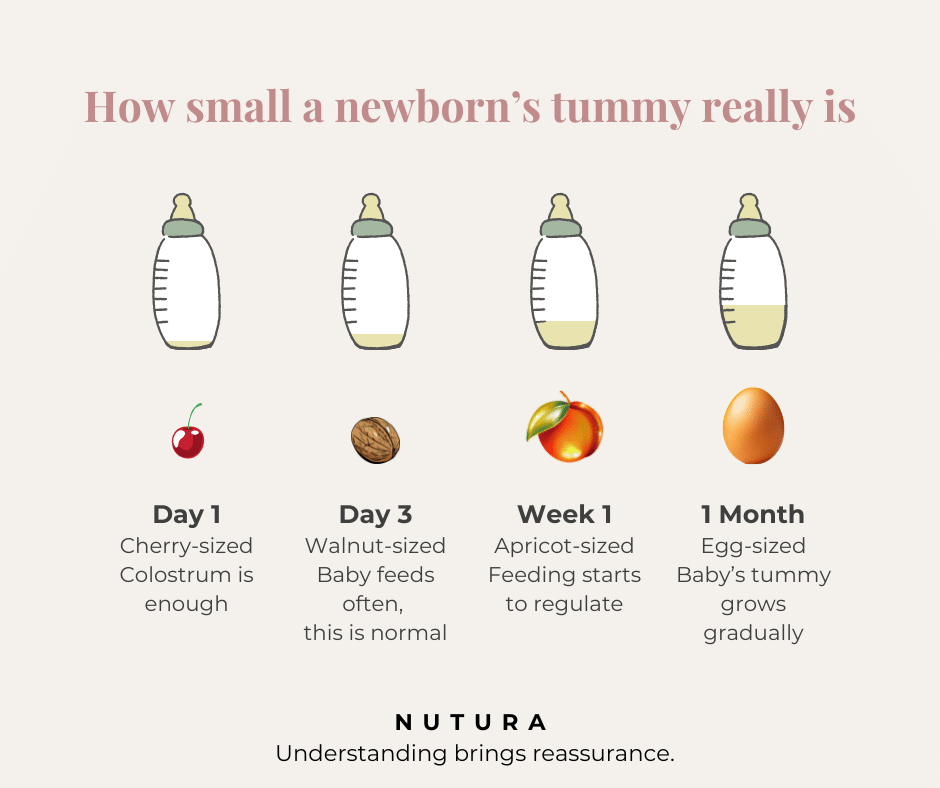
Your milk comes in between days 2 and 5 after birth. Before that, your baby is getting colostrum, a thick, golden fluid that is incredibly concentrated in antibodies and nutrition. It may look like very little, but it is exactly what your newborn needs.
- Feed on demand, which is every 1.5 to 3 hours in the early days, including at night. Frequency is what establishes supply. Do not try to stretch feeds to 4-hour schedules in the first weeks.
- The more your baby feeds, the more milk your body makes. Supply works on demand… Literal demand.
- In Mauritius heat, you need to drink significantly more water than you think. Breastfeeding requires approximately 700ml of additional fluid daily, aiming to 2 to 3L of water daily. Keep a large water bottle at your feeding spot at all times.
- If your baby is latching and feeding frequently, producing wet nappies, and gaining weight at the 5-day and 2-week checks — your supply is almost certainly fine, even if it does not feel like it.
Latching: what correct and incorrect feels like
A correct latch does not hurt, or at least, not beyond the first few seconds of initial discomfort in the early days. If feeding is painful throughout, the latch needs adjusting.
- Your baby’s mouth should be wide open, like a yawn, before latching. Wait for it.
- More of your areola should be in your baby’s mouth than feels intuitive. Aim to get the nipple far back, not just the tip.
- Your baby’s chin should be touching your breast. Their nose should be clear of the breast, or just lightly touching.
- If it hurts: break the seal with your clean finger and try again. Do not push through a painful latch — it damages your nipple and does not fix the problem.
- Nipple pain, cracking, and bleeding in the first 1–2 weeks, while common, should not be severe. If it is, contact a lactation consultant immediately.
Common Breastfeeding Challenges
Mastitis
Inflammation of breast tissue (hot, red, painful area + flu symptoms). See a doctor within 24 hours. Continue breastfeeding or pumping from the affected side. Stopping makes it only worse.
Blocked duct
Hard, tender lump in the breast. Warm compress before feeding, gentle massage towards the nipple during feeding. Usually resolves within 24–48 hours.
Low supply concerns
True low supply is less common than perceived. Before assuming low supply: check latch, increase feeding frequency, avoid formula top-ups without LC advice, rest, eat, drink. Moringa (Moringa oleifera) is a traditional galactagogue used widely in Mauritius and there is growing evidence to support its use for milk supply support.
Returning to work
Mauritius maternity leave is 16 weeks. Many mums return to work when their baby is 4ish months old. Pumping at work is possible, plan for 2–3 pump sessions per working day. A quality double electric pump makes an enormous difference. Store milk safely in a cool bag or fridge.
Newborn Care Essentials for Mauritius Mums
You have never done this before. Or perhaps you have, but every baby is different. Here are the newborn care essentials that Mauritius mums need to know, adjusted for our climate, our products, and our reality.
Sleep: safe sleep in the Mauritius climate
The safest sleep position for your baby is on their back, on a firm, flat surface, in the same room as you for the first 6 months. This is the guidance from the World Health Organisation and every major paediatric body globally.
- Room-sharing reduces the risk of SIDS by up to 50%. Your baby in a Moses basket or bedside crib next to your bed is the safest arrangement.
- In Mauritius heat: no heavy blankets. A light swaddle or a sleep bag appropriate to the room temperature. Overheating is a risk factor for SIDS.
- Air conditioning: if using AC, ensure the room is not too cold (18–20°C is optimal). Point the unit away from the baby.
- Mosquito nets: use a net over the pram or Moses basket, not draped loosely over a cot where it can fall.
- White noise: a fan (not pointed at baby) or a white noise machine helps many Mauritius babies sleep in noisy households.
Feeding: how often, how much, and what to watch for
- Breastfed newborns feed every 1.5–3 hours, roughly 8–12 times per 24 hours in the first weeks. This is normal, not a supply problem.
- Formula-fed babies typically feed every 2.5–4 hours. Follow the tin guidelines for preparation but note they are for guidance. Every baby is different.
- A newborn’s stomach is the size of a cherry at birth. They cannot overfeed at the breast; they can overfeed on a bottle.
- Signs of adequate feeding: 6+ wet nappies per day from day 5 onwards, regaining birth weight by day 10–14, content between some feeds (not all as some babies are high-need).
- Projectile vomiting (not just spitting up) after every feed, arching of the back in pain, or blood in the stool. See your paediatrician.
Skin care in the Mauritius climate
Newborn skin is sensitive, and Mauritius humidity creates specific challenges such as heat rash, nappy rash, and cradle cap all appear more frequently in tropical climates.
- Nappy rash: change nappies frequently. A breathable zinc oxide cream at every change prevents rather than treats. Let the skin air-dry between changes when possible.
- Heat rash (miliaria): small red bumps, usually on the neck, chest, or back. Keep the area cool and dry. Dress baby in loose, breathable cotton. Do not apply creams, they trap heat.
- Cradle cap: yellow, scaly patches on the scalp. Common and not harmful. Olive oil or coconut oil left on for 15 minutes, then gently combed out with a soft brush, is effective.
- Umbilical cord stump: keep it clean and dry. Fold the nappy below it. The stump falls off between 1–3 weeks. If it smells or there is redness spreading around it, see your doctor.
Baby products: use fragrance-free, dye-free products only on newborn skin. Many widely available Mauritius products contain fragrance. Check labels carefully.
Development: what your newborn is doing in the first weeks
- Week 1–2: rooting, sucking reflex, startling at loud sounds, eyes focusing 20–30cm (the distance to your face when feeding).
- Week 3–4: beginning to track movement, responding to your voice, periods of quiet alertness becoming longer.
- Month 2: the first social smile, one of the most extraordinary moments of new parenthood. Distinct from wind-smiles — it happens in response to your face and voice.
- Month 3: head control improving significantly, mini push-ups during tummy time, cooing and beginning to ‘talk’ back to you.
Tummy time is essential for neck and shoulder strength and for preventing positional flat head (plagiocephaly). Start from day one, even short 30-second sessions on your chest count. Build to 30 minutes total per day by month 3.
Your Mental Health Matters: Baby Blues, PPD, and Where to Get Help
This section might be the most important thing you read today. Not because it will affect you, but because if it does, you need to know it is not your fault, it is not permanent, and help is available in Mauritius.
Baby blues: normal and temporary
Between days 3 and 10 after birth, up to 80% of new mothers experience the baby blues. You may cry without knowing why. You may feel inexplicably sad on a day when everything is going well. You may feel overwhelmed, irritable, or disconnected from the baby you love.
This is hormonal. Oestrogen and progesterone drop sharply after birth — one of the most dramatic hormonal shifts the human body experiences. The baby blues typically resolve on their own within a week or two. Rest, eat, accept help, and let yourself cry.
Postpartum depression — when it is more than baby blues
Postpartum depression (PPD) affects approximately 1 in 7 new mothers globally. In Mauritius, it is significantly under-diagnosed because women are not screened routinely and because cultural expectations around motherhood make it hard to admit you are struggling.
PPD is not a character flaw. It is not a sign you do not love your baby. It is a medical condition with effective treatments, and it gets worse (not better) without support.
Signs that what you are experiencing may be PPD rather than baby blues:
- Symptoms lasting more than 2 weeks after birth
- Feeling hopeless or worthless and not just tired or overwhelmed
- Inability to bond with your baby, even when you want to
- Withdrawing from family and friends
- Intrusive thoughts: thoughts that frighten you
- Not eating, not sleeping even when the baby sleeps, inability to do basic daily tasks
- Feeling like your family would be better off without you
If you are experiencing any of the above, please reach out today
You do not have to feel this way. Speak to your GP or gynaecologist and tell them exactly how you feel. If you find that difficult, show them this list. In a mental health crisis, contact Befrienders Mauritius: +230 800 93 93 (free, from 9am to 9pm).
Postpartum anxiety: the condition nobody talks about
Postpartum anxiety is actually more common than PPD, and even less talked about. It presents as constant worry — about the baby’s breathing, weight, health — that goes beyond normal new-parent concern. It may include racing thoughts, difficulty sleeping even when exhausted, physical symptoms like a racing heart, and a persistent sense that something terrible is about to happen.
If your worry feels out of proportion, or if it is preventing you from functioning or enjoying any part of motherhood, speak to a doctor. Postpartum anxiety is treatable.
Taking care of yourself is not selfish — it is essential
Mauritius culture places enormous pressure on mothers to be selfless, available, and coping at all times. Extended family involvement — while often wonderful — can also mean your needs become invisible in the care of the new baby.
You cannot pour from an empty vessel. Your mental health is not a luxury. It is not something to deal with after everything else is sorted. It is the foundation of everything — your ability to feed your baby, to care for them, to be present with them. Prioritise it without apology.
The postpartum period does not happen in isolation. It connects forwards and backwards across your whole early parenthood experience. Here are the sections of this platform most relevant to where you are now.
NEWBORN CARE
Learn how to care for your newborn with more confidence and less stress.
CHILD DEVELOPMENT
Feeding, sleep, development, and health simplified for everyday life.
Discover All Postpartum Articles:





Frequently Asked Questions
These are the questions Mauritius mums ask most often in the early postpartum weeks. If your question is not here, send it to us via our contact page. We add new answers regularly.
How long does postpartum bleeding last?
Postpartum bleeding (lochia) typically lasts between 4 and 6 weeks, though this varies significantly. It starts as heavy, dark red bleeding in the first days, then gradually lightens to pink, then brown, then yellowish-white as it tapers off. Heavy bleeding that soaks a pad in under an hour, or bright red bleeding that suddenly increases after it had been getting lighter, requires urgent medical attention. If you are unsure whether your bleeding is normal, call your clinic — never feel embarrassed to ask.
When can I have sex after giving birth?
Most medical guidelines suggest waiting until your 6-week postpartum check before resuming sexual intercourse and then only when you feel physically and emotionally ready, which may be much longer. In Mauritius, the 6-week check is not always offered automatically — request one from your GP or gynaecologist. Important: you can become pregnant before your first period returns after birth. Discuss contraception at your postpartum check, or sooner if needed.
My baby only sleeps on me. Is this normal and what do I do?
Completely normal, especially in the first weeks. Newborns have spent nine months held by your body — the transition to sleeping alone is significant. In the short term, wearing your baby in a carrier during the day reduces the need to be held during sleep periods. For night sleep, a bedside crib or co-sleeper that attaches to your bed keeps baby close without bed-sharing. Safe bed-sharing, if you choose it, has specific safety guidelines — never do it on a sofa or armchair, and never after consuming alcohol or medications that cause drowsiness.
Is it normal to not feel an instant bond with my baby?
Yes and more common than you might think, though rarely spoken about. The cinematic moment of overwhelming love at first sight does not happen for everyone. For some mothers, bonding is a gradual process that develops over days or weeks. This does not mean anything is wrong with you or with your relationship with your baby. However, if you feel persistently disconnected or detached from your baby and this is not improving, it may be a symptom of postpartum depression — please speak to your doctor.
What is the difference between baby blues and postpartum depression?
Baby blues (affecting up to 80% of new mothers) typically appear on days 3 to 5 after birth when hormones crash, and resolve on their own within 1 to 2 weeks. They involve tearfulness, mood swings, and feeling overwhelmed. Postpartum depression is more persistent (lasting beyond 2 weeks), more severe, and involves symptoms like hopelessness, inability to function, intrusive thoughts, or not being able to care for yourself or your baby. If you are unsure which you are experiencing, speak to your GP. Erring on the side of getting support is always the right choice.
Can I take tea or coffee while breastfeeding?
Moringa (bred mouroum) has been used traditionally across Mauritius and the Indian Ocean for generations to support breastfeeding mothers. It is rich in nutrients including calcium, iron, and vitamin C, and is generally considered safe while breastfeeding in culinary quantities — i.e., as a food or infusion rather than in concentrated supplement form. As with any supplement, if you have a specific medical condition or are taking medication, check with your doctor first. Our moringa infusion is available in our shop with full ingredient information.
When should I take my newborn to the doctor in Mauritius?
Seek medical attention promptly if your newborn has: a temperature above 38°C (or below 36°C), is unusually difficult to wake, is not feeding at all for more than 4 hours, has a high-pitched or unusual cry, has fewer than 6 wet nappies per day from day 5, has yellow skin spreading below the navel or to the palms (jaundice), has blood in the stool, or if you have any strong instinct that something is wrong. In Mauritius, your nearest public hospital is always open. For non-emergency concerns, your paediatrician or GP is the first port of call.
I feel completely alone in this. Where can I connect with other Mauritius mums?
You are not alone — even if it feels that way at 3am. Our community section has real stories from Mauritius mums who have been exactly where you are. You can also join our newsletter for weekly support, or find our Facebook community group for Mauritius mums. If you are experiencing serious emotional distress, please speak to a professional — your feelings are valid and support is available.
A final word from us
This platform was built by a mum who spent a bedridden pregnancy searching for exactly this information — and finding nothing that was made for Mauritius. Every page, every guide, every product on this site exists because of that experience.
You are doing an extraordinary thing. On the days it does not feel that way — and there will be many — come back here. We will be here.
NUTURA team