

- Pregnancy Week by Weeks
- 10mins read
- No Comments
Four weeks.
Give or take. Probably less, possibly a little more. But roughly 4 weeks, 30 days, the same amount of time that separated you from each of the big milestones of this pregnancy, except that this time what is waiting on the other side is not a scan or a test or an appointment. It is your baby.
The reality of that has a particular quality at 36 weeks that it has not had at any other point. Not the abstract future-baby of the first trimester, or the kicking presence of the anatomy scan weeks. Something more immediate now. Something that happens very soon, in a specific clinic, on a day that is coming whether you feel ready or not.
You are probably spending a lot of time right now doing one of two things: either nesting with a ferocity that is surprising even you, cleaning, organising, packing, preparing, an energy you had not felt since the second trimester arriving from nowhere and directing itself at the contents of your wardrobe or lying very still wondering whether that tightening is a contraction or a Braxton Hicks and whether you should call the clinic or wait and see. Sometimes both, alternating.
Both are completely normal. Both are your body and your mind doing what they do in the final stretch.
Here is what is happening this week.
Your baby at 36 weeks: almost everything is ready
Your baby is approximately 47-49 centimetres long and weighs somewhere between 2.6 and 2.9 kilograms, roughly the size and weight of a large cabbage, though the comparison does nothing to capture the person it represents.
Baby looks, now, like a newborn. Their cheeks are filling out as fat accumulates under the skin, the same fat stores that will help them regulate their body temperature in the first hours after birth and maintain their blood sugar through the early feeds. The wrinkled, slightly alien quality of earlier ultrasound images has given way to something softer. If you have a scan this week or next, you may see the face that you will see when they place baby on your chest, and the resemblance can be startling.
Baby’s lungs are nearly mature. By 36 weeks, the vast majority of babies have lungs capable of functioning independently outside the womb, the surfactant that prevents the air sacs from collapsing has been produced in sufficient quantities. They will continue maturing until birth and into the early weeks of life, but a baby born at 36 weeks today has an excellent prognosis. Not full term, not yet, but well past the point where the lungs are the primary concern.
Baby’s immune system is receiving a final significant contribution from yours. Throughout the third trimester, antibodies have been crossing the placenta, your immunological history, everything your body has learned to fight, transferred to baby. These maternal antibodies will protect them in the first months of life, supplemented by the additional immunological protection in colostrum once feeding begins. The timing of this transfer is one of the reasons that third trimester weeks genuinely matter, and why every day baby stays inside is doing something useful even when it does not feel that way from your end.
Most babies have moved into a head-down position by 36 weeks. If yours has not, if your gynaecologist has told you baby is breech at this stage, the conversation about your options is happening now, not next week. External cephalic version, the procedure where a trained practitioner manually encourages the baby to turn, is performed around 36 to 37 weeks and has a success rate of approximately 50%. Your gynaecologist will advise whether it is appropriate in your specific case. Whatever the outcome of that conversation, a breech position at 36 weeks has a clear management pathway, it is not an emergency, it is a decision to make with your doctor.
Your body at 36 weeks: the uncomfortable truth
There is no soft way to say this: the final weeks of pregnancy are physically demanding in a way that the second trimester was not. By 36 weeks, most women are dealing with a combination of symptoms that makes ordinary daily life considerably more effortful than it was 4 months ago.
The pelvic pressure is the most visceral of them, the sensation that your baby is sitting very low, that there is a weight between your legs that was not there before, that walking has become a waddle and sitting down and getting up are their own small projects. This is your baby engaging, moving lower into the pelvis in preparation for birth and it is a good sign even when it is uncomfortable. The technical term is lightening. The experiential reality is that you feel like you are carrying a bowling ball in your pelvis.
With engagement often comes a welcome companion: slightly easier breathing. If your baby has spent the third trimester lodged under your ribcage, their descent into the pelvis gives your diaphragm room to expand again. Some women experience this as a noticeable physical relief. Others barely notice it alongside everything else.
Braxton Hicks contractions are likely frequent and noticeable by now, the tightening across the abdomen, irregular and often painless, that your uterus uses to practise for the real thing. The question you are probably asking every time you feel one is: is this it? The answer, most of the time, is no. The distinction matters: Braxton Hicks contractions are irregular, do not become progressively stronger, and usually ease with movement or rest. Real labour contractions become regular, lengthen over time, intensify regardless of what you do, and do not stop. If you are unsure, if contractions are coming every five minutes and lasting around a minute, consistently, for an hour, call your maternity. That is the 5-1-1 rule and it is the guideline most Mauritius clinics use.
Sleep has probably become difficult in a way that feels cruel given what is coming, the irony of struggling to sleep in the weeks immediately before the sustained sleep deprivation of a newborn is not lost on any woman at 36 weeks. The discomfort of the bump in any position, the frequency of bathroom visits, the Braxton Hicks that wake you, the mind that will not quiet down. A pillow between your knees and another supporting your bump from below is the most consistently helpful physical adjustment. The rest is largely endurance.
Swelling of the feet and ankles is common in late pregnancy, particularly in Mauritius heat. Mild, symmetrical swelling that comes and goes is normal. Sudden, severe swelling, especially if it involves the face and hands, or is accompanied by headache, visual disturbances, or a feeling of being unwell, is a warning sign for preeclampsia and warrants immediate medical attention. If in doubt, call your clinic. They would always rather check you unnecessarily than have you wait at home with something that needed attention.
The nesting instinct: what it is and why it arrives
At 36 weeks many women experience an arrival of energy and a compulsive need to prepare the home, organise the baby’s things, clean things that did not need cleaning, and complete tasks that have been sitting on the to-do list for months. This is the nesting instinct, and it is both biological and extremely common.
It is driven by the same hormonal and physiological changes that are preparing your body for labour, and most midwives and obstetricians treat it as a soft indicator that birth is approaching, not imminent necessarily, but on the near horizon. If you have been lying low for weeks and suddenly find yourself at 11pm reorganising the baby’s clothes by size and colour, you are not irrational. You are nesting.
Channel it where it is useful, packing the hospital bag is the most productive deployment of this energy at 36 weeks, but do not exhaust yourself. You need rest right now as much as you need a clean kitchen. The dishes will wait. Your body will not.
Your hospital bag: pack it this week
If you have not packed your hospital bag yet, 36 weeks is the moment. Not because labour is necessarily imminent (note that most first-time mothers deliver between 39 and 41 weeks, I went to labor at 39+0) but because the window between now and term is short enough that leaving it undone creates unnecessary stress, and because you will not want to be making decisions about what to pack when you are in early labour.
The broad principles: bring more maternity pads than you think you need. Bring comfortable front-opening nightwear for both the birth and the recovery, not a matching set, something you can open easily for breastfeeding and wound checks. Bring your own toiletries rather than assuming the clinic provides them. Bring phone chargers for both you and your partner. Bring the baby’s car seat, not for the clinic but for the journey home. In Mauritius, many clinics require it before discharge.
Signs of labour: what to watch for and when to call
The question underneath every twinge and tightening at 36 weeks is always the same: is this it?
Here are the signs worth paying attention to, and what each of them means.
The mucus plug, the thick, jelly-like discharge that may be tinged pink or brown, can come away days or even weeks before labour begins. Its appearance tells you your cervix is beginning to efface and soften, which is preparation rather than imminent labour. Note it. Do not rush to the clinic on the basis of it alone unless there is heavy bright red bleeding alongside it.
Your waters breaking, a gush or a trickle of clear or pale fluid, means the amniotic sac has ruptured. It is not always the dramatic flood of film and television. Sometimes it is a slow leak that makes you wonder whether you have simply not quite reached the bathroom in time. If you are unsure, put on a pad and note the colour, amount, and smell. Clear or pale fluid that continues to leak is waters. Contact your clinic. They will check. Do not sit at home waiting to be more certain.
Contractions that follow the 5-1-1 pattern, meaning every five minutes, lasting one minute, for one hour, are the signal most Mauritius clinics use as the threshold for coming in during a first labour. Earlier than 5-1-1, you are generally managing at home with the strategies we discuss below. At 5-1-1, you call.
Contact your clinic or go directly to the Emergency if you experience any of the following regardless of whether contractions have started: reduced baby movements (baby should still be moving at 36 weeks, and a significant change in baby’s pattern warrants prompt assessment), heavy bright red bleeding, severe headache with visual disturbances or swelling of the face, or any strong instinct that something is wrong. The instinct one is not something to dismiss. You know your body and your pregnancy. If something feels different in a way that concerns you, act on it.


Movement monitoring at 36 weeks
Your baby’s movements may feel different at 36 weeks compared to a few weeks ago, less the dramatic rolling and kicking of earlier months, more the subtle shifting and stretching of a baby who has run out of room. This change in character is normal. What should not change is the frequency and pattern of movements overall.
There is no minimum daily kick count that is universally agreed upon, with current guidance that has moved away from prescriptive counting toward awareness of your baby’s individual pattern. What you are looking for is any significant, sustained change from what has been normal for her. If baby is usually active in the mornings and is unusually quiet, or if you have gone more than a few hours without any movement you can identify, eat something cold or sweet, lie on your left side for an hour, and count. If you are still not feeling baby’s normal movement pattern, call your clinic. This is not overreacting. This is exactly what the movement monitoring guidance asks you to do.
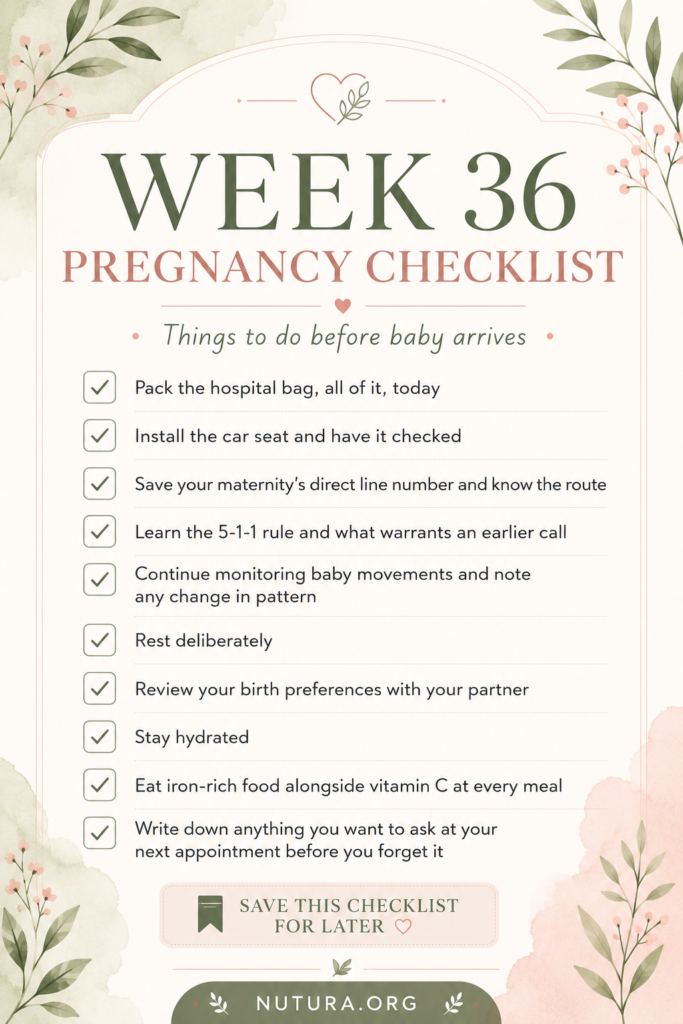
What to do this week: the week 36 priorities
Pack the hospital bag. This week, not next week.
Install the car seat. Have the installation checked if possible, the majority of car seats in Mauritius are not installed correctly, and a correctly installed rear-facing seat is one of the most important safety decisions you will make for your baby.
Know the 5-1-1 rule. Know the number for your clinic. Know which entrance to use and where to park at your time of day. Know who is driving you and what the backup plan is.
Review your birth preferences. Not because they will be followed perfectly as birth rarely follows the plan exactly, but because the process of writing them means the people caring for you know what matters to you and will factor it into their decisions when you cannot clearly articulate it yourself.
Rest. Not as a passive suggestion but as an active priority. You are 36 weeks pregnant. Growing a human being in its final weeks of preparation. The fatigue is real and the demand on your body is real and rest is not laziness. It is physiology.
The emotional reality of week 36
The particular mixture of feelings at thirty-six weeks is unlike any other week of the pregnancy.
There is the impatience, the specific, physical readiness to be done with being pregnant that arrives in the final weeks and surprises many women who expected to want more time. There is the excitement that is almost too large to contain when you think about what is coming. And there is the fear, not the generalised anxiety of the first trimester but something more specific and more near. The birth. The pain you have been told is manageable and do not quite believe yet. The moment of meeting someone you have never met but already love completely.
All of it can be present simultaneously. The excitement and the fear and the impatience and the wonder and the occasional desperate wish for it to just be over so you can stop being pregnant and start being the mother you have been preparing to be for 9 months.
You are almost there. The weeks you have been counting for months are becoming days. And somewhere on the other side of what is coming is the moment that every woman who has been here before you describes the same way, the one they could not have imagined and cannot fully explain and would not exchange for anything.
It is coming. You are ready enough. You always will be.
Week 36 checklist
Looking ahead to week 37
Next week your baby is officially early term. Labour can begin at any time from this point. Your gynaecologist appointments may move to weekly. The final weeks of preparation, physical and emotional, continue. And somewhere between now and forty weeks, or a little beyond, the waiting ends.
References: NHS — You and your baby at 36 weeks pregnant. nhs.uk. American College of Obstetricians and Gynecologists — Late preterm and early term deliveries. acog.org. WHO — Antenatal care recommendations. who.int. Tommy’s — 36 weeks pregnant. tommys.org. RCOG — Reduced fetal movements guideline. rcog.org.uk. Ministry of Health and Wellness Mauritius — Antenatal care guidelines.
Disclaimer: This article is for informational purposes only. Always follow the guidance of your gynaecologist or midwife for your specific pregnancy. If you have any concerns about contractions, reduced movement, bleeding, or any symptoms at this stage, contact your clinic immediately.