
- Pregnancy Week by Weeks
- 10mins read
- Aucun commentaire
The middle of the pregnancy has a particular quality that is difficult to describe to anyone who has not been inside it.
There is no scan this week. No significant threshold. No appointment on the horizon that is counting down days. Just the pregnancy, doing what the pregnancy does, in the weeks that sit between the anatomy scan behind you and the third trimester ahead. The kicks that are now reliable enough that you expect them. The bump that is visibly growing. The ordinary extraordinary of a body building a person in the background of your normal life.
Week 23 is one of those weeks. And if you let it, rather than spending it waiting for week 24 or week 28 or week 36, it has a great deal in it.
Your baby is over 500 grams this week. Baby has been alive inside you for more than five months. Baby knows your voice. Baby responds to sound and light and the pressure of a hand on your abdomen. Baby hiccups. Baby rolls. Baby has fingerprints and eyelashes and a face that is becoming more distinctly theirs every week.
There is nothing to do this week except be in it. So here is what is happening, in full.
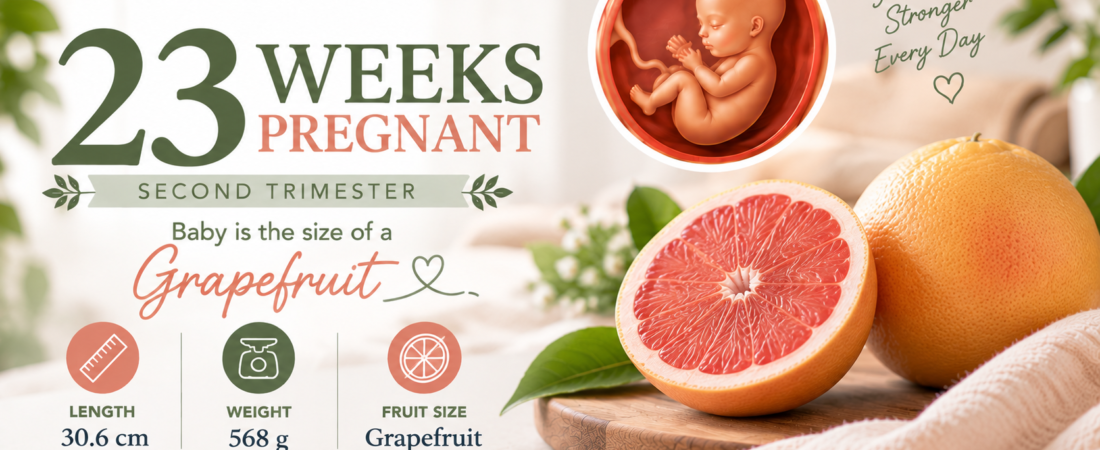
Your baby at 23 weeks: over 500 grams and growing fast
Your baby measures approximately 30.6cm from crown to heel and weighs around 568 grams this week. Crossing the 500 gram threshold is not a clinical milestone in the way that 24 weeks is, but it is a genuine marker of how much growth has occurred since the anatomy scan just a few weeks ago.
The most significant development happening at 23 weeks is in the lungs. The air sacs, alveoli, are forming and multiplying, and the cells lining them are beginning to produce surfactant, the substance that will prevent the air sacs from collapsing when they first inflate after birth. The lungs are not yet capable of sustaining independent breathing, that capacity develops progressively through weeks 24 to 36, but the foundation for it is being laid this week. This is one of the reasons that each additional week of pregnancy from this point onward meaningfully improves the outcomes of any premature birth.
The skin is becoming less translucent as fat accumulates beneath it. The characteristic wrinkled appearance of a very premature baby, caused by the absence of sufficient subcutaneous fat to fill the skin, is something your baby still has at 23 weeks, but the fat that will eventually smooth and fill that skin is actively accumulating. The brownish-red tone of the skin at this stage, which comes from the blood vessels showing through the still-thin layers of skin and fat, will progressively shift to the pinker tones of a newborn as the layers build.
The inner ear is fully developed this week, and your baby not only hears but can now distinguish the directionality of sounds. This means the familiar sounds of your body, your voice, your household, and the external world your baby has been absorbing for weeks are now experienced with increasing spatial accuracy.
The brain continues its extraordinary pace of development. The surface of the brain is developing its folds, the gyri and sulci that dramatically increase the surface area available for complex neural activity. This folding, which gives the brain its characteristic appearance, is a developmental process that continues through pregnancy and into the early years after birth, and it is happening rapidly and visibly at 23 weeks.
Your body at 23 weeks
The physical experience of 23 weeks is shaped by the bump that is now clearly present and the baby whose movements are now a daily feature of your awareness. The second trimester comfort that began around week 14 remains, but the physical demands of the pregnancy are becoming more present as the bump grows and the body continues adapting to it.
La kicks at 23 weeks are likely strong enough on some days to be visible from the outside, particularly if you are sitting quietly and watching. Partners and family members can typically feel them with a hand placed on the abdomen during an active period. Many babies at this stage show a clear response to the outside world: pressing gently on the abdomen may provoke a kick toward the pressure, a game that feels different from every angle and that connects the people around you to the baby in a tangible way for the first time.
Stretch marks may be appearing or becoming more visible on the abdomen, hips, breasts, or thighs. They are driven by the rate and extent of skin stretching rather than by any topical product or its absence, and genetics determines significantly who develops them and to what degree. They will fade progressively after birth, from the reddish or purplish tone of active stretching to a silvery, skin-toned mark that becomes less visible over months and years. No cream or oil reliably prevents them, though keeping skin well-hydrated supports general skin health.
Back and pelvic discomfort is likely a regular feature of the second half of the second trimester. The combination of the growing uterus, the relaxin hormone loosening ligaments and reducing joint stability, and the progressive shift in centre of gravity forward produces lower back pain and sometimes pelvic girdle pain in a significant proportion of pregnant women. Gentle movement, specifically swimming which removes gravitational load from the joints while allowing full-body movement, walking, and prenatal yoga, is more consistently effective than rest. If the pain is limiting daily functioning, ask your gynaecologist for a referral to a women’s health physiotherapist rather than simply accommodating it.
Leg cramps at night remain common and may be worsening through the second trimester. The most practical management is consistent: calf stretches before bed, adequate hydration throughout the day, and magnesium-rich food in the daily diet. If cramps are frequent and significantly disturbing sleep, mention it to your gynaecologist, as a magnesium supplement may be appropriate.
Heartburn and indigestion are typically present and may be intensifying as the uterus grows upward and presses on the stomach. Smaller and more frequent meals rather than larger ones, eating slowly, and avoiding lying down within an hour of eating remain the most effective dietary approaches. Safe antacids can provide relief for the worse evenings. Ask your gynaecologist which formulations are appropriate during pregnancy.
Braxton Hicks contractions may be noticeable at 23 weeks, as irregular, typically painless tightenings across the front of the abdomen that last up to a minute and then release. They do not follow a pattern, do not intensify progressively, and typically ease with movement or hydration. Regular, intensifying, or painful contractions at 23 weeks warrant a call to your gynaecologist rather than being assumed to be Braxton Hicks.
RELATED READ:


Nutrition at 23 weeks
The nutritional priorities of the second half of pregnancy are becoming more important as your baby’s growth rate accelerates and the demands on your body increase accordingly.
Iron remains the most critical nutritional priority through the second and third trimesters, because the blood volume expansion of pregnancy continues and iron demand increases correspondingly. The plant-based iron that forms the backbone of a Mauritius diet absorbs most efficiently when paired with vitamin C at the same meal. This combination should be habitual by 23 weeks: the lime on the dhal, the tomato in the lentil soup, the papaye alongside the egg. If a blood test has shown low ferritin or mild anaemia, discuss with your gynaecologist whether dietary iron alone is sufficient or whether supplementation is appropriate.
Protein is required at every main meal because your baby’s tissues, organs, and the placenta itself are built from amino acids that only protein provides. The practical target is a palm-sized serving of a protein source at each meal: fish, chicken, eggs, lentils, beans, tofu, or dairy. This does not require elaborate preparation. Eggs on toast, a bowl of dhal with rice, sardines with bread, yoghurt with fruit are all adequate and accessible.
Omega-3 fatty acids specifically support your baby’s rapidly developing brain and nervous system. Oily fish from the Mauritius market, tinned sardines requiring no preparation, walnuts, and ground flaxseed stirred into yoghurt all contribute. Including oily fish several times a week from this point through the remainder of the pregnancy is one of the most directly beneficial dietary choices available for your baby’s neurodevelopment.
The gestational diabetes test is approaching between weeks 24 and 28. Eating a normal, balanced diet in the days before the test is the appropriate preparation. Restricting carbohydrates or sugars before the test in an attempt to influence the result is counterproductive and can produce misleading findings. The test reflects how your body manages glucose in its normal state, and normal eating in the days before it provides the accurate baseline the result is meant to capture.
One week to viability
Week 24 is next week, and it represents a specific threshold that is worth understanding before you reach it.
Viability, in the context of pregnancy, means that a baby born at this gestational age would receive a neonatal medical response aimed at survival. Before 24 weeks, the lungs and other systems are not sufficiently developed for survival outside the womb even with the most advanced neonatal care. After 24 weeks, while a premature birth at this stage still carries significant risks and requires intensive neonatal support, medical intervention is offered.
Reaching 24 weeks does not mean you should be worried about premature birth, and most pregnancies at 23 weeks have no elevated risk of early delivery. The milestone matters because it shifts the medical response that would be available if something unexpected occurred, and because it marks a genuine development in your baby’s lung maturity that has been building for the past few weeks.
Every additional day of pregnancy from this point meaningfully improves outcomes. The weeks ahead are all adding something real.
The gestational diabetes test is approaching
Confirm with your gynaecologist at your next appointment exactly when the HGPO is scheduled. The window is weeks 24 to 28 in Mauritius, and popular laboratories and clinics can be booked several weeks in advance. Given the island’s rates of type 2 diabetes and metabolic syndrome, this test matters more here than global averages suggest.
The test requires fasting from the evening before. You will have a baseline blood test, drink a glucose solution, and then have one or two further blood tests at specified intervals over two to three hours. Confirm whether water is permitted during the fasting period with your specific provider, as policies vary.
When to contact your clinic
Contact your gynaecologist for heavy vaginal bleeding, significant or one-sided abdominal pain, regular or intensifying contractions, leaking fluid from the vagina, fever, severe headache with visual disturbances or swelling, a significant sustained change in your baby’s movement pattern, or any symptom that feels clearly wrong rather than ordinary second-trimester adjustment.
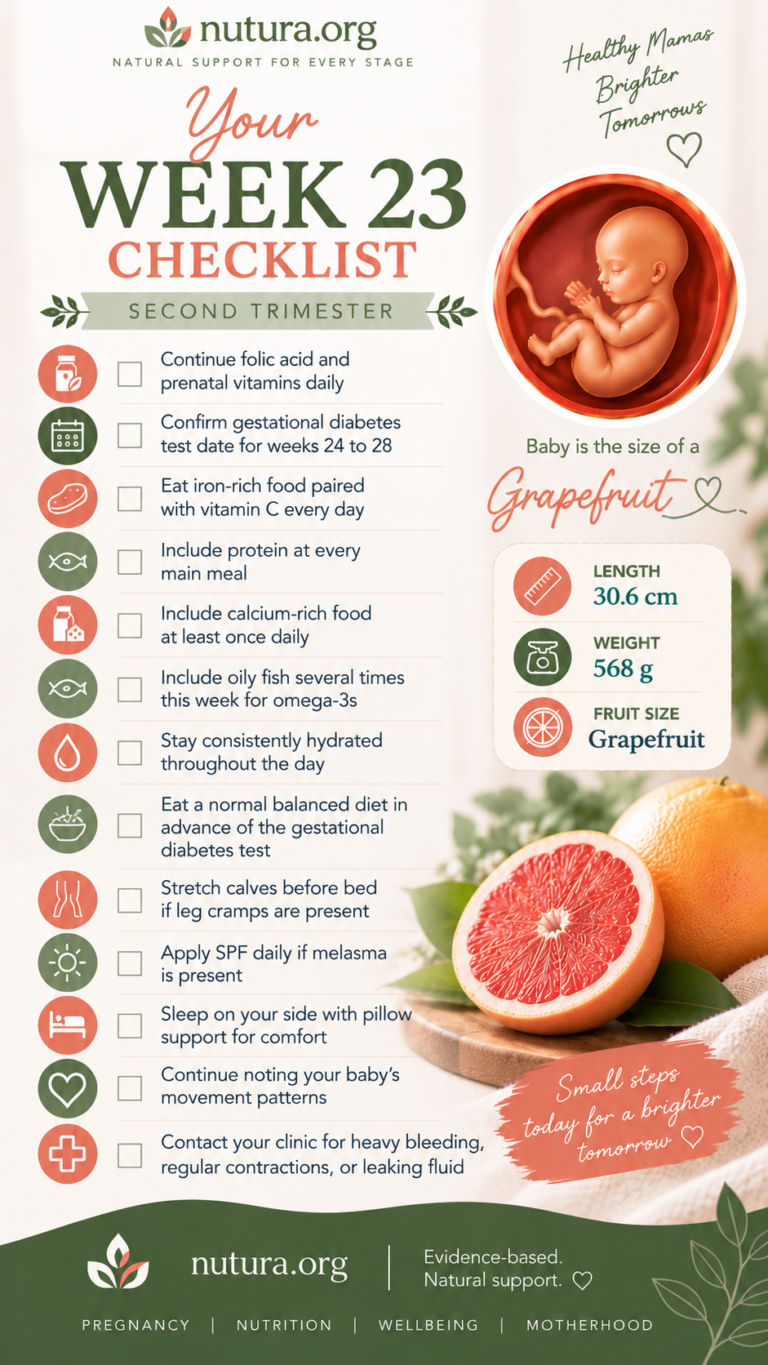
Next week is viability week, a specific threshold in the pregnancy that represents a meaningful shift in the medical response that would be available if anything unexpected occurred. The gestational diabetes test window opens at week 24. The movements will continue becoming stronger and more consistent. The third trimester is five weeks away.
References: NHS — You and your baby at 23 weeks pregnant. nhs.uk. American College of Obstetricians and Gynecologists — Second trimester prenatal care. acog.org. World Health Organisation — Antenatal care recommendations. who.int. Tommy’s — 23 weeks pregnant. tommys.org. Ministry of Health and Wellness Mauritius — Antenatal care guidelines.
Disclaimer: This article is for informational purposes only. Always consult your gynaecologist or midwife for guidance specific to your pregnancy. If you have concerns about symptoms, movement, contractions, or your antenatal care at any stage, contact your clinic.