
- Pregnancy Week by Weeks
- 10mins read
- No Comments
Take a breath.
You have been pregnant for three months. Twelve weeks of nausea and exhaustion and anxiety and a hundred small fears you could not say out loud to most of the people around you. Twelve weeks of keeping a secret that changed the entire texture of your daily life. Twelve weeks of first trimester and you are at the end of it.
Week 13 is the last week of the first trimester. Next week, officially, everything shifts into the second, the trimester that most women describe as the easiest, the one where the energy returns and the bump arrives and the fear that sat with you for the past three months begins, slowly, to loosen its grip.
You are not quite there yet. But you are very close. And before we talk about what is happening in your body and your baby’s this week, I want to acknowledge what it took to get here because the first trimester is genuinely hard, and reaching the end of it is genuinely worth marking.
Your baby at 13 weeks: from poppy seed to kiwi
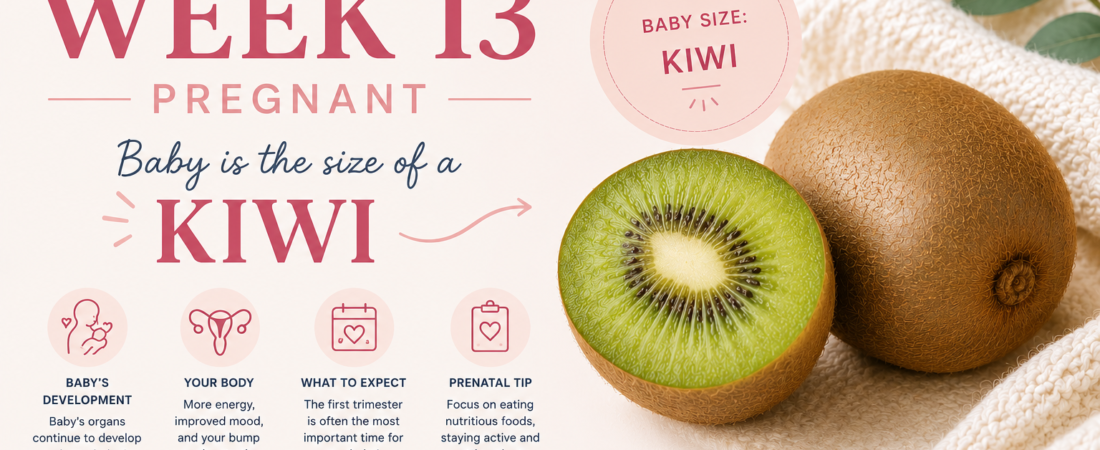
Nine weeks ago, at week four, your baby was the size of a poppy seed and existed as a cluster of cells implanting into the wall of your uterus. This week baby is approximately 7cm long, roughly the size of a kiwi and baby looks, unmistakably, like a baby.
Baby’s head is becoming more proportionate to their body, which has been catching up to the disproportionately large head of the early embryo. Baby’s facial features are forming, eyes have moved from the sides of the head toward the front, ears are approaching their final position, the nose is taking shape. Baby’s lips can open and close. Their vocal cords are developing, the structures that will eventually produce their first cry, their first laugh, the first time they say your name.
Baby’s skeleton is hardening. What was soft cartilage a few weeks ago is progressively becoming bone, a process that will continue throughout the pregnancy and into the early years of life. The organs, liver, kidneys, intestines are all present and increasingly functional. Baby’s intestines, which were briefly herniated into the umbilical cord while their abdomen was too small to contain them, have returned inside their body. Everything is where it is supposed to be.
And Baby is moving. Constantly, actively, with the particular freedom of a baby who has not yet run out of room. Kicking, stretching, opening and closing their tiny hands. You almost certainly cannot feel it yet, the nerve endings in your uterus are not sensitive enough to register movements this small, but the movement is there. Baby is busy in there. If you are lucky to capture this magical moment on an ultrasound, it’s heart mealting.
Your body at 13 weeks: the exhale
The most common experience at thirteen weeks is a shift. Not a dramatic overnight transformation, though for some women it does arrive that suddenly, but a gradual sense that the worst of the first trimester is behind you.
The nausea that has been your constant companion since week six or seven may be beginning to ease. Not necessarily gone as some women carry morning sickness well into the second trimester, and if that is you, please know it is within the range of normal and not a sign that something is wrong, but softening. The relentlessness of it giving way slightly. The foods that were completely intolerable beginning to seem possible again.
The fatigue that bone-deep, can’t-keep-your-eyes-open-at-3pm exhaustion that has nothing in common with ordinary tiredness, may also be beginning to lift. Progesterone levels are still elevated, but your body is adapting to them. Many women describe week thirteen and fourteen as the first weeks they felt like themselves again, or at least recognisably in the direction of themselves.
Your uterus has grown enough that it is now sitting just above your pubic bone rather than entirely within the pelvis. You may notice a slight roundness in your lower abdomen, the very beginning of what will become your bump. First-time mothers typically show later than women who have been pregnant before, and every body carries differently, so if you are not yet visibly pregnant to anyone other than yourself, this is entirely normal.
Breast changes continue, fullness, sensitivity, darkening of the areola as your body prepares for the possibility of breastfeeding. Vaginal discharge often increases during pregnancy; clear or white, mild-smelling discharge without itching or pain is normal. Headaches are common at this stage, driven by the increased blood volume and hormonal changes, hydration, regular meals, and rest are the most reliable remedies for most pregnancy headaches.
The emotional reality of week 13
Here is the part that the clinical pregnancy guides do not say clearly enough: reaching thirteen weeks does not make the fear disappear.
For many women, the first trimester has been a sustained exercise in holding two things at once, the love for this pregnancy and the awareness that pregnancies end. The statistics that most miscarriages occur in the first trimester are genuinely reassuring, and by week thirteen the risk has fallen significantly. But risk falling significantly is not the same as risk disappearing, and the anxiety that has been your companion for three months does not simply stop at the end of week twelve.
What many women find is that the anxiety changes shape rather than ending. The fear of miscarriage gradually gives way to other fears like the anatomy scan, the gestational diabetes test, the question of whether the baby is moving enough in the third trimester. The specific anxiety shifts. The underlying love that makes the anxiety possible stays. That is not a problem to solve. That is what it means to be a parent.
What week thirteen does offer is permission. Permission to begin believing in this pregnancy a little more fully. Permission to tell the people you have been keeping this from. Permission to look at baby items without feeling that you are tempting fate. Permission to say out loud, when someone asks how you are: I am pregnant. I am thirteen weeks. We are almost at the second trimester.
If you have not yet shared your news and you are ready to, this is the week many Mauritius families choose to announce. There is no obligation to announce at any particular week, the decision is entirely yours, and a private pregnancy is a valid one but if you have been waiting for the end of the first trimester to feel ready, you are there.
What to do this week in Mauritius
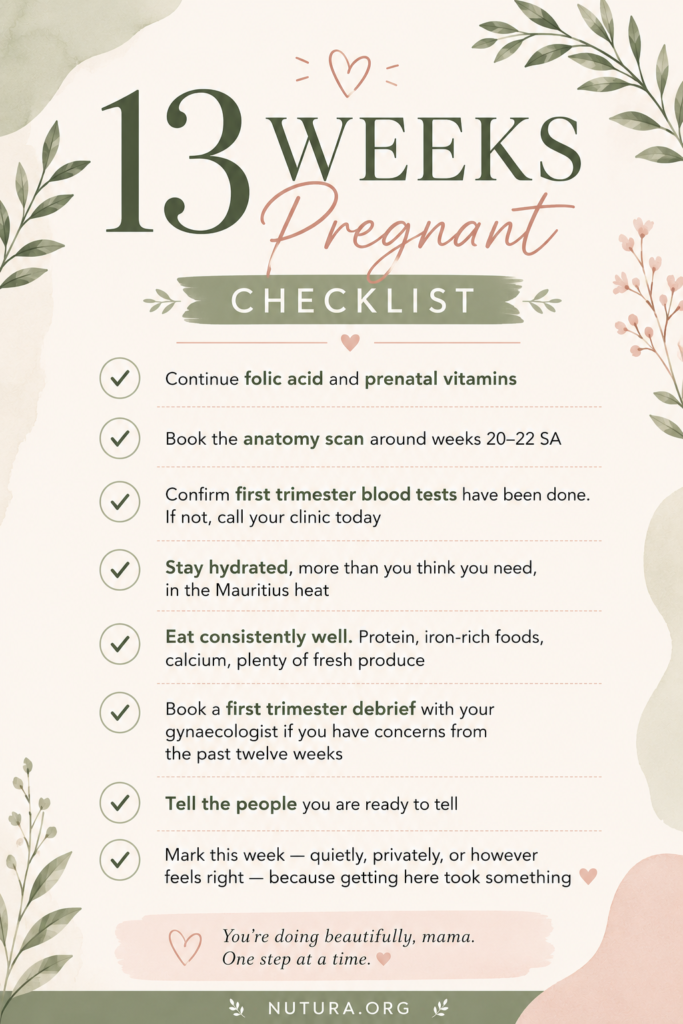
Continue your folic acid. The recommendation is to take it through at least the end of the first trimester, and many healthcare providers suggest continuing throughout pregnancy.
Book your anatomy scan if you have not already. The anatomy scan, the morphology ultrasound, is performed between weeks 20 and 22 SA in Mauritius. This is one of the most important appointments of your pregnancy and popular private imaging centres can have waiting times of several weeks. Book it now rather than waiting until week eighteen.
If you have not had your first trimester blood panel, speak to your gynaecologist. The nuchal translucency scan and associated blood tests for Down syndrome screening are ideally performed between weeks 11 and 13. If you are at week 13 and have not yet had these, call your clinic today, the window is closing.
Think about maternity clothes. Not urgently, and not expensively but practically. Your regular waistbands are likely already uncomfortable, and breathable, loose clothing matters more in Mauritius heat than in most pregnancies. A few well-chosen pieces are worth having before the second trimester bump arrives in earnest.
Consider your birth research. The second trimester is the time to research your birth options in Mauritius: hospitals, clinics, obstetricians, the question of public versus private, whether you want a doula.
Your week 13 checklist
Looking ahead: what the second trimester brings
Next week is week 14, the official beginning of the second trimester. For most women, this is the trimester they will look back on most fondly, a period when the worst of the nausea has passed, the bump is visible enough to feel real, and the movement that begins between weeks 16 and 22 makes the pregnancy tangible in a completely new way.
The 20-week anatomy scan, the most detailed ultrasound of your pregnancy, is approaching. This is the scan where you see your baby most clearly, where the major structural checks are performed, and where many families choose to find out the sex if they want to know.
The second trimester in Mauritius also brings the gestational diabetes test (the HGPO) which is performed between weeks 24 and 28. Given Mauritius’s high rates of type 2 diabetes, this test matters more here than in most countries, and being prepared for it is worth starting to think about now.
References: NHS — You and your baby at 13 weeks. nhs.uk. American College of Obstetricians and Gynecologists — First trimester guidance. acog.org. World Health Organisation — Antenatal care recommendations. who.int. Tommy’s — Pregnancy week by week. tommys.org.
Disclaimer: This article is for informational purposes only. Always follow the guidance of your gynaecologist or midwife for decisions specific to your pregnancy. If you have any concerns about symptoms, bleeding, or pain at any stage, contact your clinic.