
- Pregnancy Week by Weeks
- 7mins read
- No Comments
You are staring at the test.
Maybe you have stared at it for five minutes, picked it up and put it down three times, held it under the light to check that you are reading it correctly. Maybe you took a second one just to be sure. Maybe you are sitting on the bathroom floor.
Those two lines are real. You are pregnant.
At four weeks, most women feel a strange combination of things simultaneously, excitement and disbelief and a low-grade fear and an overwhelming desire to tell someone and an equally strong instinct to tell no one yet. There is no right version of this moment. Whatever you are feeling is valid.
Here is what is happening inside your body while you are having all of those feelings.
Your baby at 4 weeks: smaller than you can imagine
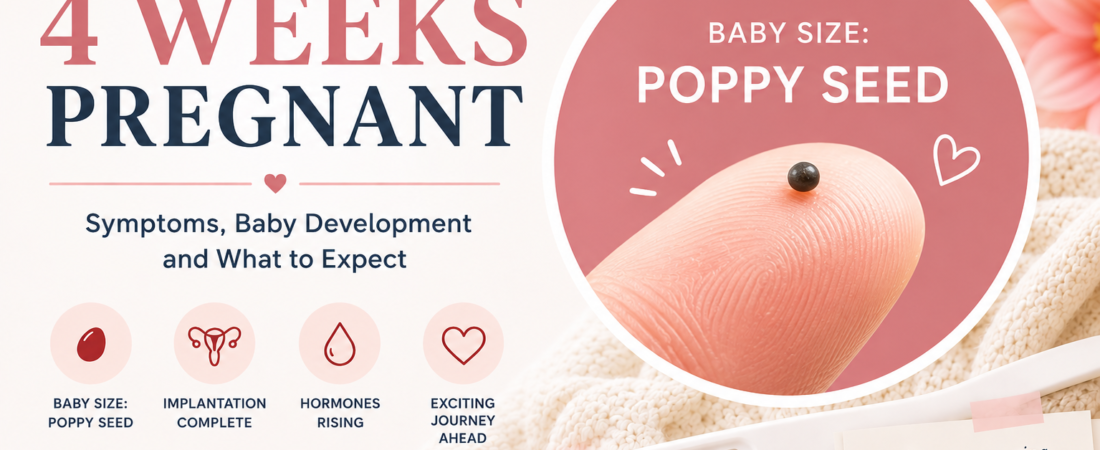
Your baby, technically called an embryo at this stage, is approximately the size of a poppy seed. A single poppy seed. Invisible to the naked eye, nestled into the lining of your uterus, and already doing something extraordinary.
The fertilised egg has completed its journey from the fallopian tube and implanted into the uterine wall. That implantation triggered the production of hCG (human chorionic gonadotropin) the hormone that turned your pregnancy test positive. Right now, your hCG levels are doubling approximately every 48 hours as your body builds the infrastructure your baby will need for the next 36 weeks.
The placenta is beginning to form. The amniotic sac is beginning to develop. Your body is building the entire support system before you have told a single person this is happening.
What you might be feeling
The most honest thing to say about week 4 symptoms is that they vary enormously. Some women feel intensely pregnant (exhausted, nauseated, breasts achingly tender) before they have even missed their period. Others feel completely normal and wonder whether the test can possibly be right.
Both experiences are completely valid. The absence of symptoms at 4 weeks does not mean something is wrong. It means your hormone levels are building and your body has not yet registered that build as physical sensation.
Fatigue is often the first thing women notice, like a heaviness that arrives from nowhere and sits on you in a way that ordinary tiredness does not. Progesterone is responsible, and it will likely intensify before it eases.
Breast tenderness: a fullness, a sensitivity, sometimes a soreness that makes your usual bra feel wrong, is driven by the same hormonal surge. Your breast tissue is beginning to respond to the pregnancy even this early.
Mild cramping or a pulling sensation: low in the abdomen is common and usually nothing to worry about. It is your uterus adjusting to implantation and the very earliest changes of pregnancy. The cramping that warrants medical attention is severe, one-sided pain, or pain accompanied by heavy bleeding.
Light spotting: a few drops of pink or brown discharge, may be implantation bleeding, occurring when the embryo embeds into the uterine lining. It is lighter than a period, lasts only a day or two, and does not progress to a flow. Many women do not experience it at all. If you saw something that looked like the very beginning of a light period and then it stopped, that may well have been it.
Frequent urination, mood shifts, bloating, and a heightened sense of smell may all begin this week. Or none of them may. Week 4 is genuinely variable, and your experience of it does not predict anything about the pregnancy that follows.
What to do this week: the four things that matter
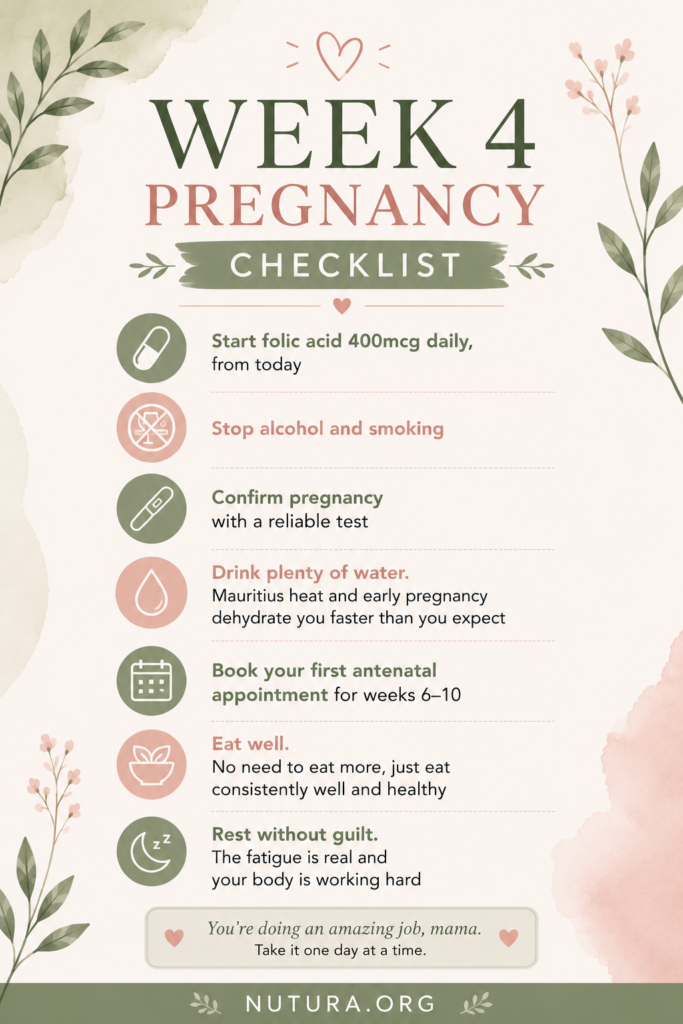
Start folic acid today if you have not already. 400 micrograms daily, available without prescription at any Mauritius pharmacy. If you have not been taking it, start now; the neural tube, which becomes your baby’s brain and spine, closes around day 28, and folic acid’s protective effect works best when it is already present in your system. Take it every day from now until at least the end of the first trimester.
Stop alcohol, cigarettes and other drugs completely. There is no established safe level during pregnancy, and the earliest weeks are when the most critical development is happening. If stopping feels difficult, speak to your doctor without judgment, support exists.
Do not rush to the clinic. Unless you have significant pain or heavy bleeding, your first antenatal appointment in Mauritius is typically scheduled between weeks 6 and 10. There is nothing to see on a scan this early, the embryo is too small, and most clinics will simply confirm the pregnancy and book you for the first proper appointment. You do not need to go today.
Confirm with a reliable test if you have not already. If you used a cheap strip test, take a second one with first morning urine for the most concentrated hCG reading. Digital tests that display “Pregnant” rather than a line remove the uncertainty about what you are seeing.
The emotional reality of week 4: the part nobody puts in the leaflet
Week 4 is the week of being pregnant and not being pregnant at the same time. Of knowing something enormous and not being able to say it out loud. Of the joy that wants to be bigger than the fear will let it.
Many women spend this week retesting daily to confirm the result is still positive. Many spend it oscillating between elation and dread. Many spend it Googling symptoms at midnight and finding articles that worry them.
You are allowed to find this overwhelming. A positive pregnancy test at four weeks is simultaneously one of the clearest moments of your life and one of the most uncertain. You have just learned something that changes everything and you will not fully understand what it changes for another eight months.
One thing at a time. Folic acid today. Booking the appointment. Telling one person if you want to, or telling no one if you are not ready. The rest will come.
What to watch for & when to contact your gynaecologist
Most of what happens at four weeks requires nothing more than the four steps above. Contact your clinic or gynaecologist promptly if you experience heavy bleeding that resembles or exceeds a normal period, severe one-sided pelvic or abdominal pain, dizziness or feeling faint, or any combination of pain and bleeding that feels wrong to you. Your instinct in early pregnancy is a valid clinical signal.
Your week 4 checklist
Looking ahead: what happens next
Next week, your baby’s heart begins beating. The neural tube that will become the brain and spinal cord begins forming. The embryo is still tiny (the size of an apple seed) but the pace of development is extraordinary.
Week 5 is also when morning sickness tends to make its first appearance for many women. If nausea arrives, it arrived on schedule. In Mauritius heat, it will likely arrive with intensity.
References: World Health Organisation — Antenatal care recommendations. who.int. NHS — You and your baby at 4 weeks pregnant. nhs.uk. American College of Obstetricians and Gynecologists — Early pregnancy. acog.org. Ministry of Health and Wellness Mauritius — Maternal health guidelines.
Disclaimer: This article is for informational purposes only. Always consult your gynaecologist or midwife for guidance specific to your pregnancy. If you have concerns about pain, bleeding, or symptoms at any stage, contact your clinic or go to your nearest Emergency.