
- Sleep Regression
- 10mins read
- No Comments
Baby just turned one.
There is a particular weight to that milestone, the candle, the cake baby mostly threw on the floor, the photographs, the slightly disbelieving feeling that an entire year has passed since the night you met this tiny human being. And underneath the celebration, if you are honest, there was probably also a quiet expectation. Surely now. Surely by one year old, sleep is supposed to be sorted.
And then, somewhere around baby’s birthday, sometimes a little before, sometimes a few weeks after, it falls apart again.
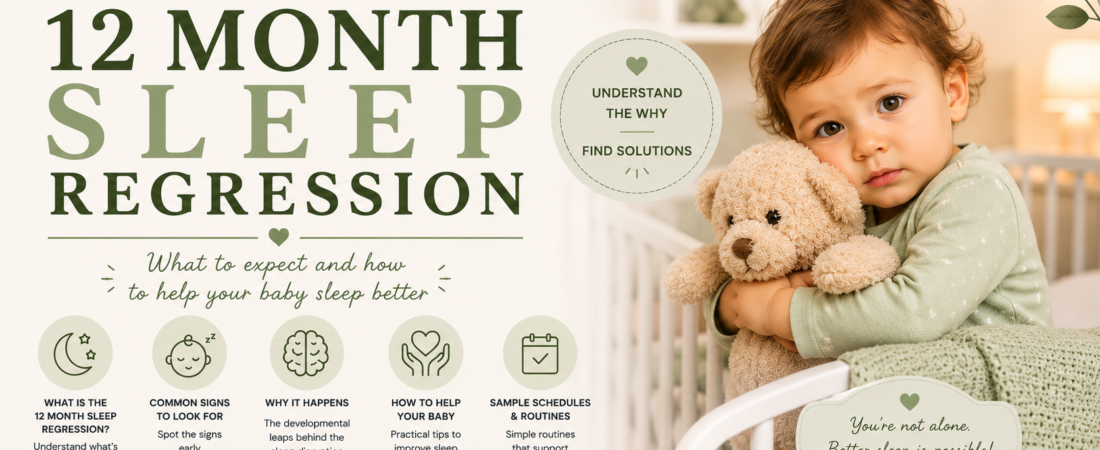
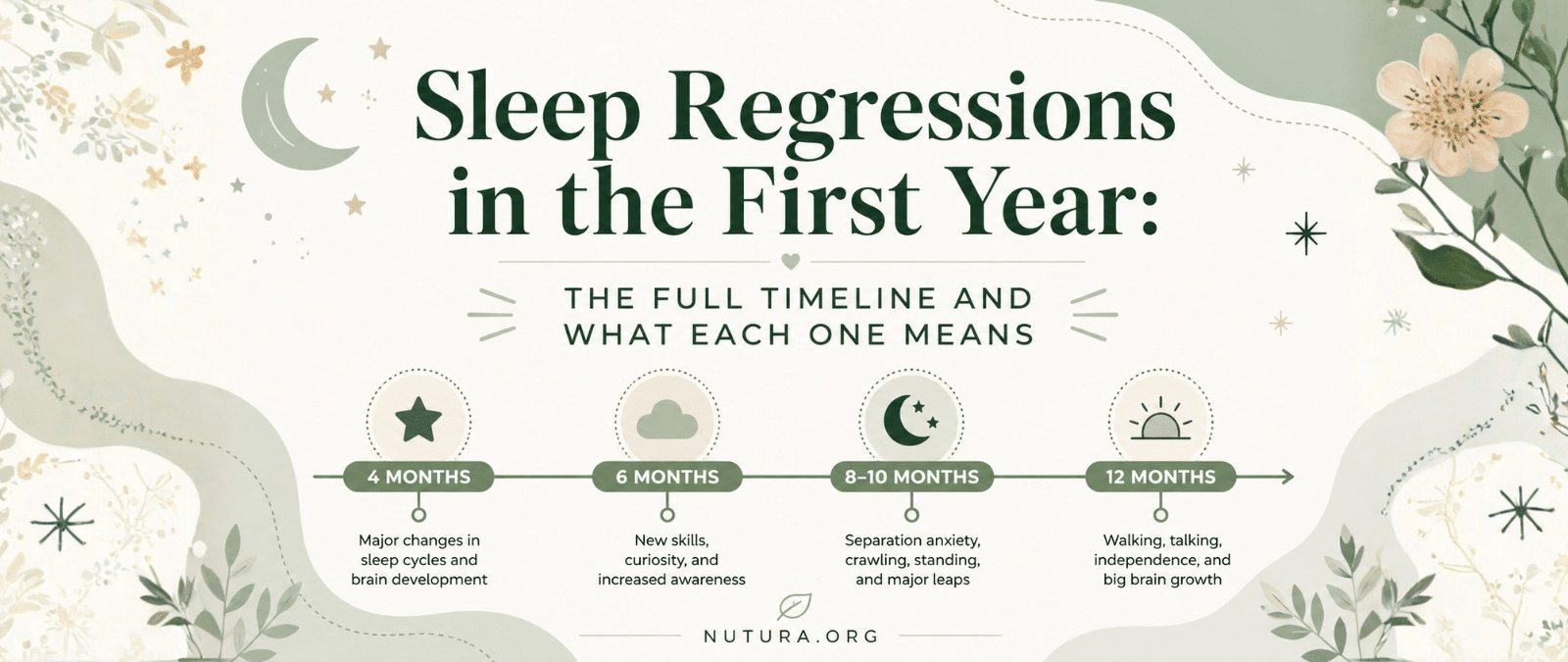
Baby is fighting bedtime in a way they had stopped doing months ago. Baby is waking at night, calling for you, standing in their crib rattling the rails. The nap that used to be reliable is suddenly a battle, or is waking at 5am with the kind of relentless cheerfulness that makes you want to weep. You thought you had made it through. You thought the worst of the regressions, the 4-month one, the 8-month one, were behind you, and that by baby’s first birthday you would finally be on the other side of the hardest sleep stretch of their life.
I want to tell you why this is happening, because the 12-month regression has a specific and slightly different shape from the ones that came before it, and understanding that shape changes how you respond to it, particularly around the question that trips up more parents at this stage than any other: the nap.
Why this regression arrives right when you thought you were done
The 12-month regression is not caused by one single thing. It is caused by the collision of several major developmental changes happening at almost exactly the same time, which is part of why it can feel more chaotic than the regressions before it.
Around 12 months, many babies experience major cognitive growth, first words, increased independence, and the physical milestone of walking, all arriving in the same narrow window. Each of these on its own would be enough to disturb sleep for a week or two. Together, they create a more sustained disruption, and your baby’s brain working overtime on several fronts simultaneously, and sleep, as always, caught in the middle of that activity.
Walking is probably the most visible driver. Whether baby is already taking independent steps or is in the intense cruising-and-pulling-up phase that precedes it, the physical practice of this skill does not stop when the lights go off. It is not unusual for babies to practise standing or walking in their crib instead of sleeping, your baby pulling themselves upright at 2am, holding the rail, working through the same motor sequence they have been rehearsing all day, simply because their brain has not finished consolidating it yet.
Language is happening in parallel. Around one year old, babies often experience what is sometimes called a language explosion, a rapid expansion in both the words they understand and the sounds they are beginning to attempt. The brain remains active even during sleep, processing and consolidating everything absorbed during the day, and a brain this busy does not always switch off easily at bedtime.
Separation anxiety, which began building around 8 months, is often still present and sometimes intensifies again around the first birthday as your baby’s understanding of relationships and their own independence continues to deepen. Baby knows you exist when you are not in the room. Baby has increasingly strong feelings about that fact. Bedtime, which is the most prolonged daily separation they experience, becomes the place where those feelings show up most clearly.
And then there is the question that causes more confusion at this stage than any of the others: the nap transition.
The nap mistake that makes the regression worse
This is the part of the 12-month regression that I want to spend real time on, because getting it wrong is the single most common way parents accidentally extend a difficult sleep period that would otherwise resolve in a few weeks.
Many parents assume their baby is ready to drop from two naps to one around their first birthday and the resistance to one of the two naps that often appears during this regression reinforces that assumption. Your baby fights the morning nap for three days in a row, and the conclusion feels obvious: baby is ready for one nap.
In most cases, baby is not. Many babies still need two naps until approximately 14 to 18 months. The nap resistance that appears during the 12-month regression is much more often a symptom of the regression itself, the same overstimulation and developmental busyness disrupting nap settling the way it disrupts night settling than it is a genuine readiness signal for fewer naps.
Dropping a nap too early creates a particular kind of trouble: a baby who is now accumulating more daily wakefulness than their nervous system can comfortably manage, which leads to overtiredness, which leads to worse sleep at night, not better. The cycle becomes self-reinforcing, overtired baby sleeps worse, parent assumes the schedule still is not right, more changes are made, and the underlying regression gets buried under a schedule problem that did not need to exist.
The guidance that holds up against this temptation: watch for a consistent pattern of nap resistance over several weeks, not several days, before making the move to one nap. A few difficult naps during an active regression is not a transition signal. It is the regression. Keep offering two naps. Protect the timing of both. Let the regression pass before you draw conclusions about the schedule.
How long it actually lasts
Most regressions last 2 to 6 weeks. Some babies move through it more quickly, particularly if only one developmental factor, say, walking alone, without significant language or separation components, is driving the disruption. Others, especially when several factors are converging at once, take longer.
What extends the duration in many cases is exactly the nap-dropping mistake above, compounded by inconsistent responses at night as exhausted parents try a new strategy every few days hoping something will work faster. The regression itself is finite. What is not finite, if it is allowed to continue, is the overtiredness and inconsistency that can grow up around it.
What actually helps
Keep the bedtime routine completely consistent. This advice repeats across every regression in the first year for a reason, it is the single most reliable lever available to you, and it matters more, not less, during a period when everything else feels chaotic. The bath, the story, the cuddle, the same sequence every single night, regardless of how the previous night went.
Do not rush to drop the nap. This is worth saying twice given how common the mistake is. Hold the two-nap schedule through the regression. Reassess only once you see several consistent weeks of genuine, settled resistance to one of the naps, not the scattered, regression-driven resistance of this particular stretch.
Give baby extensive practice time during the day for whatever skill is most active. If walking is the dominant driver, maximise baby’s supervised floor and furniture-cruising time during waking hours. If language is the dominant driver, narrate, read, and respond to their attempts at words generously throughout the day. A skill that gets thorough daytime practice is less likely to demand midnight rehearsal.
Respond to the separation anxiety with reassurance rather than withdrawal. Comfort does not create bad habits at this stage any more than it did at 8 months. Your baby is navigating a major developmental phase, and the security of a parent who responds consistently is part of what allows that phase to resolve into confidence rather than prolonged anxiety.
Watch for teething as a contributing factor without assuming it explains everything. Many babies are cutting molars around this time (drooling, gum swelling, and general irritability are the signs to watch for) and teething discomfort absolutely can compound a developmental regression. But the developmental changes are usually the larger driver, and treating every disrupted night as purely dental delays addressing what is actually going on.
RELATED READ:
A realistic shape for the day, once the regression settles
Once your baby moves through the acute phase of this regression, many 12-month-olds settle into a rhythm something like: wake around seven, a morning nap mid-morning, an afternoon nap in the early afternoon, and bedtime in the early evening. The exact timings vary considerably between babies, and this is offered as orientation rather than a target to enforce. Schedules vary between babies, and what matters more than matching a specific timetable is protecting adequate total sleep and avoiding the overtiredness that comes from too little of it.
When to ask for help beyond the regression
Most 12-month sleep disruption resolves within the timeframe described above with consistency and patience. It is worth speaking to your paediatrician if sleep problems persist for months rather than weeks, if you notice loud snoring or any pauses in breathing during sleep, if there are feeding or growth concerns alongside the sleep changes, or if you have any broader concerns about her development that the sleep disruption seems connected to. These are not common scenarios, but they are worth ruling out if the picture in front of you does not resolve the way a typical regression would.
The thing worth remembering on the hard nights
The same week your baby is standing in their crib at 2am refusing to lie down, baby is also taking the steps that will carry them across the room to you for the first time. The same restlessness that is disrupting their nap is the byproduct of a brain that just unlocked language, the words that will, within months, let them tell you they love you, ask for what they need, narrate their own small world out loud.
This regression, like the ones before it, is evidence of an extraordinary year of development arriving all at once, slightly inconveniently, at exactly the moment you hoped for a rest. It is not a sign that something has gone wrong. It is the sound of your one-year-old becoming, very quickly now, a toddler.
Hold the routine. Hold the two naps. Give it a few weeks.
Baby will get there. So will you.
OTHER ARTICLES ON SLEEP DEVELOPMENT:


References: Sleep Foundation — 12-Month Infant Sleep Regression (updated July 2025). sleepfoundation.org. Huckleberry — Navigate sleep regressions like a pro (updated March 2026). huckleberrycare.com. Medical News Today — Sleep regression stages. medicalnewstoday.com. Pennestri M.H. et al. (2018) — Uninterrupted infant sleep, development, and maternal mood. Pediatrics, 142(6).
Disclaimer: This article is for informational purposes only. If sleep problems persist for months, or if you notice snoring, breathing pauses during sleep, or have concerns about feeding, growth, or development, contact your paediatrician.