
Description
Around six months, you will reach for something to eat, look at your baby watching you with complete and undisguised longing, and think: I think it is time.
And then the questions begin.
Where do you start? Which foods first? How do you know if they are ready? What about allergens? What about gagging? What about the fact that your mother introduced rice porridge at four months and cannot understand why you are waiting?
Starting solids is one of the most exciting milestones of the first year and one of the most anxiety-producing, precisely because the guidance has changed significantly from the generation before us, and because nobody quite prepares you for the practicalities of feeding a person who has never eaten before.
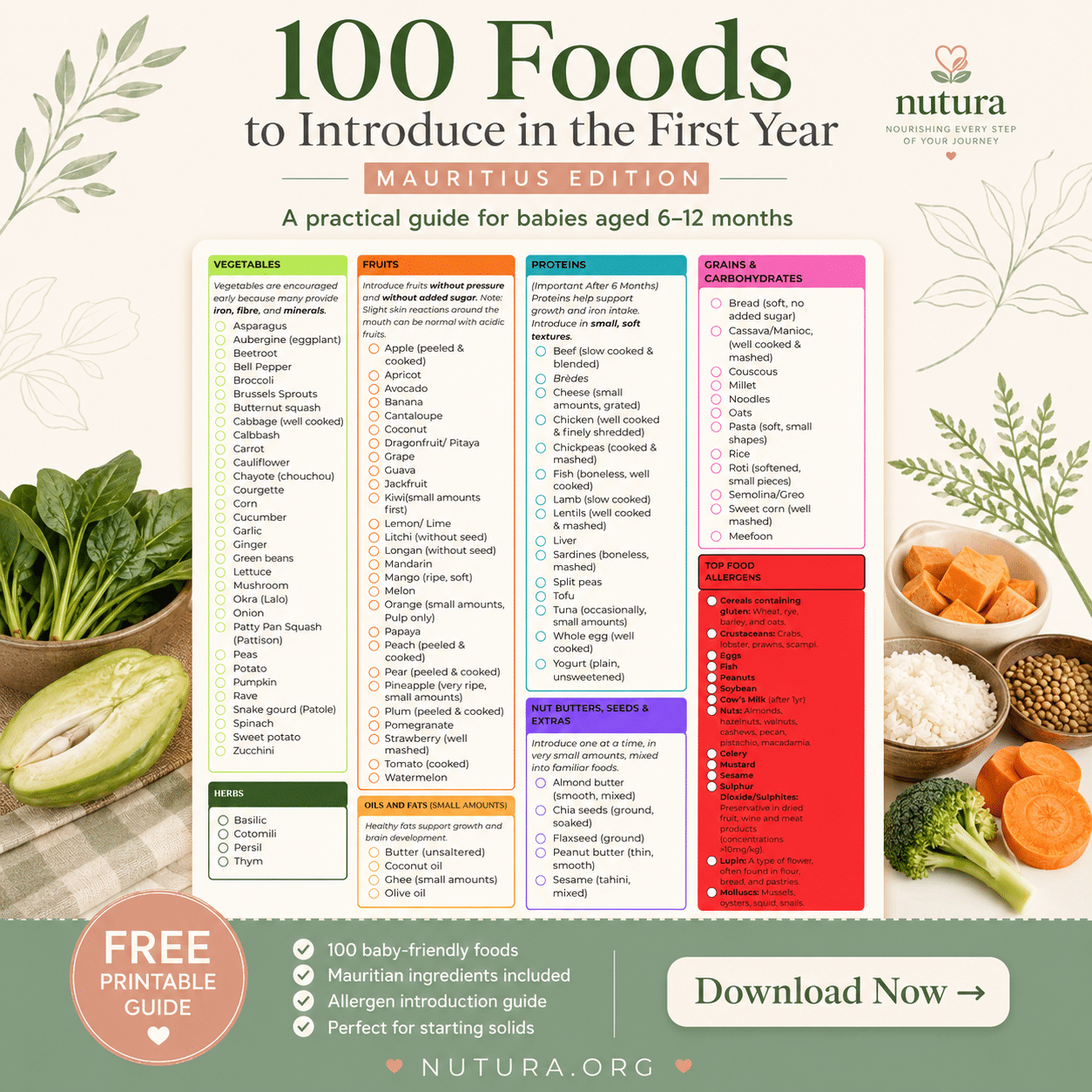
This tracker is the starting point. Not a programme with rigid rules, not a competition with a finish line, but a clear, flexible menu of 100 foods your baby can explore between six and twelve months — organised by food group, printed on one page, and designed to sit on your fridge, your kitchen counter, or your phone, quietly recording the adventure as it unfolds.
What is inside the tracker
The 100 foods list is organised across every food group your baby needs in the first year, with Mauritius-familiar ingredients woven throughout, the vegetables your family already cooks, the fruits from your market, the proteins from your kitchen table. Chouchou and calabash alongside broccoli and courgette. Papaye and litchi alongside apple and pear. Dhal and greo and roti alongside oats and pasta. This is not a generic Western weaning list with nothing recognisable in it. It is built for the kitchen you actually cook in.
The vegetables section covers iron-rich, fibre-rich and mineral-dense options that early solids guidance consistently recommends introducing early. The fruit section includes important notes on acidic fruits and how to introduce them without alarm at normal skin reactions. The proteins section — important from six months as iron from breastmilk alone becomes insufficient around this age — covers everything from well-cooked fish and slow-cooked chicken to lentils, egg yolk, liver, and sardines. The grains section includes roti and meefoon and semolina alongside the standard oats and rice. Herbs, oils, nut butters, and seeds have their own sections. The allergen section lists all fourteen major allergens clearly, flagging the current guidance that early introduction — not avoidance — is what the evidence supports.
The Before You Begin page explains the five things that actually matter when you start solids: the readiness signs that mean more than any calendar date, the one-new-food-every-two-to-three-days approach that lets you spot any reaction, the iron-rich-foods-first principle that most families are not told about, the no-salt-no-honey-no-added-sugar rule until twelve months, and the single most important piece of safety information for any parent starting solids — the difference between gagging, which is normal and protective, and choking, which is silent and requires immediate action.
What this tracker is — and what it is not
This is a menu. You do not need to reach 100 foods. You do not need to introduce one food every day. You do not need to complete every category by any particular date.
Most babies need to try a new food between eight and fifteen times before accepting it. That is not rejection. That is development. The tracker gives you somewhere to record what you have tried and when — not to create pressure, but to help you see the breadth of what you are exploring over time, and to remember the date when your baby first made that face at avocado.
Repeating foods is how babies learn to like them. Moving slowly is how you spot any reaction. There is no race here.
What the tracker does not cover — and where to find it
The tracker tells you what to introduce. It does not tell you how — the textures, the consistency at each stage, the difference between purée and baby-led weaning and a combined approach, how to progress from smooth to mashed to lumpy to soft chunks, how to structure a day’s meals at six months versus nine months versus twelve months, or how to introduce each allergen specifically and safely.
That is what the complete Introducing Solid Foods Guide covers — and it picks up exactly where this tracker ends.
How to use it
Download and save to your phone — you will want it in your pocket when you are at the market or standing in the kitchen wondering what to try this week.
Print on standard A4 paper at home or at any print shop in Mauritius. The checklist page prints clearly in black and white, though it is designed for colour.
Stick it on the fridge. Tick as you go. Note the date in the tracker column when you try something new, so you can track reactions over the two-to-three-day window.
Share it with your partner, your childminder, or anyone else feeding your baby — so everyone is working from the same list.



Avis
Il n’y a pas encore d’avis.