- Baby Feeding
- 10mins read
- Aucun commentaire
Here’s what nobody warns you about starting solids.
It’s not the gagging. It’s not the mess. It’s not even the googling at midnight to find out if babies can eat mango.
It’s the moment you run out of ideas.
You’ve done sweet potato. Banana was a hit. Dhal went down well, which, honestly, you could have predicted given how much your baby has been smelling it from the other room since they were born. Papaya is a favourite. You feel like you’re getting somewhere.
And then you stand in the kitchen on a Tuesday morning, staring into the fridge, and your mind goes completely blank.
Brèdes? Couscous? Jackfruit? Eggs… wait, when do eggs come in? What about fish? Is roti okay?
If you’ve been there, this is for you.
What this list actually is
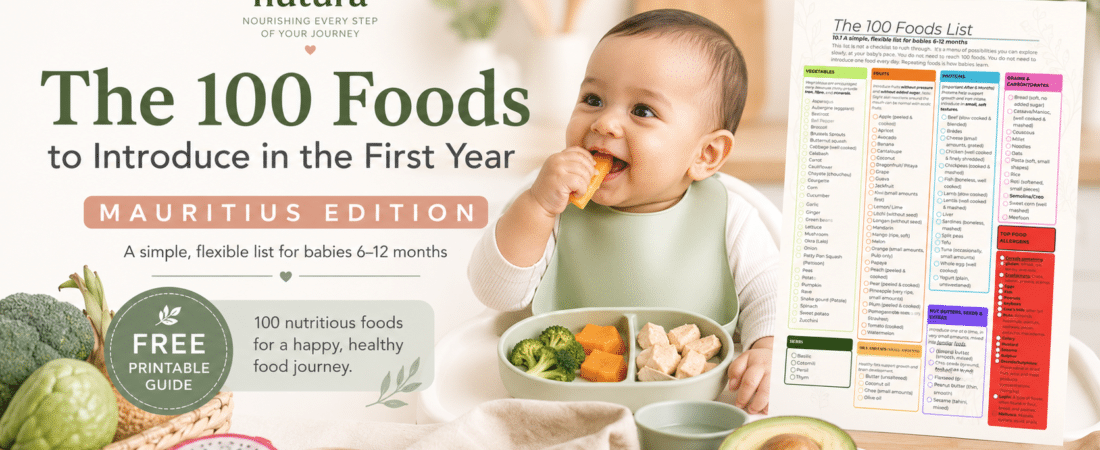
La Nutura 100 Foods List, Mauritius Edition is a free printable that does one thing: gives you ideas when your brain won’t.
It is not a race.
It is not a milestone to hit before your baby turns one.
It is not a structured programme where you need to tick off a food every two days in a specific order.
It’s a menu. A flexible, low-pressure menu of possibilities you can move through at whatever pace makes sense for you and your baby.
Some babies try something new every few days and seem genuinely delighted by it. Others find a few foods they love and want nothing else for three weeks at a stretch. Both of those babies are completely on track. Both of those approaches are completely fine.
The goal of the first year of eating isn’t to reach a number. It’s to help your baby build a relationship with food that doesn’t feel like a battle. A hundred exposures to different flavours and textures, on their timeline, with their personality, at your kitchen table, is what that looks like in practice.
Why variety matters (and why it doesn’t have to be stressful)
There’s good reason to offer a wide range of foods in the first year. Different colours and textures. Different nutrients. Different flavour profiles. Building familiarity with foods that will eventually become part of your family’s regular meals.
But “variety” doesn’t mean something new every single day. And it doesn’t mean a baby who throws broccoli on the floor five days running has rejected it forever.
Repeated exposure is one of the most underused tools in starting solids. Research suggests it can take anywhere from 8 to 15 tries before a baby accepts a new food. Not 8 to 15 days. 8 to 15 encounters, seeing it, touching it, maybe tasting it, spitting it out, trying it again.
That means the broccoli on the floor is not a failure. It’s attempt three of twelve. Keep going.
This list was built for a Mauritian kitchen
Most starting solids resources are written for a British or American kitchen. Which means they’re full of butternut squash (seasonal in Europe), blueberries (expensive here), and suggestions to introduce “salmon” as if fresh, affordable salmon is a Tuesday morning option.
The Nutura 100 Foods List looks different, because your kitchen looks different.
You’ll find brèdes and chouchou alongside carrot and broccoli. Patole and lalo next to sweet potato (our local batate) and courgette. Roti and manioc alongside rice and pasta. Jackfruit, litchi, longan, pittaya, and guava sitting next to apple and pear. Fresh fish from the market next to chicken and lentils.
The foods your family already eats. The foods available at your local bazaar on any given day. The foods your baby has already been smelling from across the room for six months.
Those are your starting solids.
There’s no perfect first food. Here’s how to actually choose.
Parents ask me this constantly: What should I start with?
The honest answer is that there isn’t a universal right answer, but there is a nutritional priority worth knowing.
Around 6 months, breast milk iron levels start to become insufficient on their own. Your baby’s iron stores from birth are beginning to deplete. This means that whatever you start with, iron-rich foods deserve early and regular attention.
That’s dhal. Lentils. Red kidney beans. Egg yolk. Meat. Liver, if your family eats it. Fortified cereals. These are not exotic, they’re already in most Mauritian kitchens.
Pair any iron-rich food with vitamin C (a little guava, citrus, tomato, papaya) and absorption increases significantly.
Beyond iron, the order is genuinely flexible. Start with vegetables or fruit or grains, whatever feels manageable. One instruction from my pediatrician was to start with “white vegetables” like chouchou, cauliflower, then during the second week, proceed with “orange-coloured veggies” like giromon or patisson. On the third week, introduce “green-coloured veggies” like brocoli, peas… and lastly during the 4th week, introduce the fruits. The list has everything grouped by category so you can move through it at your own pace rather than feeling like you need a plan.
What’s inside the free printable
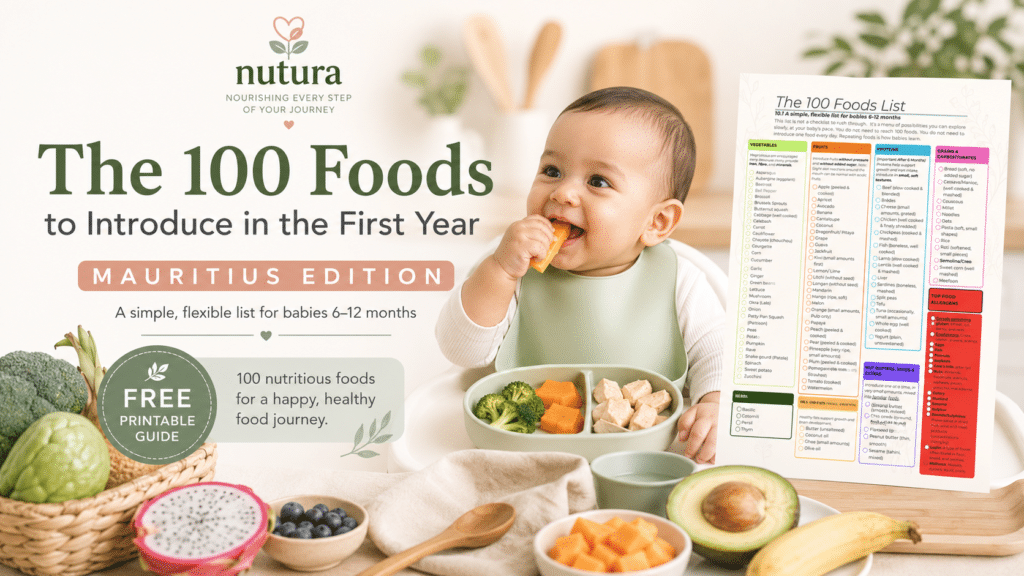
The 100 Foods List is a printable PDF, designed to live on your fridge, not in your downloads folder.
Inside you’ll find foods grouped into:
- Vegetables: including the ones actually available in Mauritius
- Fruits: local and seasonal where possible
- Proteins: meat, fish, legumes, eggs, dairy
- Grains and carbohydrates: rice, roti, couscous, cassava, pasta, bread
- Healthy oils and fats: coconut oil, ghee, olive oil, butter
- Herbs: basil, coriander, thyme, parsley
- Nut butters and seeds: with notes on introducing them safely
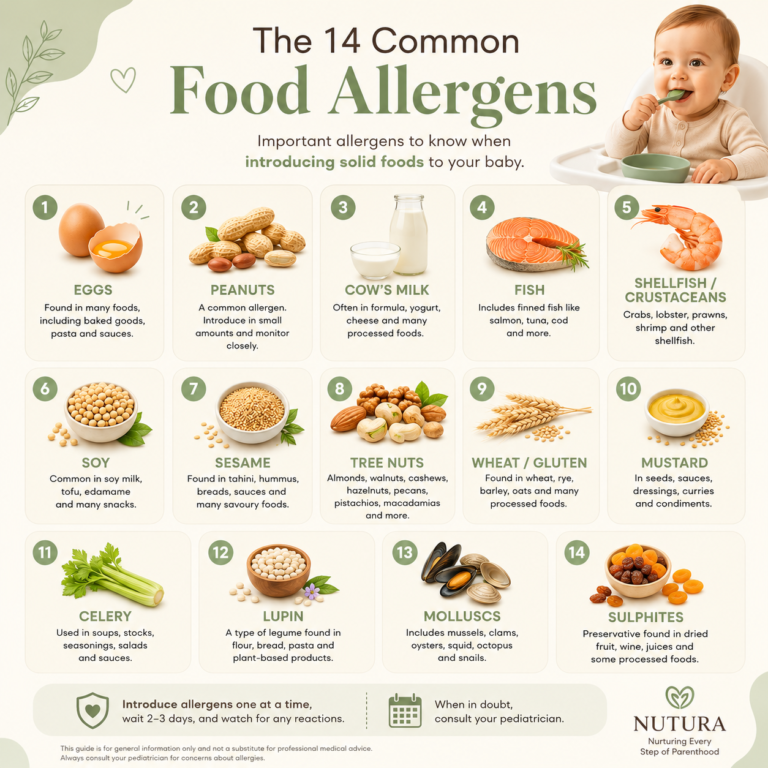
- Une food allergen section: a reminder of the 14 allergens and why early introduction matters
Tick the foods as you go if that feels helpful. Or don’t. Use it as a prompt when you open the fridge and your mind goes blank, which it will, eventually, for everyone.
A note on the allergen section
La 8 major food allergens, gluten-containing cereals, eggs, fish, crustaceans, peanuts, tree nuts, soy, dairy, sesame, and molluscs, each have a row in the printable with space to record the date you introduced them and any reaction you noticed.
Current guidance actually recommends introducing allergens early, from around 6 months, rather than waiting. The old advice to delay allergens has been largely reversed by the evidence.
That doesn’t mean throwing peanut butter at your baby on day one. It means introducing them one at a time, in small amounts, mixed into foods your baby already accepts, watching for 24–48 hours between each new allergen. The allergen section of the list walks you through which ones to prioritise.
When you’ve got the foods and need the recipes
The 100 Foods List answers what to introduce. But somewhere around week three of starting solids, a different question comes up:
I have papaya, dhal, sweet potato, and eggs. What do I actually make?
That’s exactly what the Nutura 50 Recipes for Babies ebook is for.
Fifty simple, nutritious recipes built around the ingredients already on your 100 Foods List, using what’s available here, for babies from 6 to 12 months, with options for both purees and baby-led weaning approaches.
No imported superfoods. No complicated equipment. Just real Mauritian kitchen food, adapted for a baby who is learning what eating is.
You’re doing better than you think
Starting solids is genuinely overwhelming for most parents in the first few weeks. That’s not a reflection of your parenting, it’s a reflection of how much conflicting information exists, how little of it is relevant to life in Mauritius, and how much pressure gets attached to something that is supposed to be, at its core, enjoyable.
Your baby is learning what food is. They have their whole life to eat broccoli. Right now they’re figuring out that it exists, that it has a texture, that it comes from you, and that mealtimes can be a calm and curious place.
Give them the 100 foods over a year, not a month. Follow their pace. Trust the repeated exposures even when they’re messy.
And stick the list on the fridge. You’ll be glad it’s there at 6pm on a Wednesday when the question is — again — what on earth do I give them tonight.
Further reading on Nutura:
Starting solids is a big topic. Here are a few places to go next: