
- Sleep Habits
- 6mins read
- Aucun commentaire
You have probably received at least three completely contradictory pieces of advice about your baby’s sleep since your baby was born.
Let them cry. Never let them cry. Baby should be sleeping through the night by now. Sleeping through at this age is not developmentally realistic. Put your baby down awake. Feed your baby to sleep. Rock your baby to sleep. Do not rock your baby to sleep or you will never stop rocking them to sleep. Someone in a Facebook group swears by a method that traumatised you just reading about it. Someone else says their baby slept twelve hours at six weeks and you have no idea whether to believe them or resent them.
The noise around baby sleep is extraordinary. And underneath it, the question most parents are actually asking is much simpler: is there something I can do, something gentle and consistent and realistic, that makes bedtime a little less of an ordeal, for both of us?
The answer is yes. It is called a bedtime routine, and it is probably the single most effective tool available to you for baby sleep that does not require leaving your baby alone in distress.
What a bedtime routine actually does
A sleep routine is not a method for making your baby sleep through the night. I want to be clear about that from the beginning, because too much sleep content implies that the right routine produces the right outcome, and when it does not, when your baby still wakes at 2am despite the bath and the song and the white noise machine, parents conclude they have done something wrong. They have not.
What a bedtime routine does is something more modest and more durable: it creates a predictable sequence of cues that your baby’s developing brain comes to associate with sleep approaching. Babies cannot read a clock, but they are extraordinarily attuned to pattern. The same sequence of events in the same order, repeated every evening, gradually becomes a signal, not a guarantee, but a clear signal, that the day is ending and rest is coming. That signal reduces the cortisol and stimulation that makes settling harder. It creates a sense of safety and predictability at the moment of the day that is often most difficult for both baby and parent.
Research consistently supports what generations of parents have discovered by instinct: consistent bedtime routines are associated with better sleep quality, easier settling, and fewer night wakings in infants and young children. Not because the routine itself is magic, but because predictability is genuinely regulating for a baby’s nervous system.
When to start
You can begin a gentle version of a bedtime routine from birth, though what it looks like at two weeks is very different from what it looks like at six months.
In the newborn days (the first six to eight weeks) the routine is simply about moving through a calm sequence at the end of the evening: a feed, a nappy change, dimming the lights, perhaps a swaddle, white noise if you use it, and sleep. The sequence does not need to take long and does not need to be elaborate. What matters is that it exists, that it is calm, and that it happens in roughly the same order each evening so the pattern has somewhere to land.
Around two to three months, something shifts. Your baby begins recognising repeated patterns in a more conscious way, you may notice them respond to familiar cues, track your face with more intention, settle more readily after the feed that has been the last step every evening. This is the window when a slightly more intentional routine begins paying dividends. Their circadian rhythm is developing (the internal clock that distinguishes day from night) and a consistent bedtime supports that development directly.
By four months and beyond, the routine becomes one of your most reliable tools. Your baby’s circadian rhythm is more mature, their awareness of the world is greater, and the wind-down signal a predictable routine provides is doing more useful work than it did in the newborn weeks.
What to put in it and what actually matters
The honest answer about what to include in a bedtime routine is: whatever works for your family, in whatever order makes sense to you, as long as it ends with sleep and happens consistently. The exact components matter much less than the consistency of the pattern.
That said, certain elements tend to work reliably across most babies because of what they do to the nervous system rather than because of any magic in the activity itself.
Dimming the lights is the most physiologically significant thing you can do in the lead-up to bedtime. Melatonin, (the hormone that drives sleep onset) is suppressed by light, including the screens that dominate most households in the evening hours. Lowering the lighting in the room where your baby will settle, 30 to 45minutes before you want them to sleep, gives their body the environmental cue it needs to begin producing melatonin naturally. In a Mauritius home where evenings are often bright and social, this single change can make a visible difference to how readily they settle.
A warm bath, if your baby enjoys it, functions as a powerful sleep cue through a specific physiological mechanism: the warm water raises core body temperature slightly, and the subsequent cooling after the bath mimics the natural temperature drop that accompanies sleep onset. Many babies settle measurably more easily on bath nights than non-bath nights. If yours does not enjoy the bath, it is genuinely optional, there is no rule that says it must be included, and a resistant, distressed baby does not benefit from the routine regardless of how scientifically sound the individual components are.
A gentle massage after the bath, a few minutes with fragrance-free or baby-safe oil, unhurried, making eye contact, narrating quietly what you are doing, supports bonding and physical relaxation simultaneously and functions as another reliable settling cue once it has been established as part of the sequence.
Putting on pyjamas and a sleep sack is a small sensory cue with a surprisingly reliable effect: the specific clothing and texture associated with sleep tells your baby’s body that sleep is coming. The same principle that makes adults feel differently in pyjamas than in daytime clothes (different fabric, different association, different context) applies to babies, only more powerfully because their nervous systems are building associations more rapidly than ours.
Une feed (at the breast or with a bottle, in a quiet, dimly lit space) gives your baby the satiety and physical comfort that supports sleep onset, and gives you a moment of genuine closeness at the end of a day that has probably demanded a great deal from both of you.
A song, a few minutes of your voice reading something, or simply holding them close in the quiet, these are the moments that do the emotional work of the routine. Your baby does not need sophisticated language or a particular story. They need your voice, your presence, your calm. The content is almost irrelevant. The quality of the attention is everything.
And then, when your baby is heavy-lidded and relaxed but not yet fully asleep, placing them in their sleep space. Not because the drowsy-but-awake rule is something you are obligated to achieve every night, but because giving them the opportunity to complete the final transition to sleep in their own space, when they are calm enough for it, is how that skill begins to develop. Some nights they will. Some nights they will not, and you will settle them in your arms and try again another time. That is entirely fine.
How long the routine should take
Shorter than you probably think. A newborn bedtime routine of 5 – 10 minutes is appropriate, a longer sequence will simply exhaust both of you before sleep arrives. By 2 to 4 months, 10-20 minutes is realistic. For older babies, 20- 30 minutes covers the full sequence comfortably without extending so long that the window of tiredness passes and you are back to an overtired baby who is harder to settle than they were twenty minutes earlier.
The mistake most parents make is not that the routine is too short. It is that they start it too late, after the optimal tiredness window has closed and the baby has moved into overstimulated, overtired territory where settling becomes significantly harder. Watching your baby’s wake windows, the age-appropriate amount of time they can manage being awake before sleep pressure builds and beginning the bedtime routine before they have crossed into overtiredness is the most practical single adjustment you can make.
A simple sequence that works
If you want a starting point rather than building from scratch, this is a sequence that works for most babies across most ages:
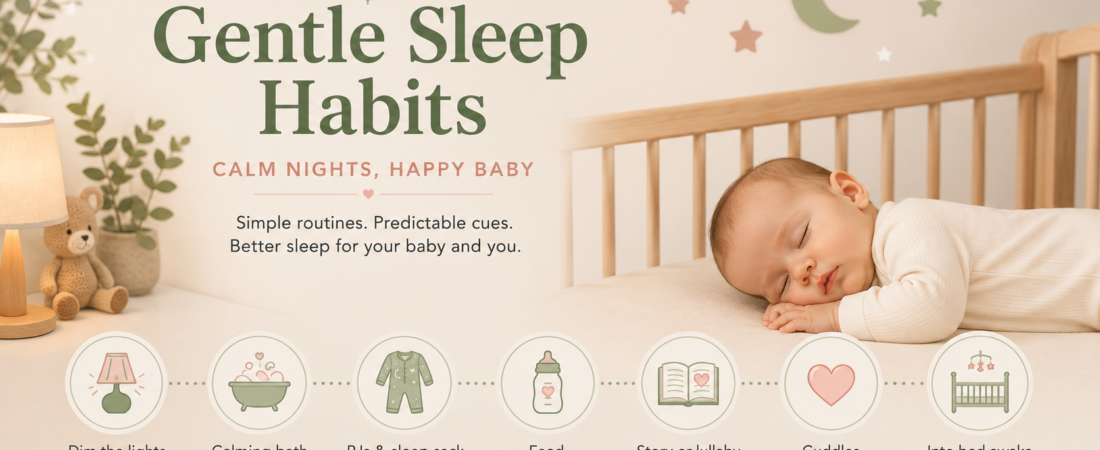
Dim the lights and turn off screens. Move to a quieter part of the home. Give a warm bath if tonight is a bath night. Gentle massage. Pyjamas and sleep sack. A calm, quiet feed in the dim room. A few minutes of your voice, singing, talking softly, reading. A cuddle. Into the sleep space, drowsy if possible. White noise on if you use it. Leave or stay close depending on what she needs tonight.
The whole thing takes 20 to 25 minutes for a baby older than three months. It is simple enough to sustain every single evening, which is the point because consistency across weeks and months is what builds the association, not perfection on any individual night.
When the routine does not seem to be working
There will be evenings when none of it lands. When baby cries through the bath, fights the feed, resists every settling approach, and finally goes to sleep 45 minutes later than you hoped by a method you had not planned to use. These evenings are not evidence that the routine is failing. They are evidence that your baby is a baby, affected by teething, by developmental leaps, by the residue of a stimulating day, by a growth spurt that has made them hungrier than they were yesterday.
The routine’s value is not in producing a perfect outcome every night. It is in the pattern itself, the reliable sequence that, across the many evenings where it does go smoothly, has been building an association that continues to work even on the difficult nights that surround it. The difficult nights do not undo the work. They are simply the nights when other factors are louder than the routine.
Sleep regressions, at four months, at eight months, at twelve months, will temporarily disrupt a routine that was working well. This is developmental rather than a failure of the method, and the routine you maintain through those regressions is the one your baby returns to most easily once they pass.

Safe sleep always, regardless of routine
Whatever your bedtime routine looks like, the sleep environment it ends in is non-negotiable. Your baby sleeps on their back, on a firm and flat surface, with no pillows, loose blankets, bumpers, or soft toys in the sleep space. A fitted sheet and an age-appropriate sleep sack are all she needs. Room sharing for the first six months minimum. In the Mauritius heat, a properly secured mosquito net over the sleep space and a ceiling fan on the lowest setting, directed away from your baby, rather than AC set below the recommended 18 degrees.
When you need more than a guide
A bedtime routine handles the predictability layer of baby sleep. What it cannot handle is the specific, individual picture of why your particular baby’s sleep looks the way it does — the four-month regression that has lasted three months, the baby who will not transfer from arms to cot, the twelve-month-old who is waking eight times a night and whose parents are running on fumes.
For those situations, a one-to-one sleep consultation exists to do what no article can: look at your specific baby, your specific home, your specific constraints, and build a plan that is made for you rather than for a hypothetical average baby.
RELATED READ:



Disclaimer: This article is for informational purposes only. Every baby is different and sleep varies significantly between individuals and developmental stages. If you have concerns about your baby’s sleep, health, or development, contact your paediatrician. For personalised sleep support, visit the Nutura sleep consulting page.