- Aurelie
- 14 mins read
- No Comments
I remember the exact moment I realised I had absolutely no idea what I was doing.
My daughter was five and a half months old. She had been watching me eat with an intensity that felt slightly unnerving for someone who had spent most of her life asleep. She was sitting upright with support. She had stopped doing that little tongue-thrust thing. She was reaching for my fork, drooling all over the place.
Every sign was there. And I sat there, holding a piece of ripe papaya, thinking: am I actually allowed to give this to her? Is papaya safe? Do I mash it? How much? What if she chokes? What if she doesn’t like it? What if I do it wrong?
I did what every mum does at that moment. I opened Google.
And I found approximately four hundred articles, none of which agreed with each other, none of which mentioned a single food that is actually available in Mauritius, and all of which assumed I had access to things like specific organic baby rice cereal brands that do not exist in any supermarket on this island.
If you are reading this, you are probably sitting somewhere very similar to where I was sitting. Your baby is somewhere between four and seven months old, watching you eat with those wide, curious eyes, and you are trying to figure out what to do next.
First, Is Your Baby Actually Ready?
For weeks before we started solids, my daughter was waking more at night, going through what felt like an endless series of hungry-but-never-satisfied phases, and chewing her fists with apparent urgency. Every aunt, every neighbour, every well-meaning person around me assured me she needed food. Ti bébé la affamé, bizin koumans manze. She is starving, you need to start food.
The first thing that helped me relax was understanding what readiness actually means — and what it does not mean. Here is the truth: age alone is not a readiness sign. The World Health Organisation recommends introducing solid foods at around six months, alongside continued breastfeeding or formula. But six months is a guideline, not a rule and it works in both directions. Some babies show clear readiness at five and a half months. Others are not ready until closer to seven.
What you are looking for is not a birthday. It is a combination of three specific developmental milestones appearing at the same time.
Readiness sign one: sitting with minimal support and holding their head steady. Your baby needs to be able to control her head and upper body well enough to swallow safely. If she is still flopping forward or to the side without help, she is not ready yet regardless of her age.
Readiness sign two: the tongue-thrust reflex has faded. Babies are born with a reflex that automatically pushes objects out of the mouth with the tongue — this is what protects them from choking before they can manage solid food. When this reflex fades, food stays in rather than being immediately pushed back out. You can test this gently with a tiny amount of food on a spoon. If it comes straight back out, wait a couple more weeks and try again.
Readiness sign three: genuine interest in food. Watching you eat with focus. Reaching towards your plate. Opening her mouth when food approaches. This is different from just being generally curious — it is a specific, consistent response to food being present.
What does NOT count as a readiness sign: waking more at night, chewing her fists, being generally unsettled, going through a growth spurt, or anything a well-meaning relative tells you means the baby is hungry and needs food. These are normal baby behaviours at almost any age. Starting solids early because of them will not help — and starting before the developmental milestones are in place carries real risks.
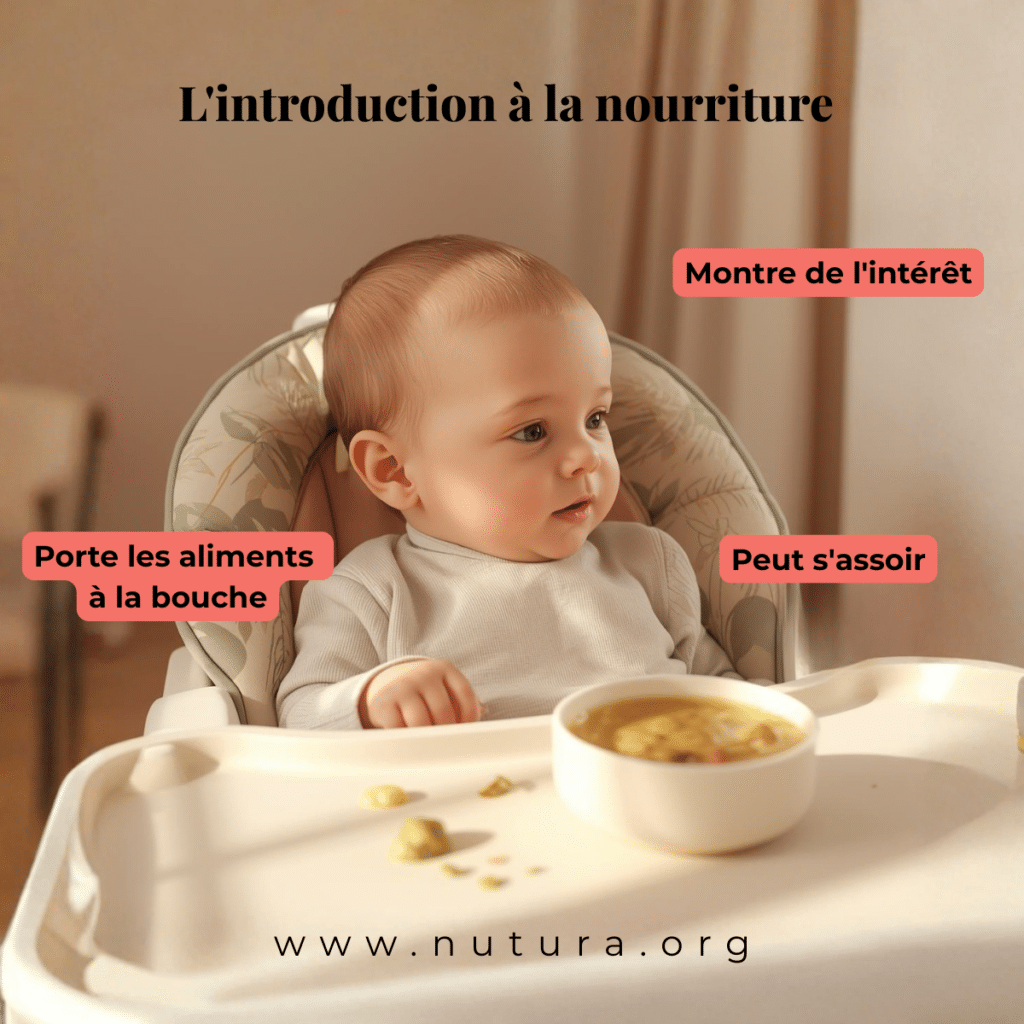
If you are seeing all three signs together: sitting up with minimal support, no tongue thrust, interested in food and brings food to his/her mouth, then your baby is ready. If you are unsure, your paediatrician at her next developmental check is the right person to ask.
The Thing Nobody Told Me About Iron
Once I understood readiness, the next thing that genuinely surprised me was learning why the timing matters from a nutritional standpoint and it has nothing to do with filling a baby up or replacing milk feeds.
It is about iron.
During pregnancy, a baby builds up iron stores from the mother. Around six months of age, those stores begin to run low naturally, predictably, as part of normal development. Breast milk and formula are extraordinary foods, but they cannot provide sufficient iron beyond this point. This is one of the primary biological reasons that solid foods are introduced at this stage.
I grew up in Mauritius. I know that iron deficiency anaemia is not rare here — it affects a significant proportion of the adult population. Which makes iron-rich first foods not just recommended but genuinely important for Mauritius babies.
The good news is that the solution is sitting in your kitchen right now. Dal. Dark lentils, cooked soft. Egg yolks. A little bit of well-cooked dark meat. Bred mouroum (moringa leaves, finely prepared) which is one of the most iron-dense plants on the planet and grows abundantly on this island. And the tip that made a real difference for us: pair any iron-rich food with something containing vitamin C, because the combination dramatically improves how much iron the body absorbs. A little papaya alongside the dal. Some tomato with the egg. Small change, meaningful impact.
Your family kitchen, the one full of the traditional Mauritius foods your mother and grandmother cooked — it is already set up for this. You do not need imported organic pouches or specialist products. You need to know which of what you already have is right for your baby, and in what form.
The Great Spoon vs No Spoon Debate: Why It Is Less Important Than the Internet Suggests
I spent an embarrassing amount of time in the weeks before we started solids trying to decide whether to do baby-led weaning or traditional spoon feeding, reading arguments for both with the seriousness of someone preparing for an exam.
Here is what I eventually understood: both approaches work, most families end up doing a combination of both, and the question that actually matters is not which method you use but whether your baby is eating a variety of foods with a variety of textures and developing a positive, low-pressure relationship with mealtimes.
Baby-led weaning: offering soft finger foods from the beginning and letting the baby feed herself rather than using a spoon has real benefits. It builds fine motor skills, it teaches babies to self-regulate how much they eat, and it integrates naturally into family mealtimes because your baby eats (a safe version of) what you are eating. It also involves a significant amount of food on the floor and a high chair that will need to be fully disassembled to clean.
Spoon feeding soft mashed food works equally well, and it is what most Mauritius grandmothers will recognise and feel comfortable with when they are helping care for the baby. The one genuine caution from the research is not to stay on very smooth purée textures for too long. Somewhere around seven to eight months, lumps and soft pieces should be introduced even if you have been spoon feeding from the beginning, because babies have a window of texture acceptance that begins to narrow after that point.
When I started with my daughter, I started with the baby-led weaning method by offering food pieces that she could actually hold in her hand. My patience took a hit when she started becoming fussy. I quickly switched to mashed food on a spoon with soft pieces alongside for her to pick up herself, and by about seven months we had essentially moved to her feeding herself most things with occasional spoon-fed meals when the logistics of the day called for it. Nobody told me this was a strategy. It was just what seemed to work for her. And that, I think, is exactly how it is supposed to go.
The Papaya I Finally Gave Her
Three days after I froze over the papaya, I gave it to her.
I mashed a small piece with a fork. Set her up in her high chair at the table with me. Put a tiny amount on the end of a spoon and offered it to her.
She looked at it. Looked at me. Opened her mouth.
And then she made a face I will never forget. The very specific expression of a person encountering a completely new sensory experience while not yet having the vocabulary to process it. Surprise. Concentration. And then, slowly, something that looked a lot like approval.
She opened her mouth for more.
That was it. That was the moment. Not dramatic, not perfect, nothing like the Instagram version of starting solids. Just a baby and her mum and a piece of ripe papaya on a Tuesday morning in Mauritius.
What followed over the next weeks was a gradual, messy, occasionally hilarious, occasionally stressful process of introducing new foods, learning what she liked and what made her screw her whole face up, figuring out when to stop a mealtime and when to try again tomorrow. We introduced lentils and she was indifferent at first and enthusiastic by the third try. We introduced egg and she did NOT like the texture. We introduced avocado and she treated it as a personal insult for two weeks before deciding it was acceptable.
I learned that babies often need to encounter a new food ten, fifteen, twenty times before they accept it. That a rejected food is not a failed food, it is a food that needs more time and more exposure. That mealtime pressure — hovering, urging, making faces of concern — creates the exact outcome you are trying to prevent. And that the baby who eats enthusiastically one day and refuses everything the next is completely, boringly, reassuringly normal.
What Our First Weeks Actually Looked Like
For the first couple of weeks, we did one small meal a day, always after a milk feed so she was not ravenously hungry but also not so full she had no interest. Fifteen to twenty minutes, one or two new foods, very small amounts, the whole thing ending the second she lost interest.
I introduced one new food every two or three days rather than many at once — not because I was following a strict protocol, but because I quickly realised that if I offered five new things at once and anything happened (a rash, unusual stool, general fussiness), I would have no idea what had caused it.
By about week three, we had moved to two small meals a day. By around eight months, three small meals with increasing variety and texture. The milk feeds did not drop significantly until well past nine months — solids genuinely do complement milk at this stage rather than replacing it, and I had to remind myself of that regularly when a meal went badly and I worried she was not getting enough.
The tracking helped enormously. Writing down what she had tried, what she had liked, what was new that week, what allergens had been introduced and when — it sounds like more effort than it is, and it takes away so much of the anxious trying-to-remember-everything feeling that comes with early weaning.
The Part About Allergens: Please Do Not Skip This
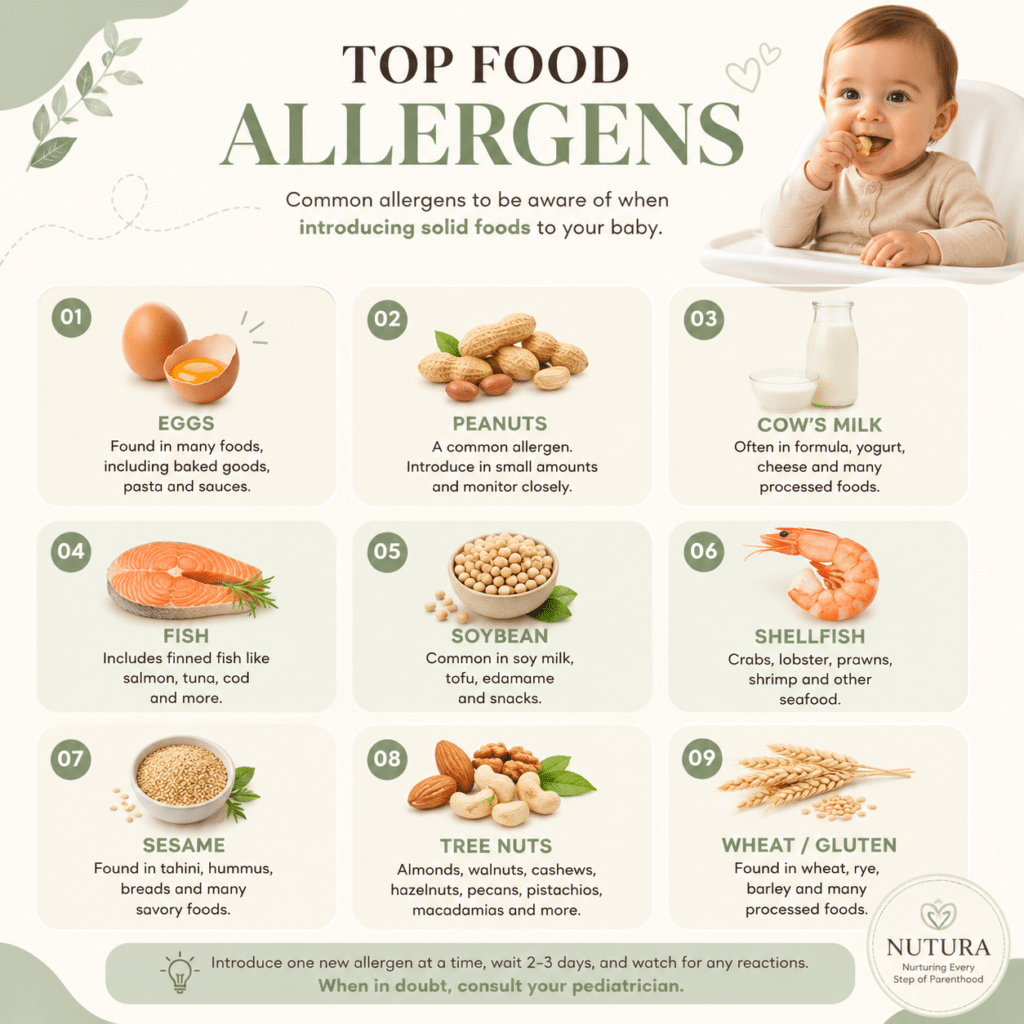
I want to say something directly about allergen introduction because it is the area where outdated advice can cause genuine, lasting harm.
For a long time, parents were advised to delay introducing major allergenic foods (peanuts, eggs, tree nuts, fish, shellfish, wheat, soy, sesame, cow’s milk products) until a baby was older, on the theory that avoidance would reduce allergy risk. The current evidence, from large, rigorous trials, shows the opposite. Early introduction of allergens, from around six months, significantly reduces the risk of developing a food allergy. Delaying introduction increases it.
This was one of the things I was most glad to have read before we started, because introducing allergens early felt counterintuitive at first. The reality was that we introduced peanut butter (thinned with a small amount of breast milk), egg, fish, wheat, and others in those first months, one at a time with a couple of days in between, watching for any reaction. There were no reactions. And the research suggests that consistent, regular exposure (not just introducing once and never again) is what builds lasting tolerance.
If your baby has severe eczema or has already had an allergic reaction to any food, please talk to your paediatrician before beginning allergen introduction. In those cases, supervised first exposure is the right approach.
For everyone else: early and regular is the evidence-based guidance. The fear around allergens is understandable, but it should not lead to delay.
The Afternoon She Laughed
About three weeks into weaning, my daughter had a piece of overripe banana in her hand. She squeezed it. It disintegrated completely. She stared at her hand with an expression of genuine bewilderment and then she laughed. Not a small laugh. A full-body, delighted, what-is-this-extraordinary-world laugh.
And I realised I had been so focused on doing it correctly (the right foods, the right textures, the right timing, the right method) that I had been sitting across from her at mealtimes like someone conducting a technical assessment rather than sharing a meal with my daughter.
Mealtimes in the first year of solids are not primarily a nutritional exercise. They are one of the earliest social rituals you and your baby share. They are about sitting together, about watching her discover that food can be joyful, about being present in a moment that happens only once. The nutritional side matters, it really does, but the atmosphere you create at the table, the absence of pressure, the willingness to let it be messy and imperfect and funny, matters just as much.
The baby who is smearing avocado on her eyebrows right now will, sooner than feels possible, be sitting at the table eating everything in front of her and asking you what is for dessert.
Everything I Put Together So You Don’t Have To
The months of figuring this out, the research, the trial and error, the questions I wished someone had answered before I started, went into something I want to share with you properly.
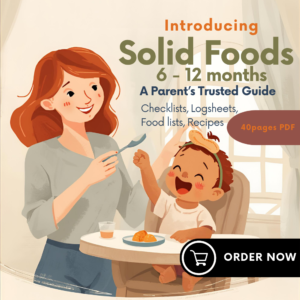
The Introducing Solid Foods guide for Mauritius mums covers everything I have written about here and everything I did not have space for: a full comparison of BLW and spoon feeding with practical guidance for whichever approach suits your family, the complete texture and progression guide from six months through to twelve, a realistic picture of what a typical day of eating looks like at each stage, and a 100 foods list that tells you exactly which foods are appropriate, when, and how to prepare them.
It includes sample food rotation plans — full weeks of meal ideas so you are never standing in the kitchen at 5pm with no idea what to give her. It includes the allergen introduction schedule with a simple tracking tool. It includes iron-rich food guidance written specifically for what is available in Mauritius. And it includes the common questions and reassurances section for the moments at 11pm when you are not sure whether that nappy colour is normal or whether she ate enough today.
It is a digital download. It arrives in your inbox the moment you purchase it, and it is yours to read on your phone, print any page, and return to throughout the first year.
If I had had it when I was sitting there frozen over the papaya, I would not have put it down.
Sources: World Health Organisation complementary feeding guidance. Perkin M.R. et al., New England Journal of Medicine (2016) — the EAT Study on early allergen introduction. Ministry of Health and Wellness Mauritius. Rapley G. and Murkett T., Baby-Led Weaning.
Disclaimer: This article is for informational purposes only. Always consult your paediatrician for guidance specific to your baby.