
- Baby Feeding
- 8 mins read
- No Comments
The first time my daughter gagged on food, I moved so fast I knocked the bowl off the highchair tray.
She was seven and a half months old. I had given her a small piece of very ripe papaya, soft, impossibly soft, the kind of soft that seemed like it could not possibly cause any problem. She picked it up, put it in her mouth, and then her whole face changed. Eyes wide, tongue pushing forward, a coughing retching sound that I can only describe as deeply alarming, and a face that had gone a dramatic shade of red.
I was halfway out of my chair before my brain caught up with my body.
And then, before I had reached her, she coughed once, spat a small piece of papaya onto the tray, looked at it for a moment with what I can only describe as scientific interest, and then picked it up and put it back in her mouth.
She was absolutely fine. She had been absolutely fine the entire time.
I, on the other hand, needed a few minutes.
If you are about to start solids, or you are in the middle of those early weeks and have already experienced your own version of the papaya incident, this article is for you. Not to tell you there is nothing to worry about, because choking is a real risk and it deserves to be taken seriously. But to give you the clear, honest distinction between the gagging that is a completely normal part of learning to eat and the choking that is a genuine emergency, so that when your baby gags, you know which one you are looking at.
What gagging actually is and why your baby is built for it
Gagging is not a sign that something has gone wrong. It is a sign that something has gone right.
Your baby was born with a gag reflex that sits significantly further forward on their tongue than yours does, meaning it triggers more easily, with less provocation, at smaller amounts of food. This is entirely intentional from a developmental design standpoint. Babies are learning to manage solid food in a mouth and throat that have, until now, only ever dealt with liquid. The gag reflex is the safety mechanism that kicks in when a piece of food moves somewhere the swallowing mechanics are not yet ready to handle and it pushes that food forward, back toward the front of the mouth, before it reaches the airway.
It is protective. Forceful. Loud. And it looks absolutely terrifying if nobody has prepared you for what it looks like.
As your baby gains experience with solid food over weeks and months, more textures, more practice, more sophisticated chewing and swallowing coordination, the gag reflex gradually moves further back on the tongue, becoming less easily triggered as the swallowing mechanics become more reliable. The frequent gagging of the early weeks becomes less common by three or four months into weaning. Not because the food has changed, but because your baby’s ability to manage it has.
In the meantime, gagging is a completely normal feature of the learning-to-eat process. Especially if you are doing baby-led weaning, where your baby is managing larger pieces of food independently from the beginning, gagging will happen regularly in the early weeks. This does not mean BLW is dangerous. It means your baby is actively developing the skills they need, using the safety mechanism they are born with.
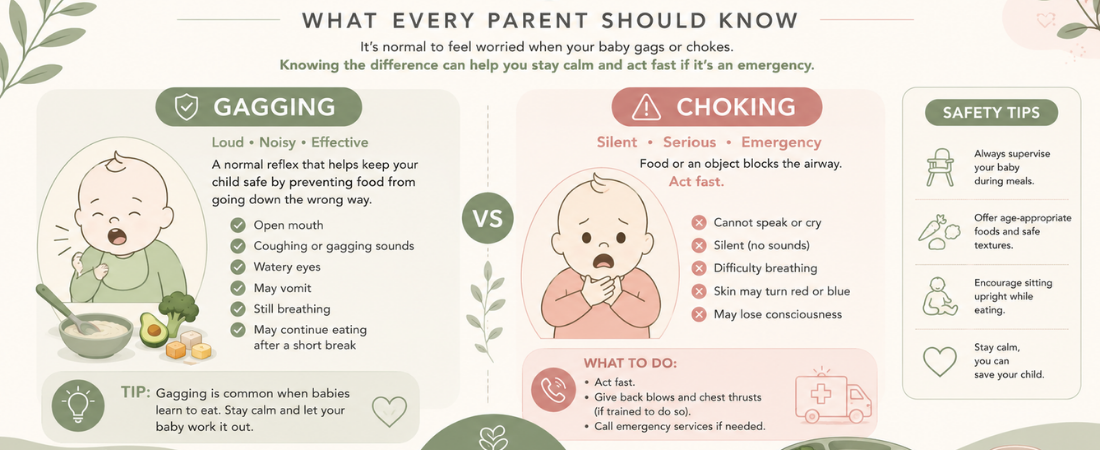
What gagging looks like: the things that will scare you and why they are okay
Gagging sounds alarming. That is genuinely true, and there is no point pretending otherwise. Here is what you are likely to see:
Your baby’s eyes will go wide, that classic expression of surprise that you will come to recognise, different from distress but genuinely startling the first several times you see it. Baby’s tongue will push forward. Baby may cough, retch, make a sound somewhere between a cough and a gag, and their face may go red as the effort of the reflex increases blood pressure to the head briefly. Food may come out. Baby may spit something back onto the tray and their eyes may water.
And throughout all of this, this is the critical thing, your baby is breathing.
The noise is what tells you baby is breathing. You can only gag if air is moving. The sound of a baby gagging is the sound of a working airway, a functioning protective reflex doing exactly what it was designed to do. Loud, alarming, red-faced gagging is not a sign something has gone wrong. It is a sign the system is working.
Most gagging resolves within seconds. Your baby will cough the food forward or out, pause, and then, as mine did with the papaya, look at the food with something approaching curiosity and potentially try again. The recovery is usually faster than your heart rate.
The hardest thing to do in this moment is also the most important thing: stay calm. Your baby is watching your face for information about whether this situation is dangerous. If you leap across the room with your hands outstretched and a look of alarm, baby learns that eating is frightening. If you watch them carefully, stay present, and allow the reflex to do its job, baby learns that this is a manageable, normal part of the process. Your calm is not indifference. It is one of the most useful things you can offer to your baby at the table.
What choking looks like: the signs that mean act now
Choking is different from gagging in one fundamental, unmistakable way.
Choking is silent.
When a piece of food has partially or fully blocked the airway, air cannot move. And if air cannot move, sound cannot be made. A choking baby cannot cough, because coughing requires airflow. Your baby cannot cry, because crying requires airflow and cannot make the alarming gagging sounds that terrify you during a normal mealtime. Instead, there is silence, or a very high-pitched, thin wheeze if the blockage is partial, accompanied by an expression of genuine panic or distress.
Look also for: lips, tongue, or fingernails turning blue or a dusky colour, which indicates oxygen deprivation; inability to breathe visibly, you will not see the chest moving; a baby who appears frozen, whose mouth is open but nothing is coming out; a limp or weak baby who is losing responsiveness.
This is the scenario that requires immediate action, not the red-faced, retching, loud gagging. The loud gagging is normal. The silent, wide-eyed, blue-lipped absence of sound and breath is the emergency.
The distinction matters because the response is different. During gagging, the right thing to do is watch, stay calm, and allow the reflex to resolve. During choking, the right thing to do is act immediately with the infant first aid technique for a choking baby, back blows and chest thrusts, and call emergency services if the obstruction does not clear.
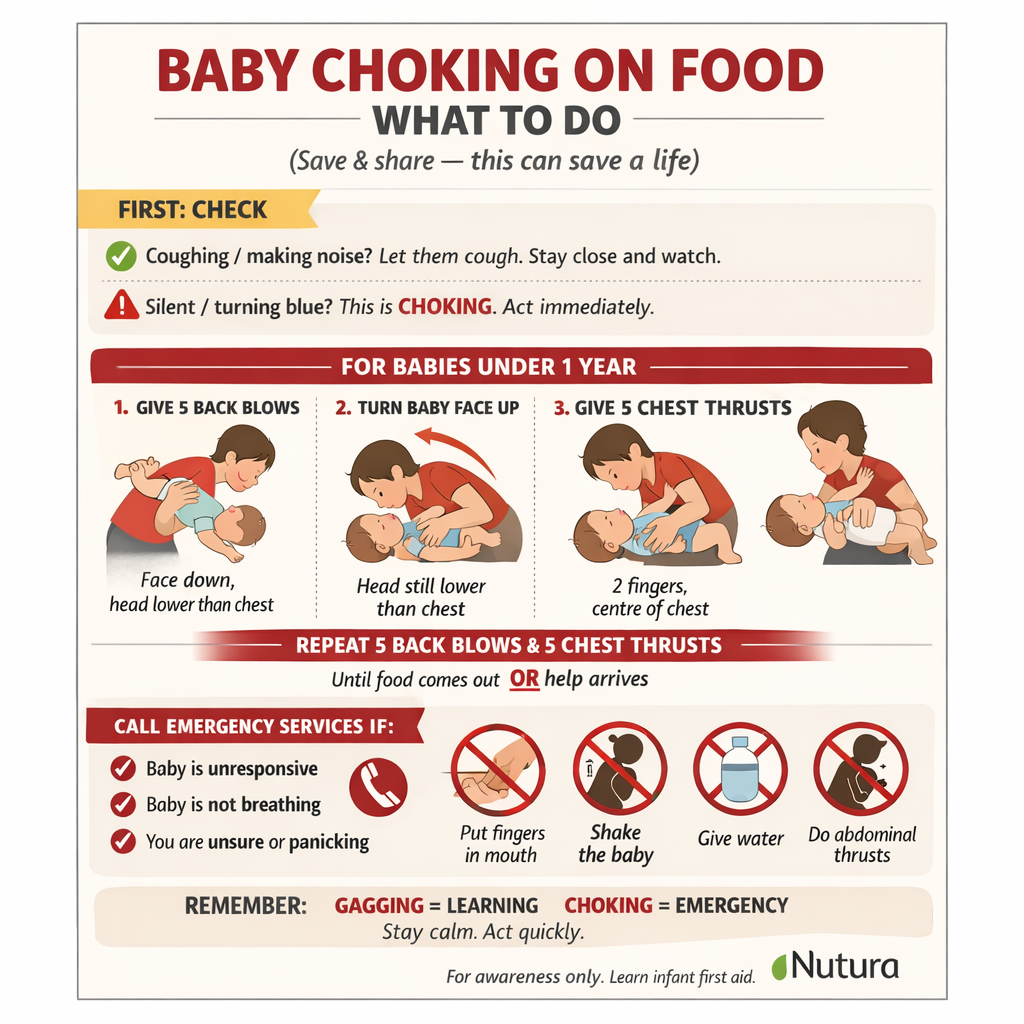
Baby Choking on Food.
What to do
Learn infant first aid before you give your baby their first meal, specially for BLW.
I know this sounds like the kind of advice that goes in one ear and out the other because it requires action rather than just reading. But I mean it sincerely, I felt so much at ease having done a first aid course prior food introduction.
A proper infant first aid course, even a short online one, covers how to identify choking versus gagging, what to do with back blows and chest thrusts, how to hold an infant correctly during the manoeuvre, and how to call for help in Mauritius. You will practise on a doll. You will feel the technique in your hands rather than just reading about it. And the next time your baby gags loudly at the dinner table, you will not freeze, because you will know with your body, not just your mind, what the difference looks like and what each situation calls for.
I am not saying this to frighten you. I am saying it because the parents who have done an infant first aid course sit at mealtimes in a fundamentally different state of mind than the ones who have not. The knowledge does not make you paranoid. It makes you calm. And calm is exactly what you need at those early meals.
Foods that carry higher risk: what to prepare differently
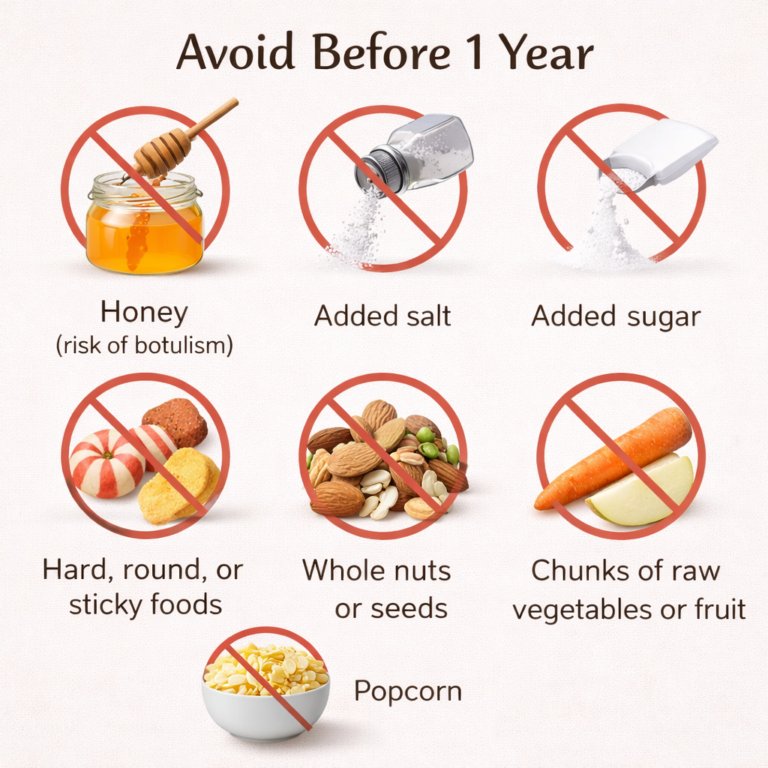
Not all choking incidents are equal, and some foods are significantly more problematic than others for babies under twelve months.
Whole grapes and cherry tomatoes are among the most commonly cited choking hazards for babies and young children as their size and shape allow them to form a nearly perfect seal over a small airway. Always quarter them lengthwise before offering them, never in half. The same applies to blueberries and olives.
Raw, hard vegetables, raw carrot, raw apple, raw cucumber in thick rounds, are not appropriate for babies as finger foods. Say NO to anyone giving you advice to give a raw carrot to a teething baby “to stimulate the gums”. They do not compress or break down quickly when bitten, which means a small piece that breaks off can be swallowed before the chewing mechanics are developed enough to manage it. Steam or roast vegetables until they are soft enough to squash easily between two fingers.
Whole nuts are not suitable for children under five. Nut butters, spread thinly, are appropriate and important for allergen introduction. Whole nuts, not yet.
Popcorn, hard sweets, and any food that is simultaneously small, hard, and irregularly shaped belongs firmly off the menu until significantly later in childhood.
The principle is simple: any food your baby eats should be either soft enough to squash between your fingers, long enough to extend outside her fist so she controls how much goes in at once, or safe if swallowed without significant chewing. If you are unsure, steam it for longer.
The position that protects your baby
Where your baby sits during meals is not incidental. It is part of the safety infrastructure.
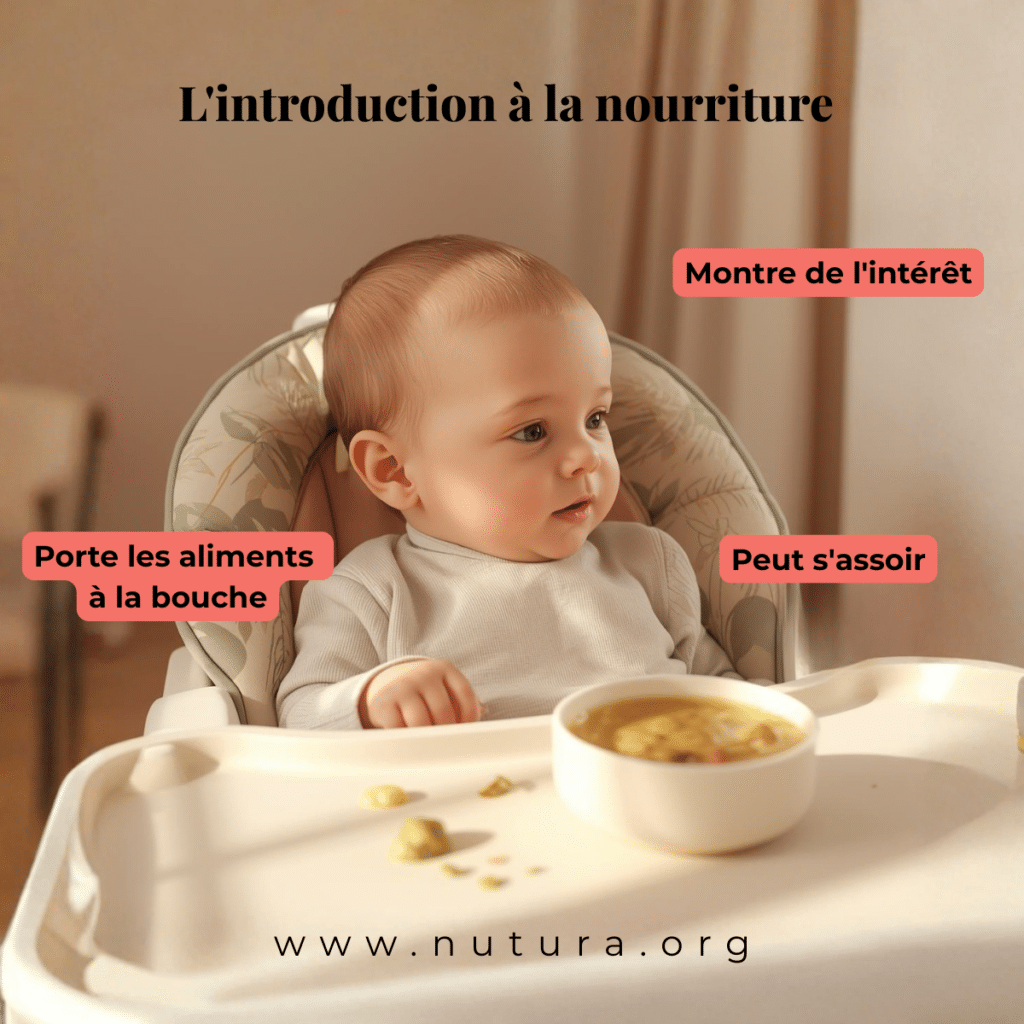
Your baby should eat upright: back supported, feet ideally resting on something rather than dangling, in a highchair that keeps their torso straight rather than slumped. This position is not about aesthetics or discipline. Upright eating means gravity works with the swallowing process rather than against it. Food goes down rather than sideways. The airway stays clear.
Never feed your baby while reclined: not in a bouncy chair, not in a car seat, not lying back in your arms. Never leave your baby unsupervised during a meal, even briefly. A baby can gag to the point of needing your calm observation at any point in a mealtime, and you need to be there to distinguish normal gagging from something that requires action.
Supervision is not about hovering anxiously. It is about being present enough that if the rare moment of genuine choking occurs, you are there to respond within seconds. Sit with them at mealtimes. Eat your own food. Make it a social occasion. But be there.
I want to tell you something about the first month of solids that nobody told me, and that I think would have helped me enormously.
It is nerve-wracking, and then gradually it is not.
The gagging that felt catastrophic in week one feels unremarkable by week six. Not because your baby has stopped gagging, they will probably gag occasionally throughout the first year of weaning, as new textures challenge their developing skills. But because you will have seen it resolve so many times that your nervous system begins to trust the process. Your reflexive lurch toward the highchair slows down. You start being able to distinguish, in real time, not in retrospect, the normal gagging from the face that would make you move.
You learn to read your baby’s face at mealtimes the same way you learned to read it when they cry, with increasing accuracy and confidence over time. The panic of the early weeks is not a character flaw. It is what the early weeks feel like, for almost every parent, before experience replaces the fear.
You will get there. Your baby will get there. And the mealtimes that feel terrifying now will become, by the end of the first year, one of the most joyful parts of your day, messy, loud, chaotic, food absolutely everywhere, and completely normal.
RELATED READ:



When to Start Your Baby on Solid Foods: The Honest Guide Every Mauritius Mum Needs
References: Rapley G. and Murkett T. — Baby-Led Weaning: Helping Your Baby to Love Good Food. St John Ambulance — Infant choking first aid guidance. stjohn.org.uk. American Academy of Pediatrics — Choking Prevention and First Aid. healthychildren.org. World Health Organisation — Complementary feeding guidance.
Disclaimer: This article is for informational purposes only and does not constitute medical advice. All parents and caregivers are strongly encouraged to complete an infant first aid course before introducing solid foods. In a choking emergency in Mauritius, call emergency services immediately (SAMU: 114).