
- Pregnancy Week by Weeks
- 10mins read
- No Comments
This is the last week of the second trimester.
Next week the third begins, and with it a different quality of pregnancy altogether. The final stretch. The countdown that has felt like an abstraction through all the weeks of the first and second trimesters becomes, from next week, something with a specific and finite number of weeks remaining. The birth that has been a future event is now close enough that it has stopped feeling theoretical.
But this week is still the second trimester, and it deserves to be marked as such.
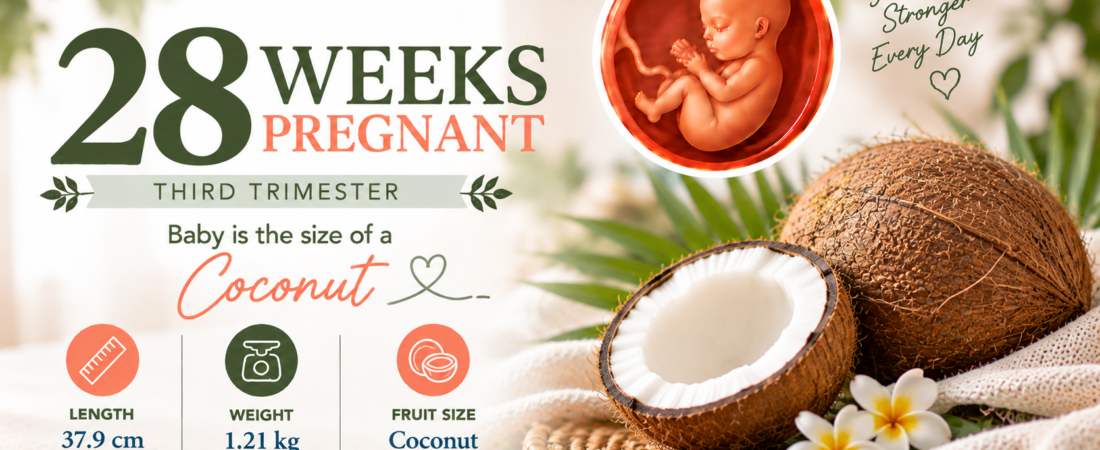
You have been pregnant for 28 weeks. You have built another human being from a single fertilised cell. Every organ your baby will ever have is present and developing. Baby weighs more that one kilogram. Baby can hear your voice, respond to light, open her eyes. Baby may be dreaming. Baby knows the particular rhythm of your daily life in a way that will be recognisable to them in the first hours after baby is born.
The second trimester that began at week 14 with the gradual lifting of the first-trimester fog ends this week. The relative comfort of these middle weeks, the energy that returned, the anatomy scan, the first unmistakable kicks, the bump that became undeniable, all of it belongs to this trimester that is now in its final days.
Week 28 also brings something new that is worth understanding clearly before the third trimester begins: formal movement monitoring. It starts this week, and it matters.
Your baby at 28 weeks
Your baby measures approximately 37.9 centimetres from crown to heel and weighs around 1.2 kilogram this week. The one kilogram threshold is not a single developmental milestone but a marker of the cumulative growth across two trimesters and a signal of what the third will continue building on.
The lungs at 28 weeks are meaningfully more developed than they were even four weeks ago. Surfactant production has been increasing steadily and continues to do so with each passing week. A baby born at 28 weeks would face real challenges and require intensive neonatal support, but survival rates at this gestational age are significantly higher than at 24 weeks, and outcomes improve substantially with each additional week from this point onward.
The brain is growing in mass and complexity at a pace that remains extraordinary. The folds of the cerebral cortex are deepening, increasing the neural surface area available for complex processing. The neural connections that will support sensory perception, movement coordination, and eventually conscious thought are becoming more dense and more sophisticated week by week. REM sleep, the stage associated with dreaming in adults, is well established.
Your baby’s eyes are open. The pupils respond to light changes. The visual system is functional enough that bright light directed at the abdomen produces a response. The focused vision that develops in the weeks and months after birth is still being built, but the eyes that will be the first thing you notice on their face are open and working in a basic and genuine way.
The immune system is receiving its most significant passive contribution before birth. Immunoglobulins crossing the placenta from your blood form the antibody protection that will carry the newborn through the first months of life. This passive transfer is most concentrated in the final trimester, making the weeks ahead genuinely important for immune preparation as well as lung and brain maturation.
Fat accumulation is accelerating. The subcutaneous fat that fills and smooths the skin is building more rapidly through the third trimester than it did through the second, and the increasingly rounded appearance of your baby reflects this ongoing process. This fat is not cosmetic. It insulates against heat loss after birth, provides a caloric reserve for the energy demands of the newborn period, and supports blood glucose stability in the first hours of life outside the womb.
Movement monitoring
From this week, your baby’s movements become one of the most important indicators of wellbeing available to you between antenatal appointments.
The guidance around movement monitoring has shifted in recent years away from rigid kick counts, counting a specific number of movements in a specific time window, toward something more nuanced and more clinically useful: familiarity with your individual baby’s established normal pattern, and prompt action when that pattern changes significantly.
By 28 weeks you will have a sense of your baby’s movement habits, whether or not you have been consciously tracking them. The times of day baby tends to be active. The types of movement baby makes. The response to a cold drink or something sweet. The kicks that arrive after a meal. This familiarity, built organically across the second trimester, is now the baseline against which you monitor.
What to pay attention to from this week: whether your baby is moving in ways that feel consistent with their established normal. Not counting every movement, not setting a timer, but having a daily awareness of whether the pattern feels like theirs. The mornings baby tends to be active. The evenings baby typically slows. The particular kick baby gives after a cold drink.
What to act on immediately: a significant, sustained reduction in movement from what has been baby’s normal. Not a quiet hour, not a slightly quieter morning, but a change across the day that feels different from ordinary variation. If this happens, eat or drink something cold and sweet, lie on your left side, and pay close attention for the next hour. If movement does not return to what feels normal for your baby, contact your gynaecologist the same day. Do not wait until tomorrow. Do not wait to see if it improves overnight. Contact your gynaecologist.
Your instinct about your own baby’s movements is a valid clinical signal. Your gynaecologist would rather hear from you unnecessarily than have you waiting at home with a change in movement that needed same-day attention.
Your body at 28 weeks
The physical experience of the last week of the second trimester is shaped by a uterus that now sits approximately 28 centimetres above the pubic bone and whose presence is felt across the entire abdominal and chest cavity.
Heartburn and indigestion are likely significant and worsening. The growing uterus compresses the stomach upward while progesterone continues relaxing the oesophageal valve, a combination that produces increasingly persistent acid reflux in a high proportion of pregnant women at this stage. Smaller meals more frequently, eating slowly, remaining upright for at least an hour after eating, and raising the head of the bed slightly for night-time symptoms are the most consistently effective approaches. Ask your gynaecologist which antacid formulations are safe if dietary adjustments alone are insufficient.
Shortness of breath during physical activity is common and will likely worsen through the third trimester until the baby drops lower into the pelvis in the final weeks, releasing pressure on the diaphragm. Slowing down when breathlessness arrives, choosing low-impact movement such as walking and swimming, and maintaining as upright a posture as possible to give the diaphragm maximum room are the practical daily adaptations. Sudden severe breathlessness at rest, or breathlessness with chest pain or palpitations, requires immediate medical contact rather than being attributed to the ordinary pressure of the growing uterus.
Braxton Hicks contractions may be more frequent and more noticeable at 28 weeks than they have been in earlier weeks. These practice contractions produce a tightening across the front of the abdomen that typically lasts 30 to 60 seconds and then releases. They are irregular, typically painless, do not intensify progressively, and ease with hydration and a change of position. Regular, intensifying, or painful contractions at 28 weeks always warrant a call to your gynaecologist rather than being attributed to Braxton Hicks without medical confirmation.
Back and pelvic pain is typically at or approaching its most significant from this point onward, as the baby’s increasing weight combined with the progressive joint loosening of relaxin creates sustained musculoskeletal demand. Swimming remains one of the most reliably effective forms of pain management because the water supports the weight of the bump and removes gravitational load from painful joints. A referral to a women’s health physiotherapist is appropriate if pain is significantly affecting daily functioning.
Swelling of the feet and ankles is common and may be worsening in the Mauritius heat. Elevation when sitting, avoiding prolonged standing, and consistent hydration are the most practical management approaches. Sudden significant swelling that includes the face and hands, particularly with headache or visual disturbances, is a warning sign for preeclampsia and requires same-day medical contact regardless of the time of day.
Sleep at 28 weeks is genuinely difficult and will not reliably improve before birth. The combination of the growing bump limiting comfortable positions, frequent urination, the baby whose active periods do not consistently align with your sleep hours, heartburn worsening when lying flat, leg cramps, and the general physical discomfort of late pregnancy all contribute to fragmented sleep. Left-side sleeping with a pillow between the knees and another supporting the bump is the most comfortable and clinically appropriate position.
RELATED READ:


Antenatal appointments from week 28
From week 28, antenatal appointments typically move to every two to three weeks rather than monthly. Your gynaecologist will confirm the schedule specific to your pregnancy.
Blood pressure monitoring becomes particularly important from this point because preeclampsia most commonly develops in the third trimester and is identified through a combination of elevated blood pressure and other signs. Each appointment includes a blood pressure check for this reason, and any reading your gynaecologist considers elevated will be managed promptly.
A blood test at or around 28 weeks is often performed to check haemoglobin and ferritin levels, because this is the peak period for iron demand and anaemia identified now can be addressed before the iron requirements of delivery and the postpartum period arrive. If your levels are low, your gynaecologist will advise on supplementation.
Breastfeeding preparation
The third trimester beginning next week is the right window for breastfeeding preparation, and this week is the moment to begin if you have not yet.
Mothers who prepare before the birth are significantly more likely to continue breastfeeding through the difficult early weeks than those who rely on reactive support in the exhausted first 48 hours postpartum. In Mauritius, where the national breastfeeding rate remains below 30% and the gap between intention and continuation is significant, preparation before birth makes a measurable difference.
The specific things worth doing in the coming weeks: read the nutura.org breastfeeding basics article that covers the first six weeks honestly rather than aspirationally. Discuss your breastfeeding intentions with your gynaecologist so they are on your birth record and can inform the care you receive in the first hours after delivery.

Nutrition at 28 weeks
The nutritional habits established through the second trimester need to be maintained and in some cases intensified through the third, when your baby’s growth rate is at its most rapid and the demands on your body are greatest.
Iron is the most critical priority. Blood volume expansion continues through the third trimester and iron demand is at its highest. Anaemia at this stage affects your energy, your capacity to recover from delivery, and your baby’s iron stores at birth. Pairing plant-based iron sources with vitamin C at every meal remains the most practical daily dietary intervention. If supplementation has been recommended, take it consistently and away from tea, coffee, and dairy which all significantly reduce iron absorption.
Calcium needs are highest in the third trimester as your baby’s skeleton is growing at its most rapid pace. The calcium your baby requires comes from your diet or from your bones, without exception. Including a calcium-rich food at least once daily is the minimum. Milk, yoghurt, cheese, calcium-set tofu, tinned sardines with soft edible bones, and dark leafy greens are the most accessible sources in a Mauritius kitchen.
DHA from oily fish is most actively incorporated into your baby’s brain tissue during the third trimester, when brain growth is at its most rapid. Including oily fish from the local market several times a week from this point is one of the most directly beneficial dietary choices available for your baby’s neurodevelopment.
Protein at every main meal continues to be essential as the rapid tissue growth of the third trimester draws heavily on amino acid availability.
Fibre alongside consistent hydration manages constipation that tends to worsen as the uterus grows and places further pressure on the digestive organs. Oats, lentils, beans, vegetables, and fresh fruit daily alongside adequate water are the most practical sources.
When to contact your clinic
From week 28, the threshold for contacting your gynaecologist should be lower rather than higher. Contact your gynaecologist the same day for heavy vaginal bleeding, significant or one-sided abdominal pain, regular or intensifying contractions, leaking fluid from the vagina, fever, sudden severe shortness of breath, severe headache with visual disturbances or swelling of the face and hands, a significant sustained change in your baby’s movement pattern, or any symptom that feels clearly wrong. Do not wait overnight.

Looking ahead to week 29 and the third trimester
Next week the third trimester begins. The appointments that have been monthly through most of the second trimester will now occur every two to three weeks. Formal movement monitoring is active from this week. Your baby’s growth rate in the third trimester is the most rapid of the entire pregnancy. The birth that has felt distant is now close enough to prepare for in earnest.
The second trimester ends with a baby who weighs close to one kilogram, whose eyes are open, whose brain may be dreaming, who knows your voice, and who has been building herself inside you across 28 weeks with a precision and an intelligence that will take years to fully understand.
The third trimester starts next week. You are ready for it.
References: NHS — You and your baby at 28 weeks pregnant. nhs.uk. American College of Obstetricians and Gynecologists — Third trimester prenatal care. acog.org. World Health Organisation — Antenatal care recommendations. who.int. Tommy’s — 28 weeks pregnant. tommys.org. Ministry of Health and Wellness Mauritius — Antenatal care guidelines.
Disclaimer: This article is for informational purposes only. Always consult your gynaecologist or midwife for guidance specific to your pregnancy. From week 28, contact your clinic promptly for any concerns about reduced movement, unusual symptoms, or anything that feels wrong. Do not wait overnight.