- Baby & Toddler Nutrition
- Ready in 1h20mins
- No Comments
Your baby’s first birthday has probably felt very far away until now.
Then suddenly, you are choosing a little outfit, looking at balloons, saving cake ideas on Pinterest and wondering how twelve whole months managed to pass so quickly.
A first birthday is not only a celebration of your baby. It is also a quiet celebration of everything you have carried through the first year: the sleepless nights, the feeding worries, the first smiles, the first teeth, the tiny clothes that no longer fit and the little personality that has grown in front of you.
And somewhere between the decorations and the photographs comes one very practical question:
What kind of cake can I give my one-year-old?
You may want the moment to feel special without serving a cake filled with large amounts of sugar, heavy icing or ingredients your baby has never tasted before.
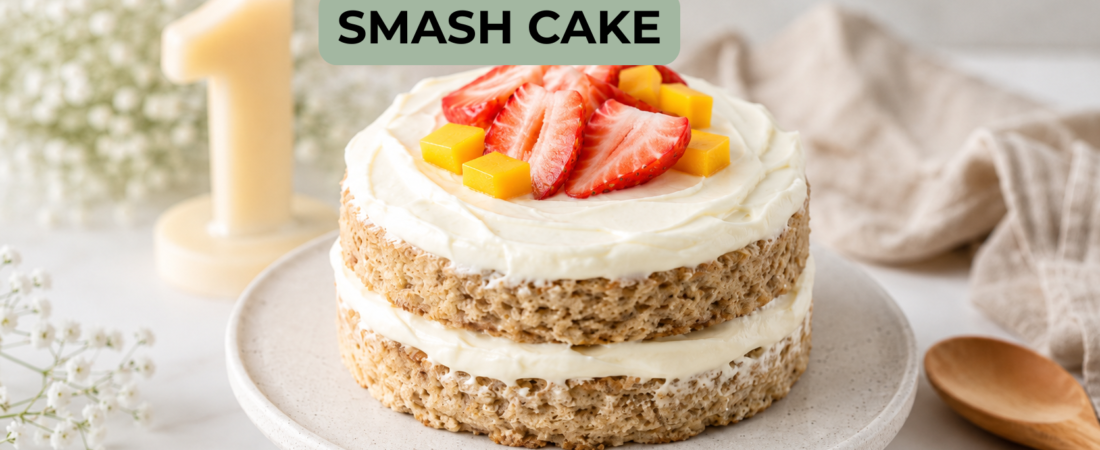
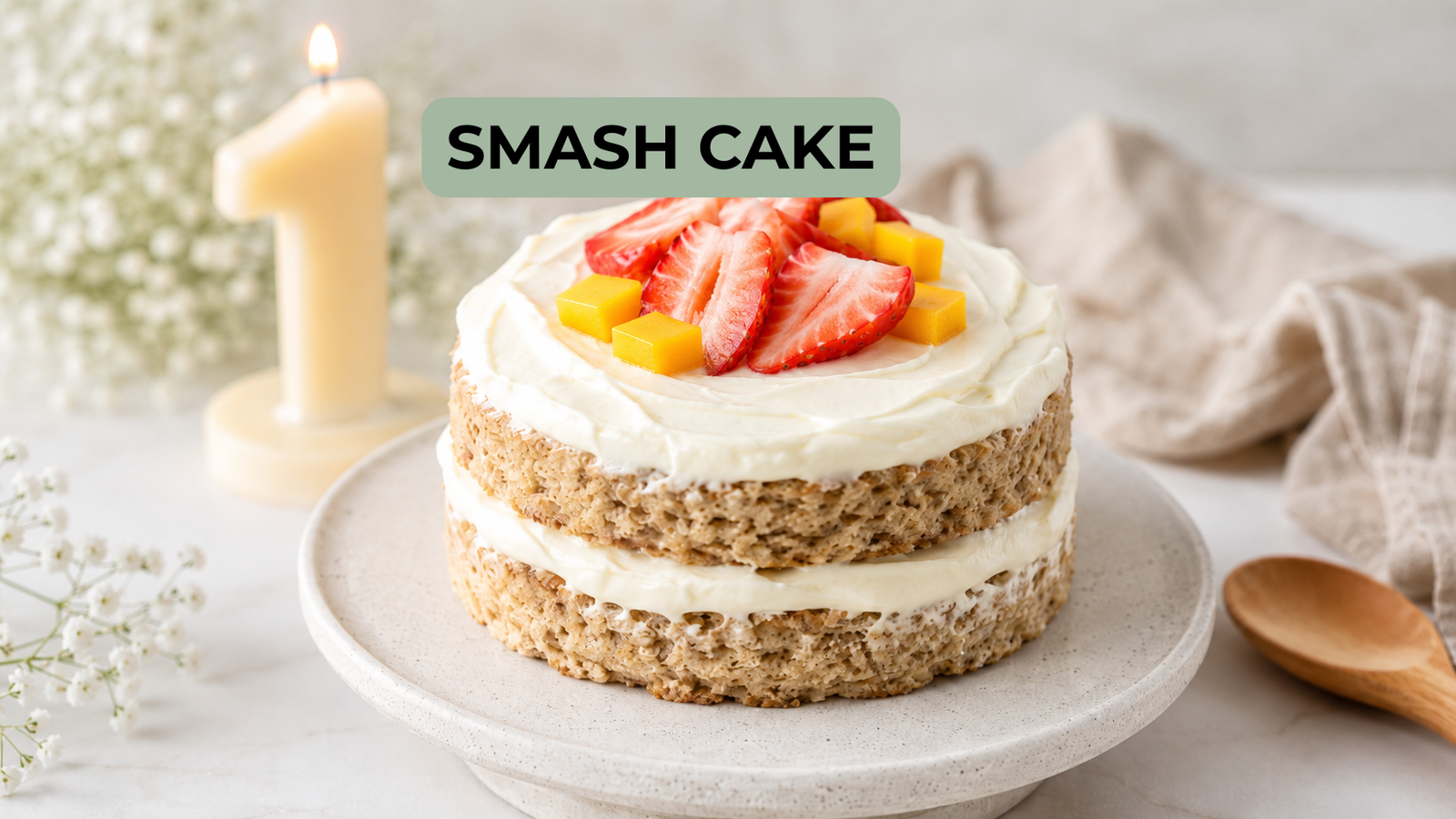
This baby’s first smash cake is made with ripe banana, oats, egg and plain yoghurt. It is soft, naturally sweet and small enough for your baby to explore with their hands.
It is not a perfectly fluffy bakery cake, and that is part of its charm. It is closer to a soft banana-oat cake, finished with a simple yoghurt frosting and fruit.
Your baby may eat some of it, squeeze it, throw it, lick the yoghurt and ignore the rest completely.
That is still a successful first birthday cake.
What is a smash cake?
A smash cake is a small cake made especially for a baby’s first birthday.
Instead of cutting a neat slice and serving it on a plate, the cake is placed in front of the baby so they can touch, squeeze, taste and explore it at their own pace.
Some babies dive straight into the frosting. Others stare at the cake suspiciously. Some carefully pick off one mango piece at a time, while others push the whole thing onto the floor within seconds.
There is no correct reaction.
The purpose is not to make your baby perform for the camera. It is simply to give them a playful sensory experience while marking a very special milestone.
Why make a separate cake for your baby?
A traditional birthday cake can still be served to family and guests.
The smash cake is simply a smaller option prepared with your baby’s age, current eating skills and familiar ingredients in mind.
This recipe contains no added sugar. The sweetness comes from very ripe banana and a small amount of fruit used for decoration.
Young children do not need added sugars in their everyday diet, and guidance encourages choosing nutrient-dense foods without unnecessary added sugar during the first two years.
That does not mean a first birthday must become a stressful test of nutritional perfection.
It is one celebration, and families will make different choices. This recipe is simply for the mother who would feel more comfortable offering a softer, lightly sweetened homemade cake.
A Little Fresh Vanilla Makes It Feel Like a Birthday Cake
There is something about the scent of real vanilla that makes even the simplest cake feel special.
For this recipe, I use the tiny seeds scraped from a fresh vanilla pod rather than bottled vanilla flavouring. You only need a small amount, but it adds a soft, warm aroma that works beautifully with ripe banana.
Nutura’s fresh vanilla pods are selected for home baking and can be used in cakes, porridge, yoghurt, custards and family desserts. One pod can be used across several recipes when it is opened carefully and stored correctly.

Baby’s First Banana and Oat Smash Cake
Ingredients
- 2 medium Very ripe bananas
- 2 Eggs
- 1 cup Finely blended oats or oats flour
- 1 tsp Baking Powder
- 2 tbsp Plain Full-Fat Yoghurt
- 2 tbsp Unsalted butter melted
- ¼ Fresh Vanilla Pod
- ½ tsp Ground Cinnamon
- ¾ cup Thick Plain Full-Fat Greek Yoghurt
- 1 tsp Mashed Ripe Banana optional
- Soft fresh fruit that your baby has already eaten safely
- Thinly sliced strawberry optional
- Soft mango pieces optional, depending on season
Method
- Preheat the oven to 175°C.
- Lightly grease two small round cake tins measuring approximately 10–12 cm across.
- Line the base of each tin with baking paper so the soft cake layers can be removed more easily.
- Place the vanilla pod on a clean chopping board.
- Using the tip of a small sharp knife, carefully split approximately one-quarter of the pod lengthwise.
- Open the pod gently and scrape out the tiny vanilla seeds with the back of the knife.
- Set the seeds aside to add to the cake mixture.
- The remaining vanilla pod can be wrapped securely and stored according to the product instructions for another recipe.
- Peel the ripe bananas and place them in a mixing bowl.
- Mash the bananas with a fork until mostly smooth. A few small soft lumps are fine.
- Add the eggs and whisk gently until combined.
- Add the yoghurt, melted unsalted butter or oil and the fresh vanilla seeds.
- Mix until the vanilla seeds are distributed through the batter.
- Add the oat flour, baking powder and optional cinnamon.
- Fold everything together gently until no dry oat flour remains.
- Avoid mixing the batter for longer than necessary once the ingredients are combined.
- Divide the batter evenly between the two prepared cake tins.
- Smooth the tops gently with the back of a spoon or silicone spatula.
- Bake for approximately 18–24 minutes.
- Check the cakes after 18 minutes. They are ready when the tops feel set and a clean skewer inserted into the centre comes out without wet batter.
- Allow the cakes to cool in their tins for approximately 10 minutes.
- Carefully remove the cake layers and transfer them to a cooling rack or clean plate.
- Leave them to cool completely before adding the yoghurt frosting.
- For a thicker frosting, place the Greek yoghurt in a fine sieve lined with clean muslin or suitable kitchen paper.
- Allow it to drain in the refrigerator for one to two hours.
- Transfer the thickened yoghurt to a clean bowl.
- or a slightly sweeter flavour, stir in one teaspoon of mashed ripe banana. This is optional.
- Place the first cooled cake layer on a small serving plate. Spread a thin layer of Greek yoghurt over the top.
- Place the second cake layer above it and press very gently to secure it. Cover the top and sides with the remaining yoghurt.
- Decorate with a small amount of safely prepared soft fruit shortly before serving.
- Keep the completed cake refrigerated until close to the birthday celebration.
- Remove all candles, cake toppers, skewers and non-edible decorations before placing the cake in front of your baby.
Notes
Use very ripe bananas with plenty of brown spots. They provide moisture and natural sweetness without the need for added sugar. Choosing the oats
For the softest texture, blend rolled oats until they resemble fine flour. Large, dry oat flakes can make the cake more crumbly. Using fresh vanilla
Fresh vanilla gives the cake a gentle, naturally fragrant flavour without relying on bottled flavouring. Only a small quantity is needed because fresh vanilla seeds are aromatic. Begin with approximately one-quarter of a pod for this small cake. Choosing yoghurt
Use plain, unsweetened, pasteurised full-fat Greek yoghurt. Greek yoghurt is preferable for frosting because it is thicker than ordinary yoghurt. Allergy reminder
This cake contains egg, dairy and oats. Ideally, none of these ingredients should be completely new to your baby on their birthday. Use ingredients that your baby has already eaten and tolerated. Honey
Honey is not required because the ripe banana provides natural sweetness. Do not add honey when the cake may be served before your baby has fully reached 12 months. Texture
This cake has a soft, moist texture similar to banana bread. It will be denser than a conventional sponge cake made with refined flour and sugar. Serving
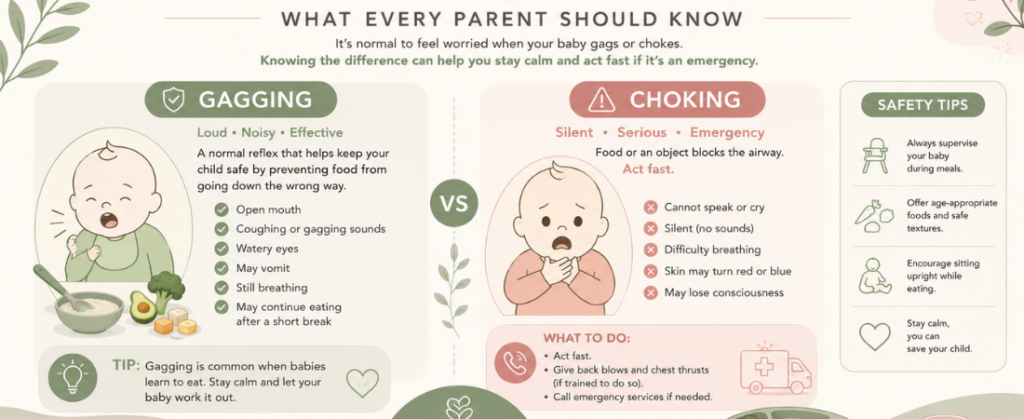
Sit your baby upright and supervise them closely throughout the cake smash. Flatten or cut round fruits appropriately and remove all hard or non-edible decorations before serving.
What does this smash cake taste like?
This cake tastes more like soft banana bread than a traditional birthday sponge.
It is gently sweet, moist and slightly dense because it is made with oats rather than refined flour and sugar.
Adults who are used to conventional cake may find it very mild. Your baby, however, does not have the same expectations of birthday cake.
For them, the yoghurt, banana and soft texture may already feel new and exciting.
The goal is not to recreate a heavily iced celebration cake without sugar. The goal is to make something simple, soft and enjoyable for your baby to explore.
Can I use regular flour instead of oats?
Yes.
You can replace the oat flour with an equal amount of plain flour, although the final texture may be lighter and slightly different.
When using oats, blend them until they resemble a fine flour. Large dry oat flakes may make the cake crumbly and harder for a young child to manage.
Oats can also be useful for families who already use them regularly in porridge, pancakes and baby snacks.
When your baby has a diagnosed gluten allergy, coeliac disease or another medical dietary restriction, use ingredients specifically recommended by their healthcare professional.
Can I make the cake without eggs?
Egg helps the cake hold together.
For an egg-free version, you can try replacing each egg with three tablespoons of thick unsweetened apple purée. The cake may be softer and more fragile, so it is often easier to bake it as several small muffins and stack them.
A recipe substitution is not automatically safe for a child with a diagnosed egg allergy. Cross-contamination, ingredient labels and individual medical advice may still need to be considered.
What yoghurt should I use?
Choose plain, unsweetened, pasteurised full-fat yoghurt.
Greek yoghurt usually works best because it is thicker and holds its shape more easily.
Avoid flavoured yoghurt for the frosting because it may contain added sugar and can be thinner.
The yoghurt should remain refrigerated until needed. Once the cake has been frosted, return it to the refrigerator rather than leaving it out for several hours.
Important allergy reminder
This cake contains egg, dairy and oats.
Ideally, these ingredients should not be completely new to your baby on their birthday.
A birthday celebration is not the easiest moment to observe a reaction or work out which new ingredient may have caused it.
Use foods your baby has already eaten and tolerated. When your baby has eczema, a diagnosed allergy or a history of reacting to food, discuss suitable substitutions with their paediatrician or allergy professional.
How to serve the smash cake safely
Place your baby upright in a stable highchair or seated position.
Remove candles, cake toppers, skewers and decorative pieces before placing the cake within reach.
Soft fruit should be prepared in a shape your child can manage. Blueberries and similar round fruits should be flattened or cut appropriately.
Stay beside your baby throughout the cake smash.
The moment can become messy very quickly, and close supervision matters more than capturing the perfect photograph.
Your baby does not need to finish the cake. The amount eaten may be surprisingly small, especially when there are decorations, people, noise and cameras around.
Let your baby decide whether they want to touch, taste or ignore it.
Can I prepare it in advance?
The cake layers can be baked one day before the birthday.
Once completely cool, wrap them tightly and keep them in the refrigerator.
The yoghurt frosting is best added on the day of the celebration.
Decorate with fresh fruit shortly before serving, particularly when using berries or banana.
The fully assembled cake should be stored in the refrigerator and used within approximately 24 hours.
Because yoghurt frosting is softer than buttercream, it may begin to loosen in warm Mauritian weather. Keep the cake chilled and bring it out shortly before the cake-smash moment.
A gentle note for the mother behind the celebration
It is easy to spend the days before a first birthday wondering whether you have done enough.
Enough decorations. Enough food. Enough photographs. Enough effort.
Your baby will not remember whether the frosting was perfectly smooth.
But one day, you may look back at the photographs and remember the way they sat in front of that tiny cake, still so small and yet no longer the newborn you first brought home.
Make the cake if it brings you joy.
Simplify it if you are tired.
Order one if baking is not how you want to spend the evening before the birthday.
The love behind the moment does not depend on whether the cake was homemade.
Related Articles:
Disclaimer: This recipe is for informational purposes only. Babies develop chewing and feeding skills at different rates. Adapt the cake’s texture, serving size and decorations to your child’s abilities, and supervise them closely while eating. Seek advice from your paediatrician or a qualified child-nutrition professional when your child has food allergies, swallowing difficulties, feeding concerns, a medical condition or specific nutritional requirements.